Book Reviews
Helmut And Allison Gernsheim / The History Of Photography
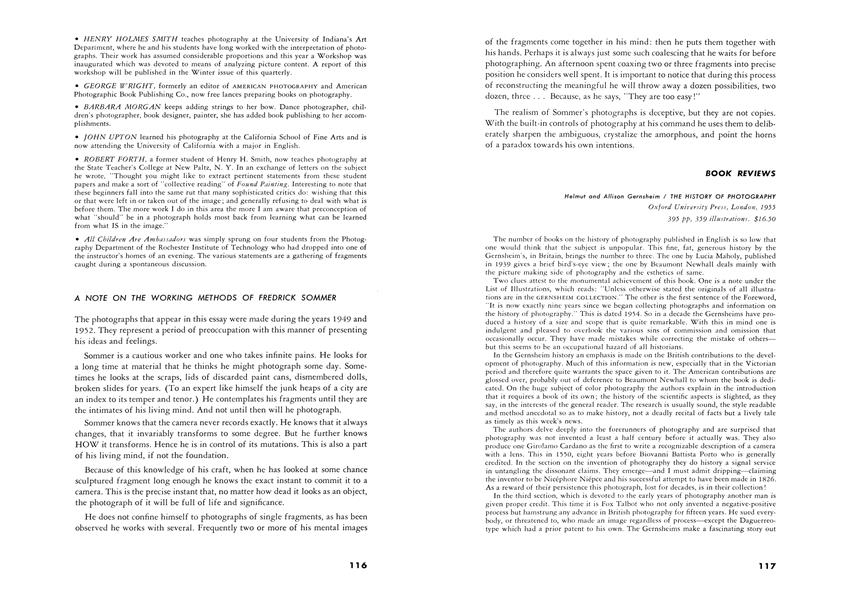
Helmut and Allison Gernsheim / THE HISTORY OF PHOTOGRAPHY
BOOK REVIEWS
Oxford University Press, London, 1955 395 pp, 359 illustrations. $16.50
The number of books on the history of photography published in English is so low that one would think that the subject is unpopular. This fine, fat, generous history by the Gernsheim's, in Britain, brings the number to three. The one by Lucia Maholy, published in 1939 gives a brief bird's-eye view; the one by Beaumont Newhall deals mainly with the picture making side of photography and the esthetics of same.
Two clues attest to the monumental achievement of this book. One is a note under the List of Illustrations, which reads: "Unless otherwise stated the originals of all illustrations are in the GERNSHEIM COLLECTION." The other is the first sentence of the Foreword, "It is now exactly nine years since we began collecting photographs and information on the history of photography.” This is dated 1954. So in a decade the Gernsheims have produced a history of a size and scope that is quite remarkable. With this in mind one is indulgent and pleased to overlook the various sins of commission and omission that occasionally occur. They have made mistakes while correcting the mistake of others— but this seems to be an occupational hazard of all historians.
In the Gernsheim history an emphasis is made on the British contributions to the development of photography. Much of this information is new, especially that in the Victorian period and therefore quite warrants the space given to it. The American contributions are glossed over, probably out of deference to Beaumont Newhall to whom the book is dedicated. On the huge subject of color photography the authors explain in the introduction that it requires a book of its own; the history of the scientific aspects is slighted, as they say, in the interests of the general reader. The research is usually sound, the style readable and method anecdotal so as to make history, not a deadly recital of facts but a lively tale as timely as this week’s news.
The authors delve deeply into the forerunners of photography and are surprised that photography was not invented a least a half century before it actually was. They also produce one Girolamo Cardano as the first to write a recognizable description of a camera with a lens. This in 1550, eight years before Biovanni Battista Porto who is generally credited. In the section on the invention of photography they do history a signal service in untangling the dissonant claims. They emerge—and I must admit dripping—claiming the inventor to be Nicéphore Niépce and his successful attempt to have been made in 1826. As a reward of their persistence this photograph, lost for decades, is in their collection !
In the third section, which is devoted to the early years of photography another man is given proper credit. This time it is Fox Talbot who not only invented a negative-positive process but hamstrung any advance in British photography for fifteen years. He sued everybody, or threatened to, who made an image regardless of process—except the Daguerreotype which had a prior patent to his own. The Gernsheims make a fascinating story out of this fracus. These three sections have that air of definitiveness which scholarly and thorough research always gives.
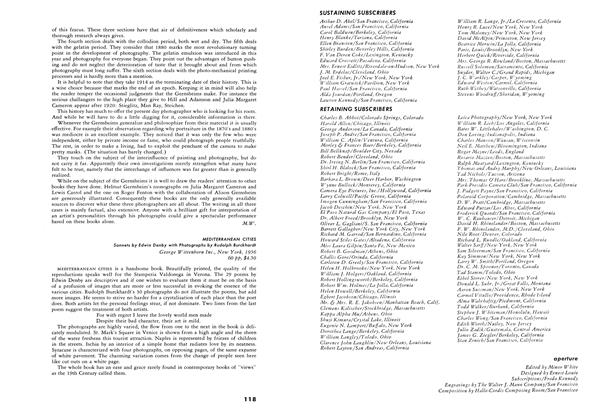
The fourth section deals with the collodion period, both wet and dry. The fifth deals with the gelatin period. They consider that 1880 marks the most revolutionary turning point in the development of photography. The gelatin emulsion was introduced in this year and photography for everyone began. They point out the advantages of button pushing and do not neglect the deterioration of taste that it brought about and from which photography must long suffer. The sixth section deals with the photo-mechanical printing processes and is hardly more than a mention.
It is helpful to note that they take 1914 as the terminating date of their history. This is a wise choice because that marks the end of an epoch. Keeping it in mind will also help the reader temper the occasional judgments that the Gernsheims make. For instance the serious challangers to the high place they give to Hill and Adamson and Julia Margaret Cameron appear after 1920: Stieglitz, Man Ray, Steichen.
This history has much to offer the present day photographer who is looking for his roots. And while he will have to do a little digging for it, considerable information is there.
Whenever the Gernsheims generalize and philosophize from their material it is usually effective. For example their observation regarding why portraiture in the 1870’s and 1880's was mediocre is an excellent example. They noticed that it was only the few who were independent, either by private income or fame, who could photograph people truthfully. The rest, in order to make a living, had to exploit the penchant of the camera to make pretty masks. (The situation has barely changed.)
They touch on the subject of the interinfluence of painting and photography, but do not carry it far. Apparently their own investigations merely strengthen what many have felt to be true, namely that the interchange of influences was far greater than is generally realized.
While on the subject of the Gernsheims it is well to draw the readers' attention to other books they have done. Helmut Gernsheim’s monographs on Julia Margaret Cameron and Lewis Carrol and the one on Roger Fenton with the collaboration of Alison Gernsheim are generously illustrated. Consequently these books are the only generally available sources to discover what these three photographers are all about. The writing in all three cases is mainly factual, also extensive. Anyone with a brilliant gift for interpretation of an artist’s personalities through his photographs could give a spectacular performance based on these books alone. a* w/
M.W.
More From This Issue
-
Fredrick Sommer: Collages Of Found Objects / Six Photographs With Reactions By Several People.
Fall 1956 -
 The Education Of Picture Minded Photographers
Teaching Photography
Fall 1956 -
 The Education Of Picture Minded Photographers
The Photo Short Courses
Fall 1956 -
 The Education Of Picture Minded Photographers
Photography At Ohio University
Fall 1956 -
 Essay
EssayThe 4 R's And The Cave Man
Fall 1956 -
 The Education Of Picture Minded Photographers
Photography At The University Of Minnesota
Fall 1956
Book Reviews
-
 Book Reviews
The 1955 Annuals
Spring 1955 -
 Book Reviews
Mediterranean Cities
Fall 1956 -
 Book Reviews
Edited By Beaumont Newhall / On Photography
Spring 1957 -
 Book Reviews
The Annuals, 1957 Version
Winter 1956 -
 Book Reviews
The Sweet Flypaper Of Life
Spring 1956 -
 Book Reviews
Vision-Value Series
Fall 1965

