Editorial
Editorial
EDITORIAL
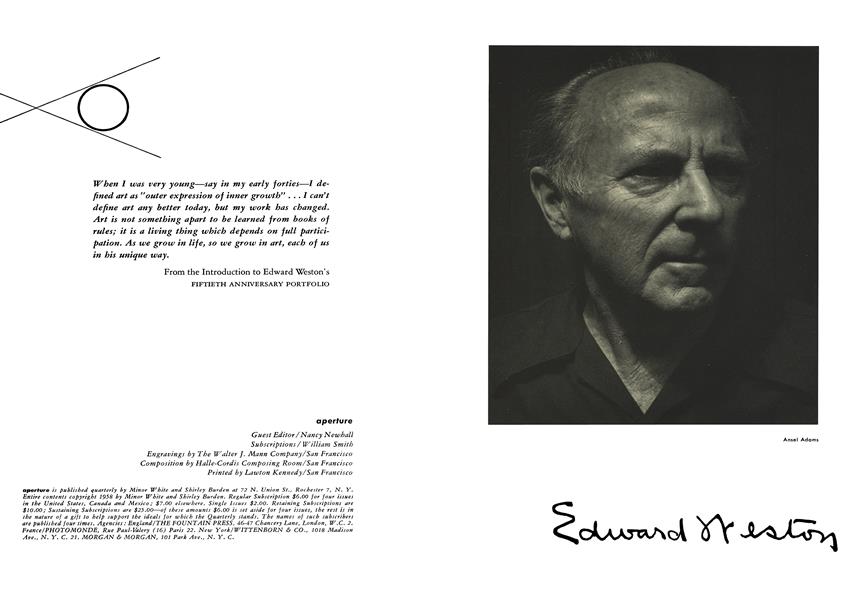
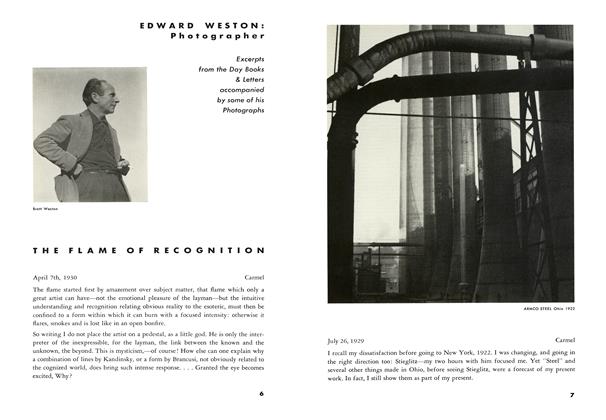
In his daybooks, Edward Weston was trying to focus himself as man and photographer. To be alone and to think, free for an hour of family, friends, loves, he rose in the dark before dawn and poured down on the page in his massive scrawl whatever was seething in him. The "headaches, heartaches, bellyaches” he later found so revolting that in 1923 he burned all except six or seven pages, and in the 1940s when publication of the daybooks just as they stood was proposed, he went through them with a razor cutting out names and comments until the pages were full of holes and sometimes sliced to ribbons. What endured for him, as for us, are his attempts to analyze his change and growth and—"my work is always a few jumps ahead of what 1 write about it”—to understand the strange flashes of vision that came through his camera.
In photography he had had to find his way alone, first because as a boy he was too shy to ask and later because, when the fashionable attitudes and easy successes were behind him, the only photographers ivho would have understood him were, so far as he knew, three thousand miles away on the East Coast. He did see them once, briefly on a journey to New York City in 1922. The rest of the years he wrestled alone ivith his medium and himself. Painters, poets, dancers, musicians among his friends helped by their affirmations and insights into his work ; great art, especially music, helped him form his goals. But how in a medium so young, so little understood, did one define art? And how could a creator live?
Films were slow in those days and exposures long; his old 8 x 10 was rickety and his bellows often leaked. And to the last, he trusted his own feeling for light more than any photoelectric meter. Deliberately he stripped his technique, his living, and seeing of unessentials and tried to concentrate on the objective and eternal—only to find that he could not and would not be bound even by his own dogma. Hoiv could he tell ivhat he ivould see on his ground glass tomorrow’?
In the early 1930s he ceased to be alone ; his own sons ivere growing up, other young photographers were coming to share the search, he load love and companionship in his ivork. And he had solved his basic problems ; he had world-wide recognition. The daybooks ceased in 1934, partly because the need for them had ceased, partly because he had always doubted his ability to write. From then on we glimpse the movements of his thought through his letters.
In this special issue of aperture, made possible by the loving contributions of scores of photographers and students, Edward Weston speaks for himself, in his own words and photographs, of his long search "to present clearly my feeling for life with photographic beauty . . . without subterfuge or evasion in spirit or technique.”
Nancy Newhall
Nancy Newhall
-
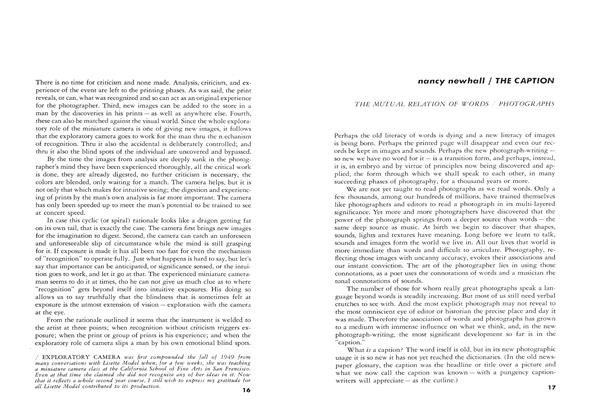
Nancy Newhall / The Caption
Summer 1952 -
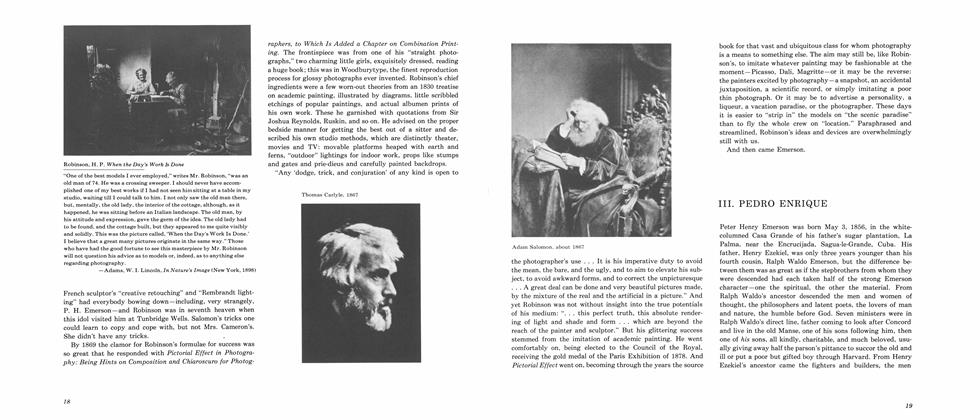 Part One P. H. Emerson: His Life And The Fight For Photography As A Fine Art
III. Pedro Enrique
Spring 1975 -
 Part One P. H. Emerson: His Life And The Fight For Photography As A Fine Art
VIII. "A Reformer Needed"
Spring 1975 -
 Part One P. H. Emerson: His Life And The Fight For Photography As A Fine Art
X. The Curious Crystal
Spring 1975 -
 Part One P. H. Emerson: His Life And The Fight For Photography As A Fine Art
XII. "Iconoclastic Pen"
Spring 1975 -
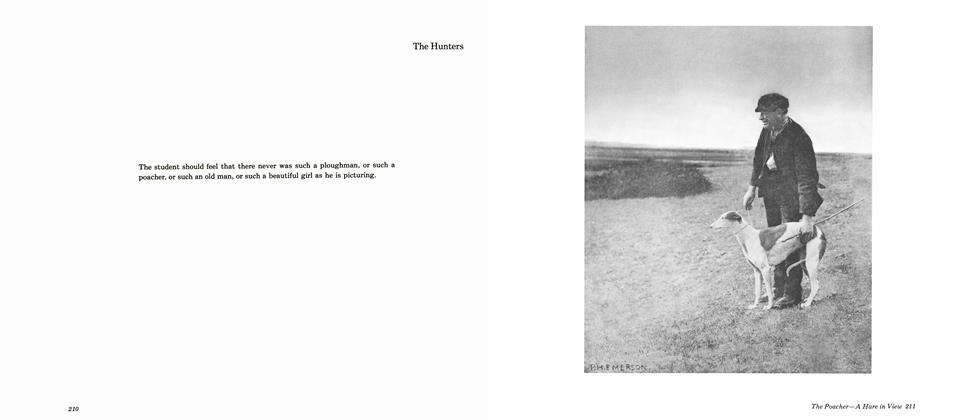 Part Two P. H. Emerson: His Photographs Accompanied By Excerpts From His Albums And Naturalistic Photography
The Hunters
Spring 1975