Chronology
Chronology
1908
Minor Martin White born July 9, Minneapolis, Minnesota; only child of Charles and Florence White.
1913-1928
Develops interest in photography through grandfather, amateur who conducts "slide evenings." Given hand camera at age seven or eight; considers beginning of own photography to be at age twelve when grandfather moves to California, leaving him photographic equipment and knowledge of its use. Attends public schools.
1928-1933
Enters University of Minnesota to study botany; begins to write. Fails to accumulate sufficient science credits to graduate and gives up regular classes in 1931.
Attends university at night to obtain necessary credits, meanwhile studying English and botany on graduate level. Develops serious interest in writing and embarks on one-year program of writing verse.
Graduates from university in 1933 with B.S. degree in botany, minor in English.
1933-1938
Continues to write verse. In 1937 turns once again to photography but first completes 100-verse “sonnet sequence," representing initial attempt with sequence form.
Purchases Argus 35mm camera. Travels west by bus and is stranded in Portland, Oregon. Works as night clerk in small hotel and briefly with photofinisher to earn money for photographic equipment. Joins Oregon Camera Club.
Makes first photographs in central city. Improves basics of technique at Oregon Camera Club. Exhibits frequently at YMCA; teaches photography there and lectures on composition at another Portland camera club. Knows work of photographers like Ansel Adams, Berenice Abbott, Alfred Stieglitz and Edward Weston from published sources only. In popular photographic press follows continuing controversies like that surrounding F/64 Group.
1938-1939
Obtains eight-month position as secretary with People's Power League.
Through friends in League is appointed “creative photographer" for Works Progress Administration. Assigned first to photograph iron-front buildings in Portland, then, in 1939, Portland waterfront.
Begins to produce publicity photographs for Portland Civic Theater of such plays as The Death of Tintagiles and Our Town.
1940-1941
Appointed teacher of photography, then director at La Grande Art Center, small WPA center in eastern Oregon. Teaches photography three nights a week. Spends weekends photographing for personal aims, notably series of approximately seventy-five photographs of Grande Ronde-Wallowa Mountain area in northeast Oregon.
Produces regular fifteen-minute broadcasts for La Grande radio station on activities of Center.
Completes first article on photography: “When Is Photography Creative?" published in American Photography (January, 1943).
1941
Exhibits first photographs in national exhibition: Image of Freedom at Museum of Modern Art.
Returns to Portland; obtains miscellaneous employment as photographer and, at Christmas, as Santa Claus while waiting to be drafted.
Continues photographing for Civic Theater.
1942
First sequence of photographs: a series, or “story," on YMCA ski trip to Mt. Saint Flelens, Washington.
First one-man museum exhibition: Portland Art Museum.
First photographs published: Fair Is Our Land, edited by Samuel Chamberlain.
Receives draft notice from U.S. Army.
1942-1945
Undergoes basic training in Hawaii. Assigned to Army Intelligence Corps. Sees limited combat in Leyte invasion.
Photographs little. Tries instead to write way through photography. “Eight Lessons in Photography," manuscript stemming from Boleslavsky's Acting: The First Six Lessons, is completed but unpublished, though incorporated into later writings.
Baptized into Catholic Church by army chaplain about 1943.
1945
Discharged from army. Goes to New York with purpose of learning what occurred in photography during the war. Seeks out Beaumont and Nancy Newhall at Museum of Modern Art.
Encouraged to undertake graduate studies in art history and aesthetics at Columbia University Extension Division. Under Meyer Schapiro submits paper on Edward Weston retrospective at Museum of Modern Art, representing first writing on how to “read" a photograph.
Studies museum methods with Newhalls and finds employment as photographer at Museum of Modern Art.
1946
Meets and experiences profound, liberating influence of Alfred Stieglitz. Creative thinking along psychological lines also influenced by Meyer Schapiro. Meets Edward Weston, Harry Callahan, Paul Strand, Edward Steichen, Todd Webb and Brett Weston.
Accepts appointment to photography faculty of California School of Fine Arts (now San Francisco Art Institute) headed by Ansel Adams. Arrives in California and resides first at Adams' home, then next-door in house owned by Adams; develops close personal rapport.
Adopts metaphorical approach to photography.
Visits Edward Weston at Point Lobos; begins deep attachment to Weston and locale.
1947
Instrumental in development of threeyear photographic program at CSFA. Gradually assumes major teaching responsibility from Ansel Adams.
Second Sequence ¡Amputations completed, representing first grouping of photographs without literary or “story" content and, as with all subsequent ones, designed primarily for wall exhibition.
1948
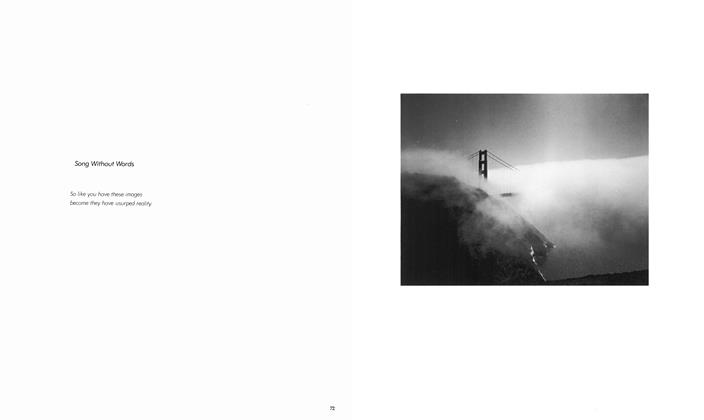
First postwar exhibition: Song Without Words sequence at San Francisco Museum of Art.
1949
Begins photographing such plays as Dear Judas, Family Reunion, Lady from the Sea, No Exit and Well of the Saints for Interplayers group; continues for nearly four years. Also directs several CSFA students in theater photography with Interplayers.
1951
Judges, with Ansel Adams and Rene Weaver, exhibition Oregon 1950 at Portland Art Museum. Directs exhibition Focus Unlimited.
Participates in Camera and Reality seminars at Aspen, Colorado; also exhibits Sequence 6. Idea for Aperture develops from one of seminars.
1952
With Dorothea Lange, Nancy Newhall, Ansel Adams, Beaumont Newhall, Barbara Morgan, Ernest Louie, Melton Ferris and Dody Warren founds Aperture, quarterly publication of photography, in San Francisco. Chosen editor and production manager. First issue appears iji April.
1953
Directs exhibition How to Read a Photograph for San Francisco Museum of Art Extension Division.
In November joins staff of George Eastman House in Rochester, New York; Beaumont Newhall then curator. Responsible for exhibitions (1953-1957) and editor of Image (1956-1957).
1954
Editorial offices of Aperture relocated in Rochester with production in San Francisco.
Directs portraiture exhibition Camera Consciousness for George Eastman House.
1955
Directs exhibition The Pictorial Image for George Eastman House.
Joins faculty of Rochester Institute of Technology. Teaches, for one year only, course in photo-journalism.
Produces first body of photographs
relating to specific landscape of the eastern United States: Sequence lOIRural Cathedrals. Distinct shift of emphasis from portraiture to landscape. Begins making 35mm transparencies in color; continues this work until his death.
Begins readings particularly in comparative religion. Period of intense personal study related to writing verse.
1956
Directs exhibition to define straight photography: Lyrical and Accurate for George Eastman House.
Conducts workshop at Indiana University and in Long Beach, California.
Resigns position of assistant curator at George Eastman House in order to devote greater energy to personal work.
Accepts appointment to faculty of Rochester Institute of Technology as part-time instructor. Begins biweekly evening workshops for undergraduate students; workshops continue intermittently for three years.
Develops deep interest in Oriental way of life.
1957
During summer begins preliminary work on autobiographical sequence of photographs: Ashes Are for Burning.
Introduced to Gurdjieff philosophy. Puts into practice "concentrationattention" and meditation techniques in looking at photographs and at subjects to be photographed. Develops these ideas in teaching and in workshops.
1959
Opening of largest exhibition to date: Sequence 13/Return to the Bud at George Eastman House.
First road trip across United States; travels with Paul Caponigro. Purchases Leica for use in color photography.
Oregon Centennial Commission sponsors workshop and exhibition Sequence 13IReturn to the Bud in Portland. Workshop at California School of Fine Arts.
First full-time three-month resident workshop. Introduces hypnosis techniques into concentration of reading photographs.
1960
Second cross-country trip; travels with
Jack Franks.
Second Portland workshop. Weekend workshops at Horizon Northwest, Salem, Oregon, and Long Beach, California.
Production of Aperture relocated in Rochester beginning with Volume 7, Number 3.
Continued involvement with Gurdjieff movement in Rochester.
1961
Works on manuscript "The Canons of Camerawork" and continues exploration in techniques of concentration.
Third Portland workshop. Workshop at Isomata Foundation, Idyllwild, California; observation of dance group there effects introduction of rhythm and movement into teaching techniques.
1962
First Denver workshop. Documentation and description published: A Notebook Resume by Arnold Gassan.
Second Idyllwild workshop and fourth Portland workshop. Interest in movement and dance intensified.
Becomes founding member of Society for Photographic Education.
1963
First of seven Cleveland workshops. Weekend workshops in New York, Boston and Chicago.
"The Canons of Camerawork" completed but not published.
Second Denver workshop. San Francisco Art Institute workshop and fifth Portland workshop.
Lectures at second conference of Society for Photographic Education: "Is There a Place for a Functional Criticism in Camera Image Making?"
Three weekend workshops (third in 1964) at St. Lawrence University, Canton, New York.
Aperture, Inc., established as nonprofit corporation.
1964
Boston and New York workshops.
Commissioned by architect Louis I. Kahn to photograph First Unitarian Church in Rochester.
Millbrook workshop. Third Colorado workshop. San Francisco Art Institute workshop. Sixth Portland workshop.
1965
Accepts appointment as Visiting Professor in Department of Architecture at Massachusetts Institute of Technology. Purchases house at 203 Park Avenue, Arlington, Massachusetts. By 1968 program consists of five courses; permanent exhibition space set aside as part of teaching facilities.
Directs Exhibition One, work of twenty-two greater Boston area photographers, for MIT.
Workshops in Arlington, Portland and Coos Bay, Cape Arago, Oregon.
Accepts temporary editorship of Sensorium, magazine of photography and arts of communication; magazine fails to reach publication.
First spring resident workshop held in Arlington.
Michael Hoffman becomes publisher of Aperture.
1966
Workshop in Arlington. Final crosscountry trip by motor; travels with Huebert Hogh. Workshops in Albuquerque and Portland.
Production of Aperture moves to New York beginning with Volume 12, Number 4.
1967
Begins work on monograph Mirrors Messages Manifestations, first conceived in 1947. Sequence 13/Return to the Bud is another version in 1959. Workshop, "Vision and the Man Behind the Camera," sponsored by Project, Inc., of
1968
Mirrors Messages Manifestations completed.
Summer resident workshop in Arlington.
Fall workshop, "Design," sponsored by Project, Inc. Exhibition of work of sixteen photographers, many from various workshops, held at Worcester Craft Center.
Directs exhibition Light7 for Hayden Gallery, MIT. Establishes permanent collection of photographs for Institute, with first to be drawn from Light7.
Begins time of intensive selfeducation, again in part through reading. Period comparable to that of 1955 but more urgent. Studies brought on by illness diagnosed as angina. Illness has profound effect on life-style: distinct psychological changes occur relative to total personal and public environment; observable in new priorities of interest and approach including increased meditation and strict food regimen.
Undertakes study of astrology. Increased emphasis on personal photography.
1969
Mirrors Messages Manifestations published.
Critique: Light7 televised over National Educational Television; includes on-camera interview.
Travels to Cape Breton, Nova Scotia, to photograph; first of two visits.
Promoted to tenured professorship, MIT.
Lecture at Princeton University: "Photography and Inner Growth."
1970
Major one-man exhibition opens at Philadelphia Museum of Art. Subsequently tours United States.
Directs exhibition Be-ing Without Clothes for MIT.
Participates in Society for Photographic Education National Conference, University of Iowa.
First Creative Photography workshop, Hotchkiss School, Lakeville, Connecticut. Summer workshops continue here and elsewhere through 1974.
Begins to teach "Creative Audience" course at MIT.
Awarded Guggenheim Fellowship.
1971
Travels to Virgin Islands and Puerto Rico.
Spends considerable time writing. Participates in founding of Imageworks, Cambridge.
Aperture offices move to Millerton, New York.
1972
Directs exhibition Octave of Prayer for MIT.
With Jerry Uelsmann organizes and participates in Sippewisset (Cape Cod) Conference.
MIT advertises for successor; position never filled.
1973
Lectures at University of Massachusetts, Boston, in rebuttal to A. D. Coleman's criticism of Octave of Prayer exhibition. Lecture, prepared with Jonathan Green, subsequently published.
Takes group of MIT students to Rome for photographic work.
Travels to Puerto Rico to photograph; first of two trips in these years.
Visit to Zen Center at Tassajara, California.
Travels to Peru to give photography workshop.
1974
Directs exhibition Celebrations for MIT.
Retires from faculty of MIT ; continues to teach Creative Audience course.
Travels to Peru for second time.
Directs exhibition 1,000 Photographers with Jonathan Green for MIT Creative Photography Galleries.
Contracts with Light Gallery, New York, to be co-publisher of forthcoming Jupiter Portfolio and to represent him in New York.
1975
Publication of Jupiter Portfolio of twelve original photographs.
Appointed Senior Lecturer at MIT. For academic year 1975-76 made Fellow of MIT Council for the Arts.
Ceases editorship of Aperture with Volume 19, Number 1. Credited henceforth as Founding Editor.
Participates on Committee on the Future of the Friends of Photography, Carmel, California.
First substantial exhibition of photographs in Europe circulated by U.S.I.A., Paris.
Travels to England in November and returns to participate in Ansel Adams Gallery/University of Arizona Photography Workshop.
Is interviewed on videotape by Harold Jones for Center for Creative Photography.
Visits Cleveland for brief workshop before returning to Boston.
Suffers heart attack on December 1; hospitalized.
1976
Personal photography continues, including work with SX-70.
Becomes consulting editor for newly founded magazine Parabola.
Receives Honorary Doctorate of Fine Arts from San Francisco Art Institute; accepted by Walter Chappell.
Dies June 24 in Massachusetts General Hospital. Private wake held in Arlington. Graveside service at Mt. Auburn Cemetery, June 26.
Bequeaths personal photographic archives, papers, library and collection of original photographs to Princeton University.