Tod Papageorge: At Ease
Notes from a Conversation with Tod Papageorge
Tod Papageorge: At Ease
Tod Papageorge
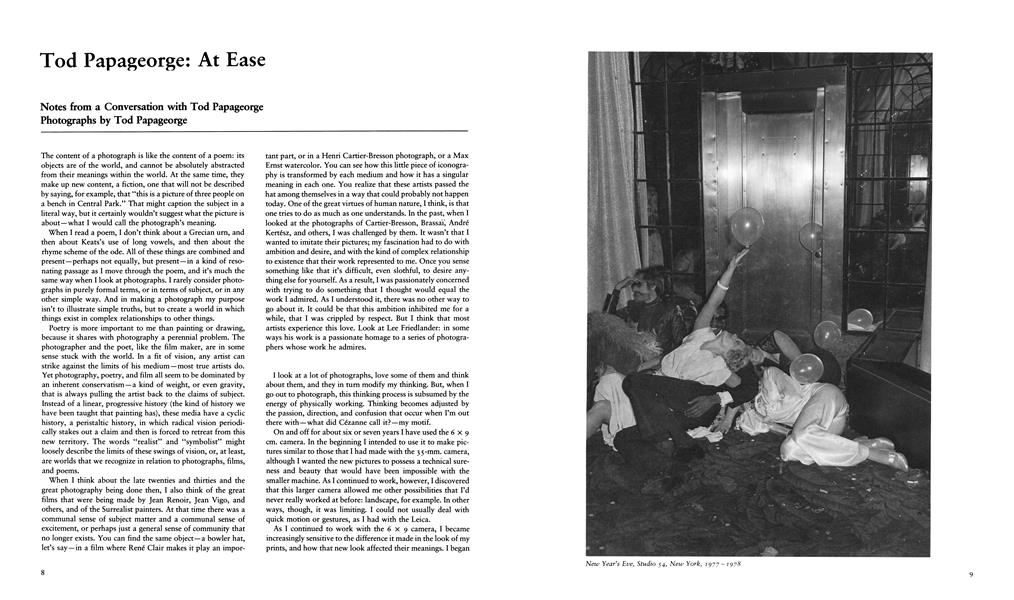
The content of a photograph is like the content of a poem: its objects are of the world, and cannot be absolutely abstracted from their meanings within the world. At the same time, they make up new content, a fiction, one that will not be described by saying, for example, that "this is a picture of three people on a bench in Central Park." That might caption the subject in a literal way, but it certainly wouldn’t suggest what the picture is about—what I would call the photograph’s meaning.
When I read a poem, I don’t think about a Grecian urn, and then about Keats’s use of long vowels, and then about the rhyme scheme of the ode. All of these things are combined and present—perhaps not equally, but present—in a kind of resonating passage as I move through the poem, and it’s much the same way when I look at photographs. I rarely consider photographs in purely formal terms, or in terms of subject, or in any other simple way. And in making a photograph my purpose isn’t to illustrate simple truths, but to create a world in which things exist in complex relationships to other things.
Poetry is more important to me than painting or drawing, because it shares with photography a perennial problem. The photographer and the poet, like the film maker, are in some sense stuck with the world. In a fit of vision, any artist can strike against the limits of his medium —most true artists do. Yet photography, poetry, and film all seem to be dominated by an inherent conservatism —a kind of weight, or even gravity, that is always pulling the artist back to the claims of subject. Instead of a linear, progressive history (the kind of history we have been taught that painting has), these media have a cyclic history, a peristaltic history, in which radical vision periodically stakes out a claim and then is forced to retreat from this new territory. The words “realist” and “symbolist” might loosely describe the limits of these swings of vision, or, at least, are worlds that we recognize in relation to photographs, films, and poems.
When I think about the late twenties and thirties and the great photography being done then, I also think of the great films that were being made by Jean Renoir, Jean Vigo, and others, and of the Surrealist painters. At that time there was a communal sense of subject matter and a communal sense of excitement, or perhaps just a general sense of community that no longer exists. You can find the same object—a bowler hat, let’s say—in a film where René Clair makes it play an important part, or in a Henri Cartier-Bresson photograph, or a Max Ernst watercolor. You can see how this little piece of iconography is transformed by each medium and how it has a singular meaning in each one. You realize that these artists passed the hat among themselves in a way that could probably not happen today. One of the great virtues of human nature, I think, is that one tries to do as much as one understands. In the past, when I looked at the photographs of Cartier-Bresson, Brassai’, André Kertész, and others, I was challenged by them. It wasn’t that I wanted to imitate their pictures; my fascination had to do with ambition and desire, and with the kind of complex relationship to existence that their work represented to me. Once you sense something like that it’s difficult, even slothful, to desire anything else for yourself. As a result, I was passionately concerned with trying to do something that I thought would equal the work I admired. As I understood it, there was no other way to go about it. It could be that this ambition inhibited me for a while, that I was crippled by respect. But I think that most artists experience this love. Look at Lee Friedlander: in some ways his work is a passionate homage to a series of photographers whose work he admires.
I look at a lot of photographs, love some of them and think about them, and they in turn modify my thinking. But, when I go out to photograph, this thinking process is subsumed by the energy of physically working. Thinking becomes adjusted by the passion, direction, and confusion that occur when I’m out there with—what did Cézanne call it? —my motif.
On and off for about six or seven years I have used the 6x9 cm. camera. In the beginning I intended to use it to make pictures similar to those that I had made with the 3 5-mm. camera, although I wanted the new pictures to possess a technical sureness and beauty that would have been impossible with the smaller machine. As I continued to work, however, I discovered that this larger camera allowed me other possibilities that I’d never really worked at before: landscape, for example. In other ways, though, it was limiting. I could not usually deal with quick motion or gestures, as I had with the Leica.
As I continued to work with the 6x9 camera, I became increasingly sensitive to the difference it made in the look of my prints, and how that new look affected their meanings. I began to want to make a print that would give the illusion of being transparent, that would call attention not to itself, but to its subject. Although this quality is so subtle that most people would have to compare a print from the 6x9 camera side by side with a 3 5-mm. one, the idea of transparency became important to me. It has even occurred to me that the form of these pictures might more nearly reflect the “transparent” looselimbed immediacy of the world than seems possible with the cruder drawing of the 3 5-mm. camera.
The dead weight of photographic literalism is a terrible problem to deal with. Many photographers avoid it in any way that they can, with the result that very few actually embrace the awful descriptive energy of the medium and try to wrestle it into a new kind of meaning. To me, photography is fascinating precisely because interesting photographs are always on the verge of being destroyed by the dumb memory of the lens. All photographers fight against this inertia of the lens, but I try to ask myself constantly how hard I am struggling against it, and, conversely, how much I am embracing its ability to “draw.” How difficult will I make the game? How open will I be to allowing the picture to be burdened, even overburdened by the content of that “drawing”?
What is interesting about photographers is the nature of the balance they create: the place where they draw that line between their own presence and the mindless memory of their cameras. The crucial interest of Garry Winogrand’s work, for example, is that he is willing—perhaps more than any other photographer working today—to suggest that as a conscious mind he has very little to do with the way his pictures look. This is a strategy on his part, of course, and one that makes some of his work difficult to respond to. Like Picasso, he is much more interested in his own pleasure—which, after all, is the only pleasure any one really understands—than he is in the presumptive pleasure of his audience.
It is important to me, on the other hand, that my photographs appear to have been intended —not stultified or overly earnest, but clearly the products of choice. This is as much, if not as extreme, a strategy as Winogrand’s, and as clearly the result of need as it is of choice.
Until recently, I was not particularly interested in thinking about myself in relation to my photographs. I knew that any artist is described in his work, either directly or indirectly, as a kind of baggage, so I didn’t care about the problem. As I have gotten older, however, and have continued to work, I have become more concerned with expressing who I am and what I understand. I was surprised to find that with age you actually do comprehend more. Things are never completely clear, but their shape becomes more immediate and more resonant. I’ve realized in some obscure way that there are certain things to understand, if not to express, about being alive. I think that’s what my latest pictures are beginning to describe, at least as far as my own modest participation in the world of experience is concerned. I hope that the pictures speak for themselves in their clarity. To me, they seem to indicate a deeper respect, a more focused feeling, for what’s in front of the camera.
More From This Issue
-
Les Champs Délicieux: Man Ray, 1922
Spring 1981 -
William Garnett: A View From Above
Spring 1981 -
Jan Groover's Embrace
Spring 1981 -
Beaton: Takes: Notes
Spring 1981 -
Laurie Anderson: Dark Dogs, American Dreams
Spring 1981 -
 People And Ideas
A Random Walk: Some Reflections On Photographic Research
Spring 1981