William Garnett: A View From Above
NOTES ON PHOTOGRAPHING FROM THE AIR
William Garnett: A View from Above
Peter Plagens
I carry an image—no, a whole gestalt, with sight and sound and smell and sense of time—around with me. It's the mid-1950s in Los Angeles. My father is a jack-of-all-trades commercial artist, and he has learned from his education at the Cleveland Art Institute and from his experience in the trade that all good art shares common denominators: compositional balance, color harmony, and technical competence. The first means a sense of framing or cropping, the second, modulated colors contraposed in hot-cold dichotomies, and the last, neatness and detail. Ordinary men, who don’t know these things, wear drab, dark business suits, oil their hair, and shave their whole faces, drive green Buick sedans, and prefer, as art, cutpaper silhouettes of their children in oval frames hung on plaster walls. Creative men, who do know these things, wear nubby sports jackets and Rooster ties, affect cavalry mustaches, drive Raymond Loewy-designed Studebaker coupes, and like European posters mounted on burlap walls. As his kid, I knew that to become a real artist you had to make yourself first a creative man, and then to refine your equipment and your touch. As his kid, I knew that with luck you might end up a Jon Whitcomb or a Saul Bass. As a man, I now realize those surenesses don’t exist, and that anyone who pursues them and their concurrent taste is not likely to end up an artist of any consequence. Such sensibilities are as useless as a hula hoop. William Garnett, who is somewhat younger than my father, does not, apparently, realize this.
I assumed, as a G.I. coming home, with all the people who flew, that there would be hundreds of photographers out there doing the same thing. But here was Beaumont Newhall, who taught photo-interpretation during the War, and who, as director of Eastman House, was looking at all the new things, telling me that as far as he knew I was the only one taking photographs from the air from a designer’s standpoint.
Photographers, however, can be great, or at least very, very good, artists and still be straight as arrows. How easy is it to believe, for instance, that a man with Garnett’s silver crew cut, wearing double-knit slacks and a straw planter’s hat, flying a 1957 Cessna with the calm expertise of a county clerk, residing in a lovely, spotlessly kept house with his wife, a friendly dog named George, and a redwood burl coffee table, and speaking softly, succinctly, and without a trace of profanity, could be a great painter?
I’m on standby right now for Life, to photograph the Cascades. That’s an editorial assignment. Those are illustrations for information.
Photography is a fine-art form that speaks, especially at the moment, to nuances in other photographs. It’s extraordinarily self-conscious—self-conscious about being self-conscious, ad nauseam. And it’s proud of it. Younger photographers take photographs as answers to the historical attitudes of photographers who took pictures as answers to previous photographers.
The things that I choose to photograph now are either the rural or the natural. I turn down most of the requests I get to photograph cities.
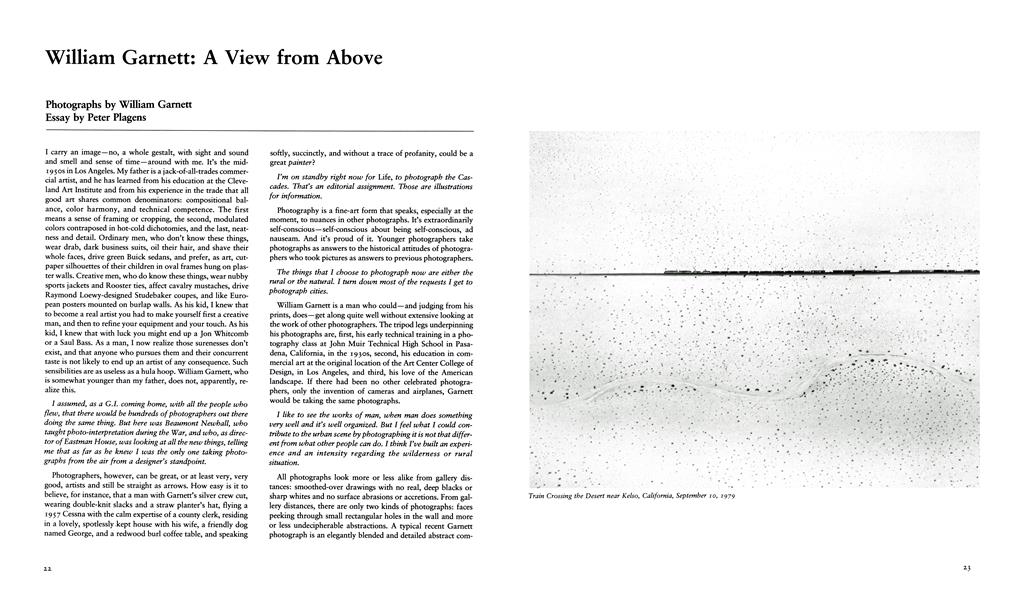
William Garnett is a man who could—and judging from his prints, does—get along quite well without extensive looking at the work of other photographers. The tripod legs underpinning his photographs are, first, his early technical training in a photography class at John Muir Technical High School in Pasadena, California, in the 1930s, second, his education in commercial art at the original location of the Art Center College of Design, in Los Angeles, and third, his love of the American landscape. If there had been no other celebrated photographers, only the invention of cameras and airplanes, Garnett would be taking the same photographs.
I like to see the works of man, when man does something very well and it’s well organized. But I feel what I could contribute to the urban scene by photographing it is not that different from what other people can do. I think I’ve built an experience and an intensity regarding the wilderness or rural situation.
All photographs look more or less alike from gallery distances: smoothed-over drawings with no real, deep blacks or sharp whites and no surface abrasions or accretions. From gallery distances, there are only two kinds of photographs: faces peeking through small rectangular holes in the wall and more or less undecipherable abstractions. A typical recent Garnett photograph is an elegantly blended and detailed abstract composition that resembles, from gallery distances, a reproduction of a painting by Paul Jenkins or Edward Corbett or Jean Paul Riopelle, but that, closer up, reveals itself as a gorgeous hunk of nature’s handiwork your pedestrian urban agnosticism has heretofore prevented you from appreciating.
To tell a pilot, “I want to be at a forty-five-degree angle to the haystack on the down-sun side when the baler gets two tractor lengths from the haystack,” is impossible. There isn’t one in five hundred charter pilots who could put you there. They’re not seeing with your eyes, and they’re certainly not seeing through the viewfinder.
My father also believed in years of training. Years of training tell the artist at a glance what he wants in his picture.
Most photographers, especially beginners, are looking through the finder forever before they take the picture. You’ve experienced this in a family snapshot. You get ready, smile, and think, “Why doesn’t he shoot it?” Over the years, I’ve had to train myself to see very clearly and very quickly. I know the elements I want and don’t want in a picture, and I constantly scan for them. I get organized. When I get ready to take the picture, the camera comes up to my eye for only a second or two.
Years of training tell the artist how to get what he wants.
See that purple mud down there? It’s actually grayish, but it’s reflecting blue sky. Now watch. I’ll turn the airplane so we get a different angle of light, and you’ll see a truer color. Even hay and grain will do that —reflect colors depending on your angle, the sun’s angle, and what color the sunrise or sunset is. So I can mix colors just like a painter using his palette.
There is an awful lot of blather in the air about photography—an attempt to inject culturally profound, existentially edgy readings into something rather simple: shoplifting images from the world at large. My father would have no use for them: William Garnett is too busy steering the aircraft and aiming the camera: and I, frankly, am alternately aficionado and philistine.
Let’s work with that guy in the tractor moving down there. Let’s say I want him on the way back. I’ve got to watch his timing. And let’s say I want a backlight three-quarters of the way. See how fast he’s going? If I want to get him as he pulls up to that load, we’ve got to turn tight.
We don’t say, “He made that photograph”; we say, “He took it.” Taking it presupposes finding it, and what interests us in most photographs is the realization that this vista of Yosemite, close-up of a Brooklyn teenage couple, or, when we recognize it, aerial view of a furrowed field exist for us to find, too.
When there’s something moving like that, there has to be fairly tight maneuvering. When I’m shooting a design that’s standing still, I can fly around farther away. When I’m trying to coordinate timing, I can make a tight turn and close in.
Photographs, even the most “personal,” reveal little about the psyche of the photographer except for general type, but they do tell us something about his technical ability and taste.
That sand-dune picture required precise timing. The sun was very low and, as you know, when it’s like that, you can actually see the shadow move. So you know that it’s going to be there in that particular configuration for only a few minutes.
Photographs are interesting, in the main, for what they say about their subject matter, and only secondarily for what they are formally. It has been said that all art aspires to the condition of music—that is, to an autonomous abstraction whose structure is as self-evident as the regularity of a heartbeat. Photography, to the contrary, aspires to the condition of literature, notably the tract and the ode.
I worked very hard on the ecological content for a long time; I still do, to some degree. But I came to the conclusion that I can’t really make much of a change in society’s attitudes about land use by just showing them what’s wrong. I’ve come to the conclusion you have to show them what’s right, and inspire them.
Perhaps it is that necessary connection to the real, describable physical world that requires most photography to maintain the familiar. An odd view of an easily recognizable object is permissible, as is an easily recognizable view of an odd object. But an odd view of a not-so-easily recognizable object is uncomfortable. For all the camera’s abilities to go where our heads and eyes normally don’t, the five-feet-off-the-groundand-gazing-parallel-to-it vantage point remains one of photography’s most astounding conservative constancies.
I think the first color aerial photograph for the cover of Fortune was of homes in Palo Alto by Eichler, who did the first production housing project ever to have circular streets to try to break up the regimentation of the grid.
In the end, with Garnett, there is a certain unmysterious kind of mysterious quality; it comes from ideas about good art so tried and true they seem at first either unusable clichés or applicable only to commercial art geared to the general public. But extended hard enough and honed finely enough, these ideas, held by my father, yield a jewellike quality not corrodible by hipness.
I aim for as close to a real interpretation as I can get.
NOTES ON PHOTOGRAPHING FROM THE AIR
I carry three or four Pentax thirty-five-millimeters in a case, hanging down. When Pm flying alone, I put it down where my feet will be, in front of the seat. The six-by-seven-centimeter I put on the seat. Then they’re easy to reach.
If you use sheet film, as most four-by-five-inch cameras do, the film held in the film holder will bow two thousandths of an inch in and out of the picture plane. When you’re on the ground, you’re usually stopping down, but when you’re in the air, you’re at infinity, and the depth of focus in the film plane is at its most critical level. If you work early in the morning and late in the day as I do, you don’t have much light, so you have the lenses wide open. Consequently, you have no depth of focus. I fought that for a great many years; I even tried glass plates. The only aerial cameras with vacuum backs are terribly heavy and you cannot change focal lenses quickly; also they’re very expensive. When you’re piloting yourself in a small plane, you can’t pick up an eighty-pound camera and put it up over the control wheel, shoot back over your left shoulder, and put it back down easily. I’ve been through quite a few cameras and processes in the thirty-three years I’ve been doing this. The sixby-seven-centimeter holds the film flatter than any other camera on the market that I know of.
The way that particular print [sand dunes] was made was to have the thirty-five-millimeter color transparency enlarged to an eight-by-ten-inch color transparency, then to a color interpositive. The primary reason for doing this is that the material it’s printed on is Cibachrome, one of the longer-lived color printing materials, and also one with the highest resolutions. It’s also very slow, so to get that ratio of enlargement directly from thirty-five-millimeter to Cibachrome would require very long exposures, which would be impractical, due to vibrations in the enlarger, etc. The intermediate steps also give us a chance to modify the color BALANCE.-W.G.