Another Country
A look back on the brief and unhappy history of the German Democratic Republic, better known as East Germany, and the difficulties of photographers who worked under it.
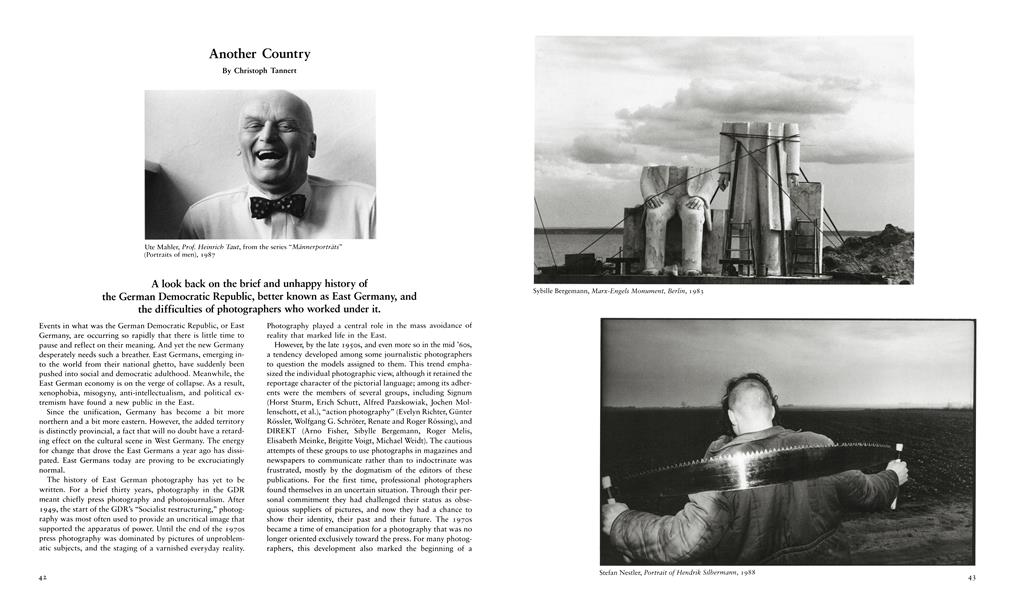
Another Country
Christoph Tannert
A look back on the brief and unhappy history of the German Democratic Republic, better known as East Germany, and the difficulties of photographers who worked under it.
Events in what was the German Democratic Republic, or East Germany, are occurring so rapidly that there is little time to pause and reflect on their meaning. And yet the new Germany desperately needs such a breather. East Germans, emerging into the world from their national ghetto, have suddenly been pushed into social and democratic adulthood. Meanwhile, the East German economy is on the verge of collapse. As a result, xenophobia, misogyny, anti-intellectualism, and political extremism have found a new public in the East.
Since the unification, Germany has become a bit more northern and a bit more eastern. However, the added territory is distinctly provincial, a fact that will no doubt have a retarding effect on the cultural scene in West Germany. The energy for change that drove the East Germans a year ago has dissipated. East Germans today are proving to be excruciatingly normal.
The history of East German photography has yet to be written. For a brief thirty years, photography in the GDR meant chiefly press photography and photojournalism. After 1949, the start of the GDR’s “Socialist restructuring,” photography was most often used to provide an uncritical image that supported the apparatus of power. Until the end of the 1970s press photography was dominated by pictures of unproblematic subjects, and the staging of a varnished everyday reality. Photography played a central role in the mass avoidance of reality that marked life in the East.
However, by the late 1950s, and even more so in the mid ’60s, a tendency developed among some journalistic photographers to question the models assigned to them. This trend emphasized the individual photographic view, although it retained the reportage character of the pictorial language; among its adherents were the members of several groups, including Signum (Horst Sturm, Erich Schutt, Alfred Pazskowiak, Jochen Mollenschott, et al.), “action photography” (Evelyn Richter, Günter Rössler, Wolfgang G. Schröter, Renate and Roger Rössing), and DIREKT (Arno Fisher, Sibylle Bergemann, Roger Melis, Elisabeth Meinke, Brigitte Voigt, Michael Weidt). The cautious attempts of these groups to use photographs in magazines and newspapers to communicate rather than to indoctrinate was frustrated, mostly by the dogmatism of the editors of these publications. For the first time, professional photographers found themselves in an uncertain situation. Through their personal commitment they had challenged their status as obsequious suppliers of pictures, and now they had a chance to show their identity, their past and their future. The 1970s became a time of emancipation for a photography that was no longer oriented exclusively toward the press. For many photographers, this development also marked the beginning of a financially risky road, a situation that did not change until the end of the decade brought government subsidies (shows, grants, etc.) for art photographers.
A powerful social documentary tradition links the younger and older generations of East German photographers. The generation of the 1950s and 1960s has been followed by a younger group of photographers that includes Christiane Eisler, Jürgen Hohmuth, Thomas Kläber, Georg Krause, Gerdi Sippel, Renate Zeun, and others who have widened the paths of social documentation laid out years earlier.
In June 1990, at GALERIE vier, East Berlin’s first private commercial gallery, Arno Fischer premiered his works from the 1950s: “raw and unusual pictures obsessed with details and everyday life,” according to the critic Wolfgang Kil, who compared these photos to those of Robert Frank and René Burri. Fischer’s works revealed the great impact he has had on subsequent GDR photographers, many of whom regard him as their “master.” This mentor/pupil relationship has not yet been documented, even in the GDR, just as other chapters of East German photography remain obscure. When Ulrich Domröse, a collector and historian of photography, presents his treasures from the early days of the GDR, certain opinions about the nature and value of work done since the War will have to be modified, and the photography of this country considered in an international context.
Even now, East German photography is dominated by narrative forms; only the generation of photographers born around 1950, among them Ulrich Wüst, Erasmus Schröter, and Florian Merkel, have had the courage to explore other directions. Today, reportage and documentation are alive and well; but now the youngsters—with installations, conceptual pieces, and medium-reflective questioning of reality—are coming into public awareness.
A few advocates of conceptual photography, chiefly artists, have paved the way for this development. The photographer’s body, his or her personal problems, besieged by decay and surrounded by the shards of civilization—these and other disparate themes have become the focus of a new interest. In Klaus Elle’s work, existential feelings enter the pictures symbolically or through staged actions. Kurt Buchwald develops series of minute experiments in his performance-based efforts to track down a kind of essential photography; in 1990, Jörg Wahner and Buchwald undertook various anti-Stalinist protests, using conceptual means. Else Gabriel combines personal texts with photographs, seemingly without any logical connection, to produce an associative, sensual frame of reference.
Berlin, February 2, 1981 . . . The list of people here who are going away keeps growing. Daily struggle for the ability to work, not to mention for “enjoyment.” . . . We cannot hope that the used-up institutions, to which many were accustomed, will supply a new direction. Run a zigzag course. But there is no escape route in sight. . . .
CHRISTA WOLF, Cassandra, 1983
Even after the opening of East Germany, its artists still remain marked by the “damage wrought by dictatorship.” In the work of photographers who pursue more conventional forms, such as Jörg Knöfel, Peter Oehlmann, Tina Bara, Michael Scheffer, and Maria Sewcz, there is a conspicuous interest in the fragmentation of reality, expressed through pictures of details and angled shots. The works of these and other photographers make it clear that Eastern Europe is going through a profound and not always hopeful transformation.
Jens Rötzsch develops a critical stance that confronts the viewer, especially in his pictures of political life before the “change,” studying the mass jubilees and athletic events sponsored by the totalitarian social systems. Together with Peter Oehlmann he created an overview of East Germany with a provocative title: “Protokoll Strecken” (Protocol stretching). This exhibition, shown at the underground gallery EIGEN + ART (a pun meaning “one’s own art” as well as “peculiarity”), promptly brought out the state security police.
Matthias Hoch, too, is an unerring observer with a strong sense of style. His commitment to photojournalism during the Leipzig Autumn has garnered recognition even beyond photography circles. The same is true of Uwe Fraudendorf; along with Ernst Goldberg, Frauendorf is one of the most important documentarians of Leipzig’s counterculture, as well as a portraitist. In his 1990 project “Real Mode” (Real/fashion), Frauendorf presented a series about the lives of adolescents in the GDR— unspectacular but full of pleasure, frustration, and humor. Gundula Schulze’s photos have always been controversial in
East Germany. Her nude portraits might have caused resentment if she had treated her models with voyeuristic sensationalism, but instead her pictures are gently ironic in depicting people without their social masks.
In discussing East German photography, it is important also to recall the many photographers who, under the pressure of constant regimentation, fled to the West before the Berlin Wall came down: among them Barbara Berthold, Markus Hawlik, Erasmus Schröter, Thomas Florschuetz, and the group called “Nach uns die Zukunft” (After us the future) (Leupold, Hentschel, and Leupold). Florschuetz, a native of Karl-Marx-Stadt, is a self-taught photographer whose first pictures were black-and-white portraits, presented in a 50 x 50 cm. format. Now, with his wallsized compositions which pay homage to picture-within-a-picture photographs as well as to symbolic scenarios based on close-ups of the body, Florschuetz belongs in the first rank of young European photographers.
Nowadays, anyone writing about East Germany might do well to narrow his field of vision to the daily newspapers. Even weekly forecasts are likely to be contradicted by events. On October 3, 1990, the German Democratic Republic ceased to exist. 1 feel as if I were writing on burning paper. Yet the opening of the border to the West has brought momentum and change to East Germany’s cultural scene. The artists’ associations, which have been meeting to discuss the crisis, are now focusing on such issues as self-criticism and organizational reform. The Association of Fine Artists of the GDR, which before was a government tool for intimidating artists, has lost all influence and is on the verge of disbanding. New and independent artists’ associations are already being formed. Art has shucked off its role as a safety valve and a surrogate reality for the public. With the dismantling of taboos between fall 1989 and fall 1990, provocative young artists found that they had lost their notoriety as martyrs; they have now had to develop a new conception of themselves, to get back to their work. The past twelve months have been difficult but exciting for East German photographers. Now this chapter has ended. Henceforth, individual artists will have to test their worth in the international arena. □
Joachim Neugroschel
More From This Issue
-
The Metaphysicians Of Dionysus: Comments On The New German Photoworks
Spring 1991 -
Another German Autumn
Spring 1991 -
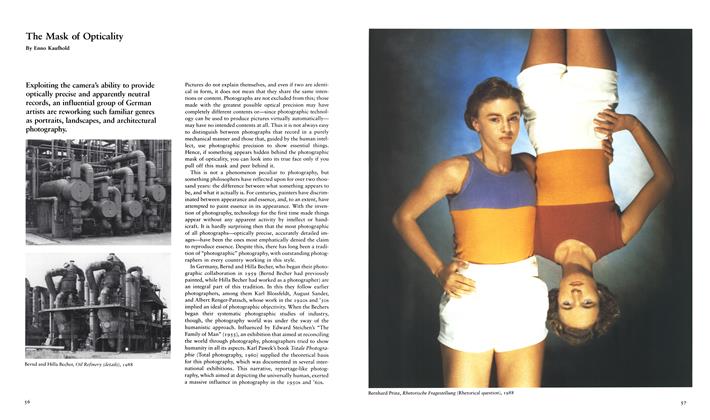
The Mask Of Opticality
Spring 1991 -
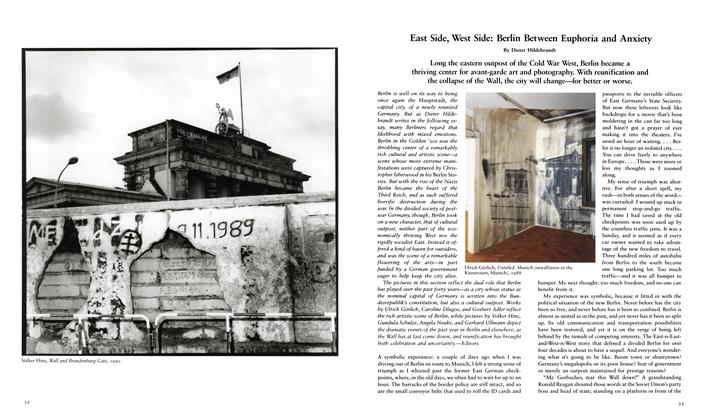
East Side, West Side: Berlin Between Euphoria And Anxiety
Spring 1991 -
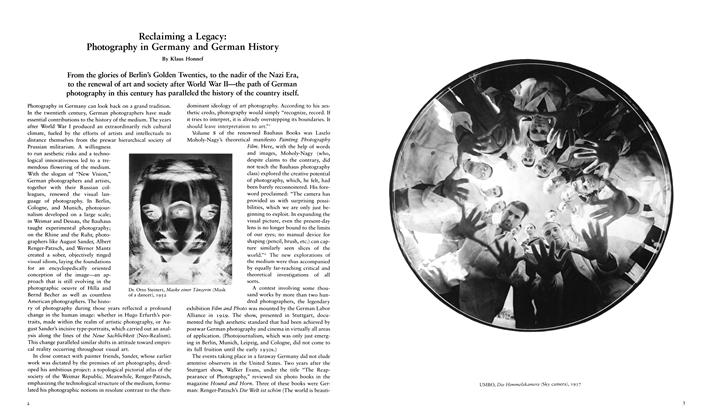
Reclaiming A Legacy: Photography In Germany And German History
Spring 1991 -
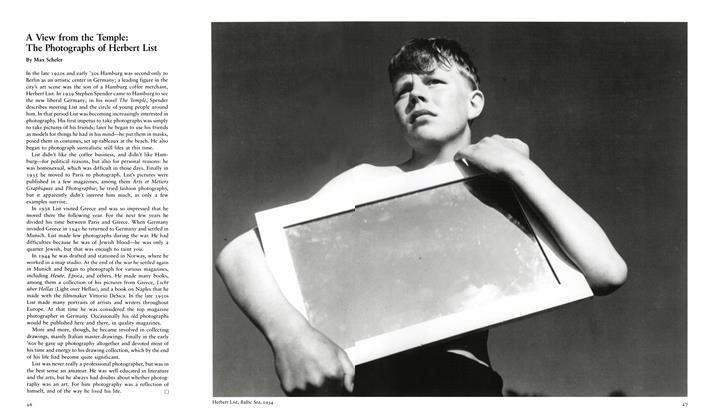
A View From The Temple: The Photographs Of Herbert List
Spring 1991


