Joel-Peter Witkin
JOEL-PETER WITKIN
R. H. CRAVENS
The theater of grand emotions... requires the great romantic repertory. —Jerzy Grotowski, Founder, Polish Laboratory Theater
Two actors; two-score dwarfs; a prefabricated, photosculptured stallion rampant; one-half slaughtered white cow; sundry lunatics and their keepers; a Mercedes-Benz full of French filmmakers; a drum; a yoke of flowers; the mask of a youth; a kingly costume composed in aluminum foil and cardboard; a power stick; a staircase; an abandoned, toiletless factory; a palace modeled on Versailles; sulfur hot-spring baths; three insane asylums.
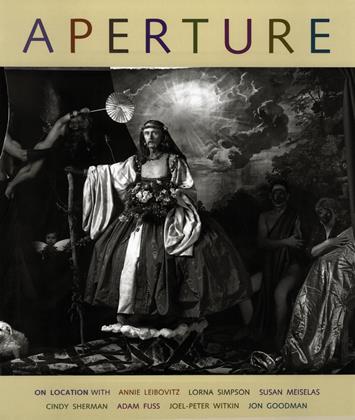
These are among the elements JoelPeter Witkin, photography’s master of mise-en-scène, attended to in the July heat of Budapest as he created one of the most ambitious images of his working life. He sent into collision his adaptations of two Renaissance masterpieces: Velásquez’s Philip IV, Equestrian and Titian’s Rape of Europa. Faithful to his sources, heedful of his own psychic imperatives, Witkin implants such associations as Francis Bacon and an echo of Picasso. His purpose is a unitary image that imparts instantaneous ideological, emotional, and spiritual comprehension emerging from a maze of visual signifiers, metaphors, and puns—a veritable Chinese box of allegories within allegories.
“As I grow older and evolve aesthetically, the work grows more complex,” says Witkin. “It can’t get any more difficult.”
Although he photographs almost exclusively indoors, more than half of Witkin’s images are made on location, usually in France and Mexico. “The reason I work in Europe and other countries is that visual associations are embodied within their history. I’m lucky enough to find people who help me, speak the language for me. And when I return I can share what I pick up consciously and unconsciously: all the angst, all the unknowns that emerge in the discovery of creating an image.”
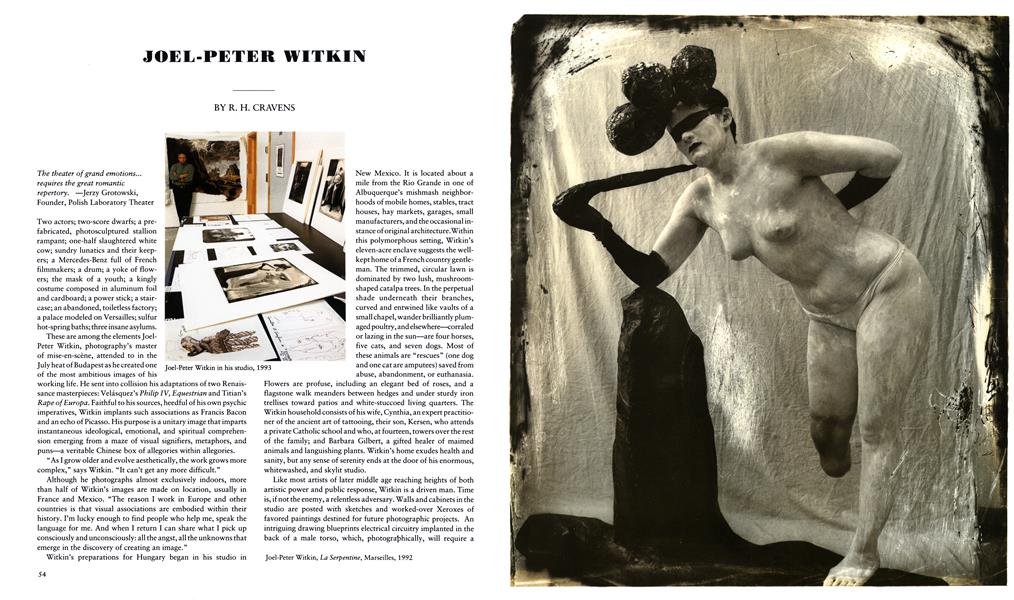
Witkin’s preparations for Hungary began in his studio in New Mexico. It is located about a mile from the Rio Grande in one of Albuquerque’s mishmash neighborhoods of mobile homes, stables, tract houses, hay markets, garages, small manufacturers, and the occasional instance of original architecture. Within this polymorphous setting, Witkin’s eleven-acre enclave suggests the wellkept home of a French country gentleman. The trimmed, circular lawn is dominated by two lush, mushroomshaped catalpa trees. In the perpetual shade underneath their branches, curved and entwined like vaults of a small chapel, wander brilliantly plumaged poultry, and elsewhere—corraled or lazing in the sun—are four horses, five cats, and seven dogs. Most of these animals are “rescues” (one dog and one cat are amputees) saved from abuse, abandonment, or euthanasia. Flowers are profuse, including an elegant bed of roses, and a flagstone walk meanders between hedges and under sturdy iron trellises toward patios and white-stuccoed living quarters. The Witkin household consists of his wife, Cynthia, an expert practitioner of the ancient art of tattooing, their son, Kersen, who attends a private Catholic school and who, at fourteen, towers over the rest of the family; and Barbara Gilbert, a gifted healer of maimed animals and languishing plants. Witkin’s home exudes health and sanity, but any sense of serenity ends at the door of his enormous, whitewashed, and skylit studio.
Like most artists of later middle age reaching heights of both artistic power and public response, Witkin is a driven man. Time is, if not the enemy, a relentless adversary. Walls and cabinets in the studio are posted with sketches and worked-over Xeroxes of favored paintings destined for future photographic projects. An intriguing drawing blueprints electrical circuitry implanted in the back of a male torso, which, photographically, will require a surgically sculptured cadaver. “We’re all basically toys,” Witkin says of the concept. Why not a female torso? “I get luckier photographing men when they’re dead,” he explains. “Men remain strong.” Other cadavers will be required to realize adaptations of three female portraits by Jacques-Louis David, the heads laterally severed at the brow, which are intended “to make the lips of a dead woman smile.” Of the French painter’s homage to Countess Daru, Witkin says: “I will make her beautiful again.”
Hope lies somewhere between two extremes of reality—the tragic and the grotesque. —Jerzy Grotowski
In the final days of preparation, Witkin had on hand an example of the culmination of his image-making process. The photograph, after Rembrandt, is entitled John Herring, Person with Aids, Posed as Flora with Lover and Mother, 1992.
“When I knew John was ill I could basically see a kind of distancing between his physical body and his shadow...as the light was moving toward him, the shadows were longer...his spirit was manifesting itself in a reality that was apparently physical.” After Herring posed in a Renaissance-inspired gown made by his mother and his lover, Witkin rushed to make a print and brought it to Herring’s hospital room in the final moments of his life. “My belief of beliefs is that we don’t perceive with our physical senses. I believe that even if John had been dead a few moments, or even an hour, he could see the picture...see what I’d made through his energy and all the people involved.”
What is extraordinary about the massively framed Herring print exhibited on an easel is that it has undergone Witkin’s encaustic process. “Burned” onto aluminum, the image is subtly, pointillistically colored by Cynthia Witkin. A layer of wax is applied and buffed with the palm of the hand for up to fifteen hours. After “resting” through three months of temperature changes, the waxing-buffing is repeated, and once again three months after that. Witkin rarely undertakes this arduous process, and then makes only a single encaustic rendering of an image, which becomes a unique work; straight photographic prints of the same image make up his signed and numbered editions.
Witkin’s reverential attitude toward dying subjects carries over, somewhat peculiarly, into his studies of human remnants. “When I’m working with a severed head,” he says of Still Life, Marseilles, 1992, “I’m engaged in very direct spiritual dialogue. This person really had a life. His body is in a coffin somewhere, and part of his brain was taken out for medical research. My job, given the opportunity, is to put flowers into the remainder of his brain, as if it were the well of my existence. I’m trying to make a totally humbling image. It’s a very crazy and profound experience.”
The overwhelming artwork in the studio is a fifteen-byeighteen-foot background painting to be used in Budapest. It is a brilliant, accurate fusion of Velásquez’s landscape with the ocher waters that flow through the lower right corner of the Titian. The first attempt—failed—at the equine figure, will lead Witkin into twenty-two hours of nonstop effort in the darkroom. There, he will use special cameras to photograph six sections of a newly photographed horse, enlarging each section to create a royal mount scaled to his background.
In mid July, packing various props, industrial construction foam, special adhesive glues, the background, and all the necessary photographic equipment and supplies, Joel and Cynthia left for Budapest, ten thousand miles distant. And for all the painstaking preparations, he had embarked on a costly, exhausting venture of pure risk—the quest for what he calls “the big shot.”
Witkin’s absence afforded an opportunity to seek out other participants in his necessarily collaborative photography. One of the most valued is his background painter, Beth Love.“Beth,” he says, “endows a painting we both admire with her own outlook and vision. It makes my work richer.”
Beth Love shares a World War II Quonset hut in an industrial park with Simon Bolt, an expert restorer of vintage automobiles. Beth has worked with Witkin since 1984. “Initially, he’ll give me some idea of what he wants. I work in his studio, and we bounce ideas back and forth. I’m learning from Joel to let go of control in my own painting. And I think more than ever about my own mortality, death.”
An intriguing aspect of Witkin’s art, inevitably, is his relationship with his models. It can be, by turns, affectionate, distant, and very demanding. Laconic as an ancient Roman governor, he has observed: “I have crucified two brothers.” And with these two— Beth’s former husband, Carl Love, and his brother, Eric Love— Witkin thrust his vision into extremes of illuminating tragedy and grotesque darkness.
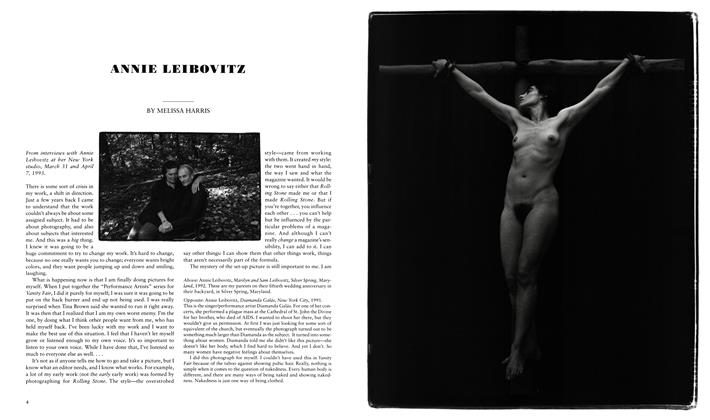
Carl is a slender, blond mental-health worker, chosen for Witkin’s epic, life-sized, body-cast sculpture of Christ on the cross, which was also reproduced in photographs. In preparation for what would be nearly eighty hours of posing, Witkin sent his model to an institute for hypnosis. The idea was to master selfinduced trances that would help him remain motionless. “I didn’t think it worked,” Carl says, “but I must have been in a trance. The first session I was up there for about thirty minutes. When I came down I was sick all over the floor. After that, the most I could stay up was fifteen minutes. ” Carl also fainted several times. Despite the ropes slung for arm supports, and a small platform under the buttocks, he was, essentially, experiencing crucifixion:
“It was physically exhausting, difficult. Joel doesn’t go out of his way to make you feel comfortable. He doesn’t talk to you or offer philosophical ideas. You’re a tool, objectified. But I indentify with Christ because this is a fairly unreal existence. And I thought that this was the kind of image I might look at—and behind—in another lifetime.”
In discussing his relationships to models, Witkin has acknowledged his tendency to objectify. “You’re not thinking about their personalities or memories. A photograph is successful for me in terms of what the viewer sees in it. Distancing myself from the model lets the viewer make different kinds of choices about the subject.”
Yet, Witkin also can be utterly engaged with an individual trapped in “the aberrations of love. ” Carl’s brother, Eric, who died of AIDS last year, was the photographer’s most frequently used model—the subject of images involving crucifixion, sadomasochism, and bestiality.
“The Grotesque,” Witkin reminds us, “derives from grotto, the caverns and subterranean darkness. Saints have loved the darkness because that’s where you go to bring out the people who are drowning. When I, as an individual, continue my journey into perception and better realities, I have to engage the person in darkness because I’m in darkness. I have an opportunity to celebrate that person’s life. But unless the image of emotional associations represents a moral equivalent of some higher, noble force, it can damage me and others in the process. We all have to make a decision as to what we’re basically serving. If your life and work are about despair, there’s no resolution, no redemption.”
The art of mise-en-scène [has provided] a place of direct contact between artists and spectators, where the attention, thought, and will of the participants are united into a communal plunge into existential problems of human fate, interpersonal connections, and the relationship of man to Cosmos in order to find a seed of hope. —Jerzy Grotowski
In less than a fortnight, Joel and Cynthia returned from Budapest. In his account, abbreviated; “We went there with a filmmaker from Paris. He knew I needed a dwarf, so they had had a casting call and there were forty dwarfs waiting. Hungarians are proud that for some reason they produce a lot of dwarfs. Many of the dwarfs in The Wizard of Oz were Hungarian....
“In Budapest, we were given a whole factory to use, which was great, except it had no toilet...only a hole. We worked around the clock.... The film crew and others were loaded into two Mercedes and we went looking in three asylums. In two of them, everyone looked normal, but the third was perfect. The gate was opened by a guard in uniform, and he turned out to be an inmate. In that asylum, we found the right dwarf” (who, it should be added, bears an uncanny resemblance to Velásquez’s portrait of Don Sebastian de Morra).
“For our location, we had a small copy of a copy of a palace from Versailles, which was important. I was working with a kind of lunatic story about a person in a palace, exerting himself as a signifier of power, iconography filled with the colossal and the portentious. For Titian’s Europa, the white bull was too expensive, and the gray, spotted bull they sent over looked too much like a horse. So the owner of the slaughterhouse killed a white cow, cut it in half, and we had to drag this carcass of a half-cow into the palace. We used an actor for Philip IV, but I placed a mask on his face that was a photograph of my son, suggesting a kind of blind, adventurous youth. The actress had a pretty good body, but she was quickly fed up with the wax and latex I wanted to use to evoke the horrific, raped face from Bacon, which I’ll now scratch onto the negative... .The dwarf was covered with feces, so we made him keep his socks rolled up to lessen the smell.
“ Cynthia was working with me every minute and we were white with fatigue. Only the hot mineral baths, the healing waters, kept us going. We put all of our knowledge and energy and ambition into making this image occur. I’ve often felt as if I were working in a trance, but never this hard, never this amount of risk. But it’s like St. John’s promise that you receive ‘grace for grace,’ efforts making you ready to receive. By the time it was all put together, I only had about ten minutes to make the shot.”
Weeks of intense work ensued before he printed a fulfilled vision of Raping Europa, Budapest, Hungary, 1993.
Witkin’s hard-won photograph is at once both illumination and satire of a great master’s aesthetic stoogery: Velásquez’s nearly lifelong devotion to one of the Habsburg’s—and Europe’s—most vicious, ineffectual rulers. Even a superficial reading reveals the clarity of Witkin’s transfigured symbols. The dwarf, bearing a yoke of flowers, represents the populace. Philip IV’s mount, slightly reduced in scale, is also diminished from the heroic to the slightly absurd, vaguely in motion but going nowhere. The ideological yields to the deeper spiritual suffering of Witkin’s Europa, rape victim of mythology, now expressing Bacon’s contemporary irredeemable despair. In place of Titian’s robust, almost jovial white bull, Witkin’s wretched cow assumes both the posture and pathos of Guernica's agonized dying horse. Velásquez’s portrait of Innocent X, the Habsburg-allied pope, hovers at upper right. A flying fish with a parachute embodies, for Witkin, a multitude of meanings, ranging from Christ’s healing powers to the idea of peace distorted into missiles, bombs, and environmental rapine. And to the upper left, there is a detail from Velásquez’s The Forge of Vulcan, that Grand Guignol scene in which Apollo reveals the adultery of Venus with Mars.
Within this elaborate imagery there is a remarkable fluidity of associations: of Velásquez’s familiarity with his friend Titian’s masterwork; of Titian’s patronage in Rome that provided Velásquez with access to the pope; of Bacon’s obsession with Velásquez’s portrait of Innocent X; and of Philip IV’s own historic role in shifting the center of Habsburg power and tyranny to the east.. .to Hungary, most raped of nations, and to lunatic asylums, shelters of raped souls.
Where is the line between travesty and transfiguration? Or between the dark and light events of the soul? It is a place where rare, fearless artists have gathered for centuries (certainly, long before the invention of photography) and it is within their company and traditions that Witkin belongs. Masters of painting from the Renaissance onward have provided him with a symbolic lexicon; innovators from the Italian Comedy Theater of Cruelty celebrated the robust madness that fires his imagination and labors. Witkin’s unique contribution is the use of the camera to adapt and transform this heritage, to inhabit an image such as Raping Europa with a stunning, eternal moment and dramatic grace.