Wild Irises
A Nash Editions Portfolio
WILD IRISES
A Nash Editions Portfolio
VINCENT KATZ
Graham Nash is a man of many interests. He is probably best known as the soft, dreamy voice in the rock group Crosby, Stills and Nash. His previous band, the Hollies, rattled off a string of hits in the 1960s with a decidedly English feel, different from CSN's down-home, radical American hippie sound. Further in, Nash is the Manchester-born son of an amateur photographer, who fell in love with the art when he was very young, helping his dad tack up a blanket over a window to create an impromptu darkroom.
After Nash achieved musical success, he began amassing one of the most prodigious collections of photography in the world. Never limited to a period or school, Nash is fascinated by the medium as a whole, from its tentative beginnings to the latest experimentation. When Nash put some 2,400 photos from his collection up for sale at Sotheby’s in 1990, almost every important photographer was represented. But the sale, which brought in $2.17 million, raised questions: Had Nash created this collection simply as an investment? Was he just a very shrewd speculator who had realized photography’s under-tapped market potential, turning millions into more millions? In fact, this was not the case. Nash had sold his collection, which he cherished dearly, to finance another project, even closer to his heart. He started Nash Editions in Manhattan Beach, outside of Los Angeles, with friend and former CSN road manager, Mac Holbert, to initiate a high-quality digital screening and printing studio.
Part of Nash Editions’ mission is to create an environment where artists feel comfortable experimenting with this new technology. There are two basic techniques that can be applied. The scanner can turn an existing image into digital information, from which a print can be produced of up to three by four feet, with remarkable richness of tone, and none of the graininess that occurs in normal photographic enlargement. The blacks are pure rich blacks, the grays pure grays. The delicacy of the entire print is comparable to that of a lithograph or a gravure. The other, and perhaps even more exciting, aspect to the new technology is the well-known capability of manipulating digital information. Once an image has been translated into digital, the artist can rearrange, add, discard, mutate, bend, and color it at will.
Nash and Holbert started with an Apple Macintosh II, a Truvell scanner, and a program called Photoshop. Although Nash relished the opportunity to experiment on-screen (he is also a digital music afficionado), he was dissatisfied with the printed results, and began to seek out better machinery. Finally, he came across a color ink-jet printer from Iris Graphics, and he found the quality of the prints amazing. The printer sprays ink through infinitesimal openings onto paper attached to a rotating cylinder; there is no actual contact with the paper itself—it is in fact possible to print onto any surface. But even this extraordinary (and very costly) printer has its drawbacks. Designed for color proofing, the inks tend to fade rapidly, and black-and-white capabilities are not equal to the color results. At Nash, a computer programmer was able to adjust the black-and-white levels, and water-based inks resulted in prints that will hold up, it is estimated, for a minimum of twenty years. Nash expects that they will soon achieve the permanence of archival prints. “The most exciting thing we’re working on,” he says, “is the stability of the inks. We’ve been saying for some time, ‘You give us stable ink, and this business will be blown wide open.’”
Having purchased the Iris 3047 Graphics printer, Nash Editions brought in Jack Duganne to be their master printer. They wanted to create an atelier, a place where this new graphic opportunity could be expanded by those best equipped to do so—artists. Early on, publisher Raymond Foye was instrumental in introducing Nash to Francesco Clemente and David Hockney. According to Nash, these two artists “always saw it as a new medium, embraced it immediately, and just incorporated it into their own mode of expression.” David Byrne and Allen Ginsberg have also worked with Nash Editions, and the company continues to grow.
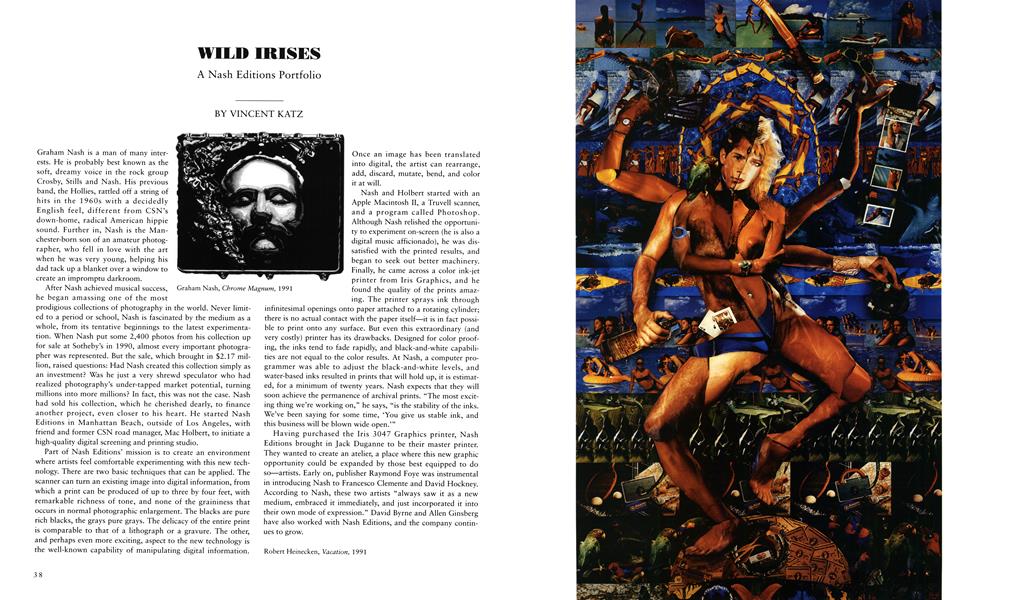
Some artists are content to scan their own existing images and to work with the system’s wonderful printing capabilities; others are more intrigued by the possibility of computer manipulation. Robert Heinecken has created a powerful icon in his unique photo-collage, Vacation, which measures an imposing seven by four feet. The Nash Vacation is composed of four sheets, and although it is of course flat—not collaged in texture—the intricacy in detail and the color balance of this postmodern take on the Hindu god Shiva are breathtaking. Heinecken’s interest has not been in the manipulative side of Nash Editions, but in reproduction: “I’m not involved in the computer. I generate these things by hand; they’re collage pieces. All I’m using the technology for is to get from that original matrix to a print. I’ve always used lithography and etching in that way.”
But the ability to produce reliably perfect images, time after time, should not be discounted. Heinecken explains, “There are precise ways you can lighten, darken, change hue....In the case of Vacation, perhaps the colors are a little brighter or more saturated than they are in the original piece. It’s very simple to proof; you can make any subtle shift you want in any of the four colors [cyan, magenta, yellow, black].”
Eileen Cowin has done two pieces with Nash Editions, both, like Heinecken’s, to reproduce existing imagery. “Based On A True Story” is a series of six images that tell a mysterious tale involving a bed and a package. Cowin uses the technology to create striking gestures—the relationships of pitch blacks to light tones, the cinematic contrast between extreme close-up and long shot, a storyboard development of “scenes.” “The manipulation is almost like darkroom manipulation,” Cowin explains, “where you go in and lighten something up, bring something out. I didn’t add or cut and paste anything....Sometimes when you’re in the darkroom burning and dodging, it’s difficult to get it perfect. But here, you can get it perfect....I work in a lot of different media: video installations and room-size photographic pieces. I like the way the object looks, from Nash. It’s on this beautiful paper, and the way ink becomes part of the paper is beautiful. For me, it’s more the object—where the technology’s under the surface, not on top of it. To be able to get six images on one piece of paper, as we did in ‘Based On A True Story,’ is really interesting. Jack Duganne and I played with the color of the print—‘Based on a True Story’ has a slight warm tone to it.”
Olivia Parker has created a fascinating image in Horseplay: a smashed can patterned with an evanescent geometric design— like an architectural blueprint—and medieval-looking military figures on horses. In fact, the “architectural blueprint” comes from an Egyptian game board, to which Parker added dimension via the computer. The horsemen are taken from Parker’s own photographs. Here, the artist actively engaged the computer qualities of Nash’s equipment—the ability to shift digital information easily, creating combinations that would otherwise be impossible. Based in Massachusetts, Parker visited Nash and had what she calls a “tutorial” with Holbert. Since then, she’s worked with Nash via disk and the U.S. mail. “The thing about working with a computer,” Parker says, “is an image can evolve into something else in a way it can’t in photography, and this fascinates me. Most of what I use is derived from my own photographs— Horseplay started with a four-by-five black-and-white negative of several figures—I wiped out all the figures but the one on the right. The people on horseback are from 35mm color slides I took. I use what they call the ‘cloning tool’ in Photoshop. It’s almost as if you can paint one image into another, and you can vary the degree of transparency. It takes a long time. Horseplay took about sixteen hours of solid work, and the first time I did it, the computer ate it— there was a software glitch, which got fixed rapidly. As I was doing Horseplay again, I stored things along the way. And I think the second one is better....I’ve done a lot of thinking about what the computer is doing: I look at it as a tool to enable me to do things I could never do before.”
One senses that the possibilities at Nash Editions are only beginning to be revealed, and, as with all beginnings, an innocence prevails. But a process has been established: a process that provides a new fine-print medium and expands the creative universe within which artists can explore. They have laid the groundwork for a new collaborative “studio,” in which the centuries-old practice of fine printing adapts to the age of the computer.