The Life Of The Soul
THE LIFE OF THE SOUL
REBECCA BUSSELLE
PHOTOGRAPHS BY CORNELIUS M. PIETZNER AND STEPHAN RASCH
Camphill is an expression of a great intuitive thrust out of the deep heart of nature which has us in its keeping, and knows that both we and it are in mortal peril. —Sir Laurens van der Post
Dusk, early winter. Karen, a woman with straight gray hair and serious glasses, sits at a table made of maple in a spacious and cheerful kitchen, a basket of wool at her feet. Around her, several people chat, while a woman reaches into a cupboard for mugs and tea bags. From the living room come the crisp notes of Bach, played on a grand piano. Down the hall, Susan sits on her bed gazing through a window framed by curtains of soft, gray silk from India.
Look again, more closely. Karen works yarn around Karen works yarn around the needles, adding crimson to a lengthy muffler already resplendent with yellow, lavender, green, and she holds the needles awkwardly. The woman who pours water from the kettle into mugs is a houseparent. Her husband plays the grand piano, which dominates a room with Persian rugs, a spinning wheel, a card table strewn with a two-thousand-piece jigsaw puzzle. In the bedroom—one of ten in the house—Susan lifts her face in order to look out the window, her immovable eyes able only to see straight ahead, as though peering through a tiny hole. She parks her wheelchair beside the bed.
In this tranquil and gracious house on 680 acres of woods and farmland in the foothills of the Berkshires, just over half this extended family has developmental disabilities—a term that some call politically correct and others call an attempt to outdistance the stalking pejorative of labels. Twenty-five years ago, they would have been classified as mentally retarded, lumping together individual handicaps of cerebral palsy, epilepsy, neurological impairment, or autism; earlier, they were called morons, and worse.
(The New York State system, perhaps reflecting a conservative ideology that evaluates human services in financial terms, currently designates people with developmental disabilities “consumers.”) At Camphill Copake they are simply called villagers.
Home to over 225 people, Copake, New York is one of more than eighty-five Camphill communities worldwide, with seven in North America, several in Africa and Eastern Europe, and the rest in the British Isles, Western Europe, and Scandinavia. Each community operates autonomously but shares the principles of Rudolf Steiner, an Austrian visionary and educator whose concepts developed into the Anthroposophical Society, “an association of people who would foster the life of the soul, both in the individual and in human society, on the basis of a true knowledge of the spiritual world.” From anthroposophy grew, among other things, the Waldorf Schools, biodynamic agriculture, anthroposophically extended medicine, and numerous contributions in the arts and architecture. The name of the movement, Camphill, derives from the estate near Aberdeen, Scotland, where, in 1939, a group of Steiner students who had fled Nazi Germany, formed a community with a social purpose in a time of deepening chaos. Under the leadership of Dr. Karl König, a distinguished Viennese pediatrician, and joined by volunteers from Great Britain and central Europe, the pioneering efforts of this founding group set the example for sharing lives while honoring individual difference that defines the Camphill experience.
Camphill communities provide an innovative alternative to the bleakness of the institutional life that is still a reality for seventy thousand people with developmental disabilities in the United States, or to the often isolated existence in community residences within neighborhoods that are hostile or apathetic. In this house in Copake, the other occupants, called coworkers, are without discernible developmental disabilities and have volunteered to participate in a community that provides concrete ways to examine consciousness, aesthetics, and spiritual values within a structure of cooperative work and social responsibility. Camphill sees itself as part of a subtle, growing, life-sharing movement in which groups of people gather to support vulnerable populations.
Through anthroposophy, the Camphill philosophy espouses the concept that every human has a perfectly formed spirit as well as an individual destiny. The physical and mental housing of that spirit varies, embodying a greater or lesser degree of ability, but all people need friendship, meaningful work, artistic expression, and worship to achieve dignity and freedom. Coworkers do not see themselves as service-oriented, but believe in a constant spiritual dialogue with a diverse community through which they invariably receive more than they give. They acknowledge the constant opportunity for renewal, self-examination, and expansion of human awareness. They rejoice in the special qualities of villagers, with whom they celebrate festivals and the changing seasons, sing Bach cantatas, produce plays and pageants, have barbecues, and laugh. Breaking barriers between the able and the disabled, the helpers and the helped, creates a therapeutic community in which healing works both ways.
Each community matches the needs of the collective with the talents of coworkers, who may teach classes, tend orchards and farm animals, work in kitchens, offices, and craft shops, administrate, and raise the ever-necessary funds. Camphill describes itself as a way of life, not a job. Status is not derived from work hierarchy. Coworkers labor without salaries, trusting the community not only to meet their basic physical requirements, but to identify and fulfill individual emotional and aesthetic needs. A community may see that one coworker needs relief from a long winter and provide a few days away, or that another needs a warmer jacket. Most longterm coworkers are married; many have families, and some have lived within the Camphill network the better part of a lifetime.
“My father couldn’t understand why I wanted to dedicate myself to Camphill,” a longtime coworker says. “He thought I’d cut myself off from life.” For her, however, the decision was clear: she wanted a community where daily encounters forged deep connections rather than superficial ones. Cherishing people rather than material goods or the present-day glut of information, coworkers choose a life away from the mainstream, structured and in many ways protected.
Choice, by necessity, often means rejection. Most communities do not have television, although—perhaps reflecting the constant struggle to stay simple and focused while not falling terminally behind contemporary society—at Copake the desirability of life with a VCR causes much discussion. In another Camphill community a houseparent admits to a television in the basement and occasional stolen moments watching a Knicks game. “There is no utopia,” one coworker says. “Community life is hard work, mentally and physically.”
In keeping with Steiner’s principles, villagers—or companions, as they are known in some communities—live in Camphill not only to benefit from such advantages as an excellent, fresh diet, curative therapies, music, eurythmie body movement, academic learning and a strong spiritual life, but also to strengthen and grow as contributing members of society. All have jobs. Each task is considered important, no matter how small. At Copake, where cows are milked twice a day, Charlie’s job is to hold the cow’s tail so it won’t whack the milker in the face. Charlie has no replacement, and when he leaves the community for short visits home, he worries about the milker. Another villager shakes cream into butter, and has been doing so with a sense of pride for a dozen years. Some make candles, some weave, some work in the wood shop, bake bread, make cheese, or bind books. Valuing the land for its intrinsic beauty, as well as its resources, most communities grow vegetables and herbs for consumption and sale, shear sheep to spin wool for weaving, and make and distribute excellent fruit spreads and jelly. Excerpts from the diary of a Copake villager, Edna, show a calm acknowledgment of natural cycles:
April 9: The estate took down the maple sap buckets.
April 16: George Chamberland died in the afternoon.
May 2: We had quite a storm and also a few trees fell.
May 14: It is nice to see all the cows and horses out in the pasture again.
While the emphasis is on an adapted form of Waldorf education at Beaver Run, a Pennsylvania village and school for children aged six to eighteen, here, too, Camphill incorporates the structure, obligations, and rewards of tasks. Coworkers report that villagers who come from Beaver Run to Copake, an adult community, have an easier time adapting to the concept of work than do those who have lived at home, where most have experienced a lower expectation of participation.
For villagers as well as coworkers, questions arise about leading a life some would call cloistered. Institutions for the mentally retarded—even when renamed as developmental centers or villages—at best hold little hope for stimulation from the outside world. At worst, institutions promise a life of abuse. Group homes operated by state or private agencies vary in quality, but in order that they not become mini-institutions, meaningful inclusion in the larger community must be a persistent focus, one which most house staffs have little incentive or energy to accomplish. Paid jobs are often the shining star of an integrated life for people with developmental disabilities, yet most of those jobs are barely paid, repetitive, and perceived as demeaning. How, then, do Camphill communities—which consciously strive to contain and mold their own environments, remaining as self-sufficient as possible—keep from qualifying as elitist mini-institutions? And is holding the cow’s tail day after day the equivalent of shrink-wrapping books, or constantly fitting one mechanical part into another?
Part of the answer lies in the concept of interdependence—acknowledging frailty in all humans while undertaking an enduring search for the appreciation of human strength and beauty through mutual engagement. Due to their bureaucratic nature, institutions foster dependence, while promoting “independent living skills.” The only sign of true interdependence is financial remuneration— hardly the spiritual dialogue Camphill nourishes. However, Camphill is sensitive to criticism that it keeps villagers from the outside world. Each Camphill community assesses the needs and goals of applicants before they join; a visit of several weeks ensures that the life offered is the one desired. During the past decade, communities have recognized that some people, including long-term villagers, may require a larger context in which to thrive. Several have initiated special programs. At Camphill Soltane, a community for young adults on rolling farmland outside Philadelphia, some villagers hold apprenticeships and jobs in adjacent towns—in the hospital, the library, an automotive manufacturing plant—carefully tailored to the individual. These are not segregated, sheltered workshops, where people with disabilities are hidden away with their own kind, but thoughtfully designed situations, and, a coworker admits, “a transportation nightmare.” Although abiding by the rule of consensus, not everyone in the community is convinced that this is the proper direction for Camphill. Another coworker warns: “A broader palate doesn’t always bring greater happiness.”
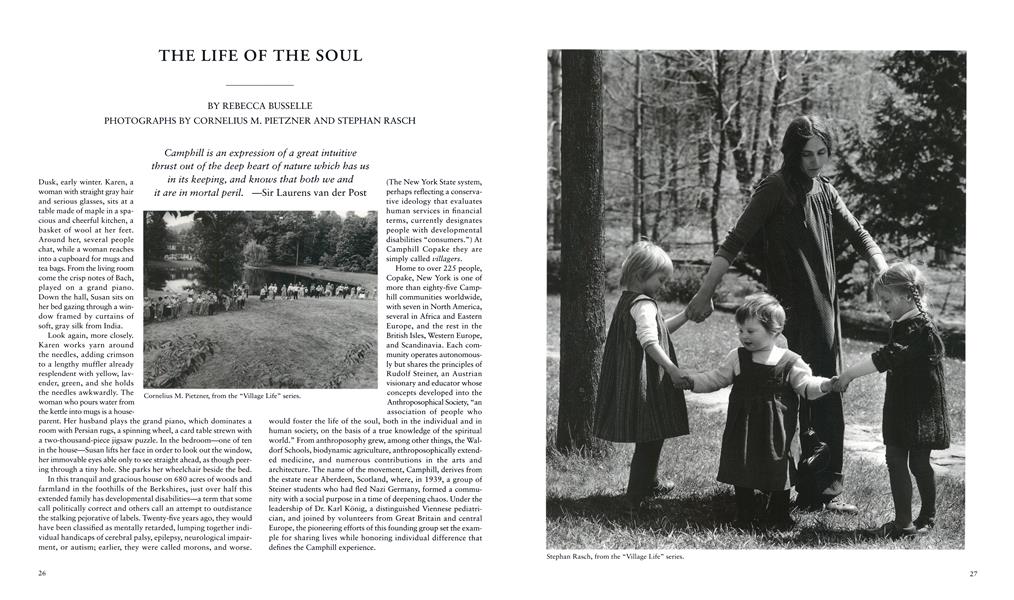
In Camphill communities happiness is visible, expressed through a palpable serenity that is molded by the forms and rhythms of a secure life. These photographs—taken by accomplished photographers who are coworkers in Copake and Soltane—are as direct and unaffected as the people they depict. Their purpose is clear: To give visual life and understanding to the intentions and realities of Camphill. They imply history as well. In them, some people look slightly anachronistic—as though they’d been imported from the first Camphill without aging: “The timelessness of being human,” a coworker comments. The photographers pay quiet homage to their subjects, honoring the sense of mutual engagement and connectedness that sustains each community. In these photographs no one is objectified, set apart, or made grotesque.
Devoid of artifice, the pictures show a lyrical gathering on a summer day; the quiet concentration of a boy snipping at grape vines; communion, joy, and responsibility as people care for animals and fellow humans. The photographs are incisive, the subjects distinctly individual, yet the cumulative effect is to blur the perceptible differentiation between the able and the disabled. A couple ascends a wooden step, the woman slightly ahead, helping, patiently guiding the man whose hand she holds. Is she a villager or coworker? In another photograph a woman makes a circle with three children— her own? Disabled? To whom is it important?