People And Ideas
The Buzz About Paparazzi: Marcello Mastroianni Remembers Working With Federico Fellini And Tazio Secchiaroli, The First Paparazzo
The Buzz About Paparazzi: Marcello Mastroianni Remembers Working With Federico Fellini And Tazio Secchiaroli, The First Paparazzo
THE BUZZ ABOUT PAPARAZZI: MARCELLO MASTROIANNI REMEMBERS WORKING WITH FEDERICO FELLINI AND TAZIO SECCHIAROLI, THE FIRST PAPARAZZO
A previously unpublished, exclusive Aperture interview with the Italian actor.
Gloria Satta
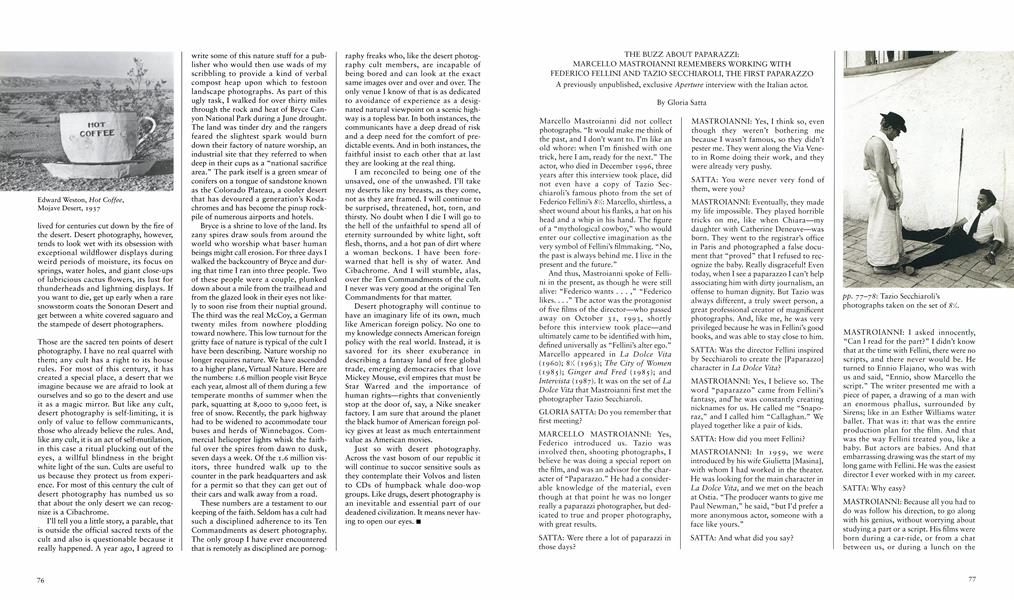
Marcello Mastroianni did not collect photographs. "It would make me think of the past, and I don't want to. I'm like an old whore: when I'm finished with one trick, here I am, ready for the next." The actor, who died in December 1996, three years after this interview took place, did not even have a copy of Tazio Secchiaroli’s famous photo from the set of Federico Fellini’s 8½ Marcello, shirtless, a sheet wound about his flanks, a hat on his head and a whip in his hand. The figure of a “mythological cowboy,” who would enter our collective imagination as the very symbol of Fellini’s filmmaking. “No, the past is always behind me. I live in the present and the future.”
And thus, Mastroianni spoke of Fellini in the present, as though he were still alive: “Federico wants . . . ,” “Federico likes. ...” The actor was the protagonist of five films of the director—who passed away on October 31, 1993, shortly before this interview took place—and ultimately came to be identified with him, defined universally as “Fellini’s alter ego.” Marcello appeared in La Dolce Vita (i960); 8A1 (1963); The City of Women (1985); Ginger and Fred (1985); and Intervista (1987). It was on the set of La Dolce Vita that Mastroianni first met the photographer Tazio Secchiaroli.
GLORIA SATTA: Do you remember that first meeting?
MARCELLO MASTROIANNI: Yes, Federico introduced us. Tazio was involved then, shooting photographs, I believe he was doing a special report on the film, and was an advisor for the character of “Paparazzo.” He had a considerable knowledge of the material, even though at that point he was no longer really a paparazzi photographer, but dedicated to true and proper photography, with great results.
SATTA: Were there a lot of paparazzi in those days?
MASTROIANNI: Yes, I think so, even though they weren’t bothering me because I wasn’t famous, so they didn’t pester me. They went along the Via Veneto in Rome doing their work, and they were already very pushy.
SATTA: You were never very fond of them, were you?
MASTROIANNI: Eventually, they made my life impossible. They played horrible tricks on me, like when Chiara—my daughter with Catherine Deneuve—was born. They went to the registrar’s office in Paris and photographed a false document that “proved” that I refused to recognize the baby. Really disgraceful! Even today, when I see a paparazzo I can’t help associating him with dirty journalism, an offense to human dignity. But Tazio was always different, a truly sweet person, a great professional creator of magnificent photographs. And, like me, he was very privileged because he was in Fellini’s good books, and was able to stay close to him.
SATTA: Was the director Fellini inspired by Secchiaroli to create the [Paparazzo] character in La Dolce Vita?
MASTROIANNI: Yes, I believe so. The word “paparazzo” came from Fellini’s fantasy, and* he was constantly creating nicknames for us. He called me “Snaporaz,” and I called him “Callaghan.” We played together like a pair of kids.
SATTA: How did you meet Fellini?
MASTROIANNI: In 1959, we were introduced by his wife Giulietta [Masina], with whom I had worked in the theater. He was looking for the main character in La Dolce Vita, and we met on the beach at Ostia. “The producer wants to give me Paul Newman,” he said, “but I’d prefer a more anonymous actor, someone with a face like yours.”
SATTA: And what did you say?
MASTROIANNI: I asked innocently, “Can I read for the part?” I didn’t know that at the time with Fellini, there were no scripts, and there never would be. He turned to Ennio Flajano, who was with us and said, “Ennio, show Marcello the script.” The writer presented me with a piece of paper, a drawing of a man with an enormous phallus, surrounded by Sirens; like in an Esther Williams water ballet. That was it: that was the entire production plan for the film. And that was the way Fellini treated you, like a baby. But actors are babies. And that embarrassing drawing was the start of my long game with Fellini. He was the easiest director I ever worked with in my career.
SATTA: Why easy?
MASTROIANNI: Because all you had to do was follow his direction, to go along with his genius, without worrying about studying a part or a script. His films were born during a car-ride, or from a chat between us, or during a lunch on the beach at Fregene. And when we were shooting, Fd arrive on the set in the morning. “What gorgeous people, Federico, what should I do today?” “What seems right to you? A poem. Youth is so beautiful, but always slipping away. . . . We can make all the adjustments when we do the dubbing.” And that’s what would happen. While they were shooting, the extras didn’t say lines, but numbers: thirteen, seventy-two, ninety-five. . . . Even Guido Alberti, who played the producer in 81/, did this. And Fellini was right: the cinema is a marvelous falsehood, it is an art that can lie at any moment.
SATTA: Have you found any other directors who work this way?
MASTROIANNI: No, never. The improvisation that really reigned with Fellini would have been unthinkable for any other director. For example on an American set, where everything is rigidly set up and scientifically planned, nothing is left to chance. With Federico, it was all invented in the moment: there were no questions to ask and no answers to expect. This is why he tried with so many foreign actors, but kept coming back to me: they wanted explanations, while I always accepted his game. Some even cried.
SATTA: Like who?
MASTROIANNI: Anouk Amiée. During the work on La Dolce Vita, she often burst into tears: “Fellini asked me to change a line, but why? Why?” She didn’t understand that an actor, with him, had to be a marionette, ready to be maneuvered, with happiness and gaiety. By contrast, I had fun with it. But what explanations, what tests! In his films, I was a spectator even before being an actor. I accepted even his irony, which could sometimes be ferocious, or downright cruel.
SATTA: Cruel?
MASTROIANNI: Yes. During the retakes of 8V1, in the scene where I take a bath in the tub, I asked him not to shoot my legs: they were very skinny, and I was ashamed of them. So he made me wrap myself in a sheet like a gaucho. And then, he made one of the women who were circling me say this line: “But look at him, what skinny legs!”
SATTA: Which is your favorite film?
MASTROIANNI: 8'f, without question. When I see it as a spectator, it still makes me very emotional. It brings back the failure of that generation, from which we were expecting so much, and which instead amounted to so little. . . .
SATTA: Is it true that Fellini wanted you to be thin and kept putting you on diets?
MASTROIANNI: Not on diets exactly, but when we were in production, during breaks, he’d send me a masseur to prevent me from eating. He wanted me to be beautiful, and so he appealed to the director of photography Peppino [Giuseppe] Rotunno: “Marcello’s nose is too short, do something about it!” Federico had an attention for actors that I’ve only come across in one other director: Luchino Visconti. But Visconti was a very authoritative figure whom you felt protected by, almost in awe of, while Federico was like the kid at school whom you’d ask: “Could I copy your homework?”
SATTA: Was this complicity between you only in your working relationship?
MASTROIANNI: No, it was really in every part of life. I had the great privilege to be his friend, his brother, his . . . lover. During the production of La Dolce Vita, Giulietta was in Poland making a film. So I moved in with Fellini. In the morning, he’d leave first, but before he left, he’d bring me coffee in bed. “Please Marcellino,” he’d say, “don’t go back to sleep.” Once, I was heading back to the set of 8’Á, and on the street, I ran into an incredibly beautiful woman, who gave me a big smile. When I got to Fellini’s place and told him about it, he got upset with me for not having followed her. He said to me, “Okay, while I change the camera s-etup, go on back to her, but hurry up. We’ll wait for you before we start shooting again. ...”
SATTA: If Fellini hadn’t been a director, what do you think he would have been?
MASTROIANNI: Certainly a writer. He loved telling stories. He was spellbinding.
SATTA: And what relationship did he have with photography?
MASTROIANNI: A very creative relationship. He liked the paparazzi and loved to improvise, and followed the “attack work” of those photographers with great interest. Like Fellini, they were creators. And Fellini, like the paparazzi, had a lot of fun. ■
Marguerite Shore
People And Ideas
-
 People And Ideas
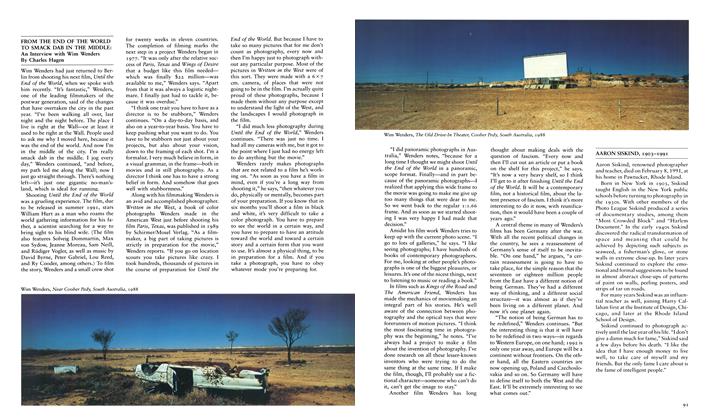
Aaron Siskind, 1903-1991
Spring 1991 -
 People And Ideas
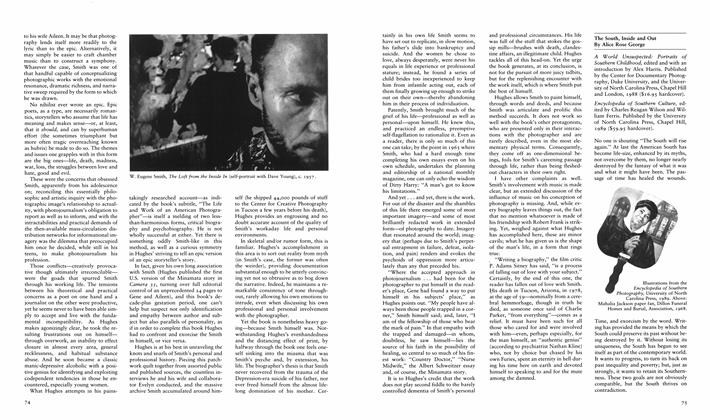
The South, Inside And Out
Early Summer 1990 -
 People And Ideas
Art Is Politics: A Review Of El Salvador And A Vanishing World
Fall 1984 -
 People And Ideas
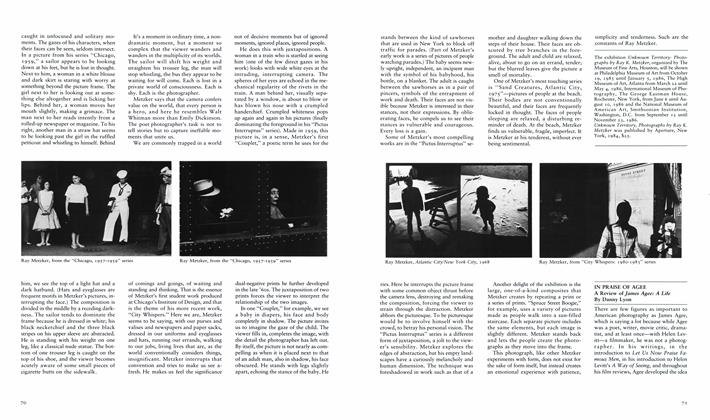
In Praise Of Agee: A Review Of James Agee; A Life
Fall 1985 -
 People And Ideas
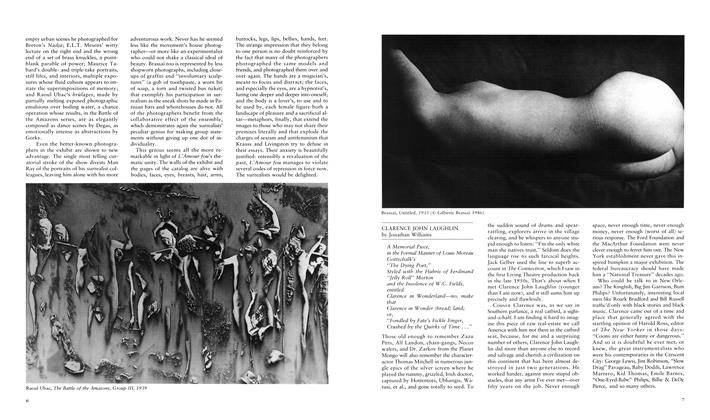
Clarence John Laughlin
Summer 1986 -
 People And Ideas
A One-Woman Show: An Interview With Marie Yolande St. Fleur
Winter 1992

