People And Ideas
Mariko Mori, Empty Dream Brooklyn Museum Of Art: April 8-August 15, 1999
Mariko Mori, Empty Dream Brooklyn Museum of Art: April 8-August 15, 1999
Lesley A. Martin
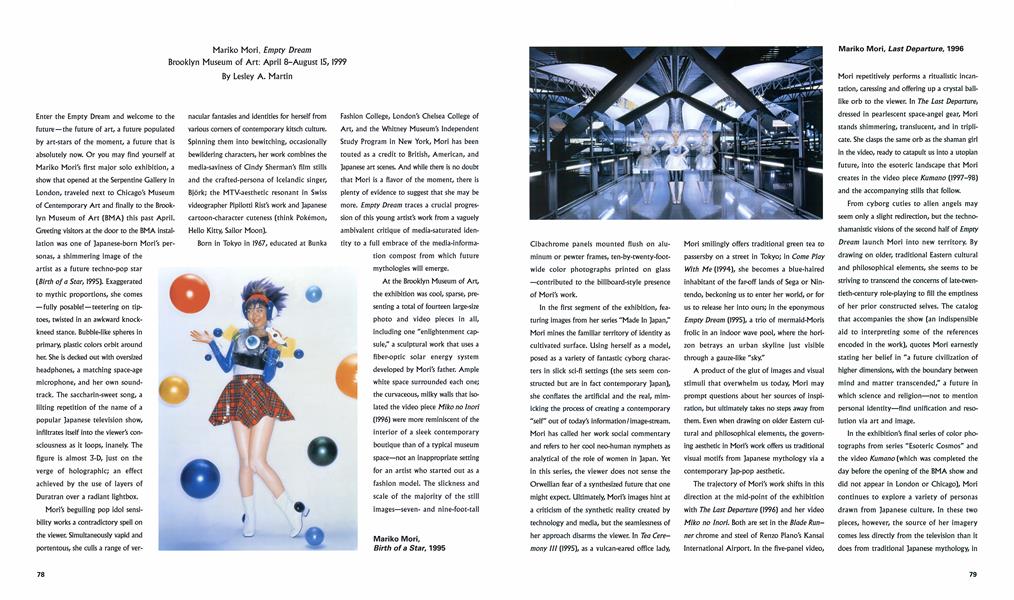
Enter the Empty Dream and welcome to the future—the future of art, a future populated by art-stars of the moment, a future that is absolutely now. Or you may find yourself at Mariko Mori's first major solo exhibition, a show that opened at the Serpentine Gallery in London, traveled next to Chicago's Museum of Centemporary Art and finally to the Brooklyn Museum of Art (BMA) this past April. Greeting visitors at the door to the BMA installation was one of Japanese-born Mori's personas, a shimmering image of the artist as a future techno-pop star [Birth of a Star, 1995). Exaggerated to mythic proportions, she comes — fully posable!—teetering on tiptoes, twisted in an awkward knockkneed stance. Bubble-like spheres in primary, plastic colors orbit around her. She is decked out with oversized headphones, a matching space-age microphone, and her own soundtrack. The saccharin-sweet song, a lilting repetition of the name of a popular Japanese television show, infiltrates itself into the viewer's consciousness as it loops, inanely. The figure is almost 3-D, just on the verge of holographic; an effect achieved by the use of layers of Duratran over a radiant lightbox.
Mori's beguiling pop idol sensibility works a contradictory spell on the viewer. Simultaneously vapid and portentous, she culls a range of vernacular fantasies and identities for herself from various corners of contemporary kitsch culture. Spinning them into bewitching, occasionally bewildering characters, her work combines the media-saviness of Cindy Sherman's film stills and the crafted-persona of Icelandic singer, Björk; the MTV-aesthetic resonant in Swiss videographer Pipilotti Rist's work and Japanese cartoon-character cuteness (think Pokémon, Hello Kitty, Sailor Moon).
Born in Tokyo in 1967, educated at Bunka Fashion College, London's Chelsea College of Art, and the Whitney Museum's Independent Study Program in New York, Mori has been touted as a credit to British, American, and Japanese art scenes. And while there is no doubt that Mori is a flavor of the moment, there is plenty of evidence to suggest that she may be more. Empty Dream traces a crucial progression of this young artist's work from a vaguely ambivalent critique of media-saturated identity to a full embrace of the media-information compost from which future mythologies will emerge.
At the Brooklyn Museum of Art, the exhibition was cool, sparse, presenting a total of fourteen large-size photo and video pieces in all, including one "enlightenment capsule," a sculptural work that uses a fiber-optic solar energy system white space by surrounded Mori's father. each Ample one; the curvaceous, milky walls that isolated the video piece Miko no Inori (1996) were more reminiscent of the interior of a sleek contemporary boutique than of a typical museum space—not an inappropriate setting for an artist who started out as a fashion model. The slickness and scale of the majority of the still images—sevenand nine-foot-tall Cibachrome panels mounted flush on aluminum or pewter frames, ten-by-twenty-footwide color photographs printed on glass —contributed to the billboard-style presence of Mori's work.
In the first segment of the exhibition, featuring images from her series "Made In Japan," Mori mines the familiar territory of identity as cultivated surface. Using herself as a model, posed as a variety of fantastic cyborg characters in slick sci-fi settings (the sets seem constructed but are in fact contemporary Japan), she conflates the artificial and the real, mimicking the process of creating a contemporary "self" out of today's information/image-stream. Mori has called her work social commentary and refers to her cool neo-human nymphets as analytical of the role of women in Japan. Yet in this series, the viewer does not sense the Orwellian fear of a synthesized future that one might expect. Ultimately, Mori's images hint at a criticism of the synthetic reality created by technology and media, but the seamlessness of her approach disarms the viewer. In Tea Ceremony III (1995), as a vulcan-eared office lady, Mori smilingly offers traditional green tea to passersby on a street in Tokyo; in Come Play With Me (1994), she becomes a blue-haired inhabitant of the far-off lands of Sega or Nintendo, beckoning us to enter her world, or for us to release her into ours; in the eponymous Empty Dream (1995), a trio of mermaid-Moris frolic in an indoor wave pool, where the horizon betrays an urban skyline just visible through a gauze-like "sky."
A product of the glut of images and visual stimuli that overwhelm us today, Mori may prompt questions about her sources of inspiration, but ultimately takes no steps away from them. Even when drawing on older Eastern cultural and philosophical elements, the governing aesthetic in Mori's work offers us traditional visual motifs from Japanese mythology via a contemporary Jap-pop aesthetic.
The trajectory of Mori's work shifts in this direction at the mid-point of the exhibition with The Last Departure (1996) and her video Mi ko no Inori. Both are set in the Blade Runner chrome and steel of Renzo Piano's Kansai International Airport. In the five-panel video, Mori repetitively performs a ritualistic incantation, caressing and offering up a crystal balllike orb to the viewer. In The Last Departure, dressed in pearlescent space-angel gear, Mori stands shimmering/ translucent, and in triplicate. She clasps the same orb as the shaman girl in the video, ready to catapult us into a utopian future, into the esoteric landscape that Mori creates in the video piece Kumano (1997-98) and the accompanying stills that follow.
From cyborg cutíes to alien angels may seem only a slight redirection, but the technoshamanistic visions of the second half of Empty Dream launch Mori into new territory. By drawing on older, traditional Eastern cultural and philosophical elements, she seems to be striving to transcend the concerns of Iate-twentieth-century role-playing to fill the emptiness of her prior constructed selves. The catalog that accompanies the show (an indispensible aid to interpreting some of the references encoded in the work), quotes Mori earnestly stating her belief in "a future civilization of higher dimensions, with the boundary between mind and matter transcended," a future in which science and religion—not to mention personal identity—find unification and resolution via art and image.
In the exhibition's final series of color photographs from series "Esoteric Cosmos" and the video Kumano (which was completed the day before the opening of the BMA show and did not appear in London or Chicago), Mori continues to explore a variety of personas drawn from Japanese culture. In these two pieces, however, the source of her imagery comes less directly from the television than it does from traditional Japanese mythology, in particular the mythology of Amida Buddhism. Amida Buddhism places an emphasis on magic, ritual, and ceremony; the visual image is considered a powerful tool of enlightenment and transcendence. And although the cartoon-ethos is certainly still present in this work, Mori moves away from Barbarella-like space vixens. Her focus is instead on a futurism that grounds itself in tradition and spirituality. Her new personas leave the future-metropolis behind and instead inhabit dense forests, undulating sand dunes and deserts, stalactite-rich caves, or the fantastically empty realm of a pink-hued paradise.
The 3-D installation Nirvana (1996-97), and the color photographic still Pure Land (1996— 98), most solidly unify the progression of Mori's concerns. In the BMA exhibition, the video was presented at the beginning of the exhibition, to the right of the entrance, and the still image at the end, creating a mobius-Iike progression through Mori's work, ending and beginning with the same incarnation of a transcendantly divine Mori. It's not difficult to imagine the disco star of her earlier piece in Birth of a Star reincarnated as this rave-kid boddhisattva. The threedimensional graphic effects of Nirvana are impressive, tantalizing, particularly when Mori, in a costume based on classic Buddhist iconography, floats gently toward the audience, scattering lotus petals. The petals appear to rain down toward the floor, directly into the viewers' 3D glasses. Hovering in Pure Land (also known as the Western Paradise of Amida Buddhism), Mori is encircled by candy-colored, computer-generated handmaids who accompany her chant with tweedling pipes and stringed instruments. The repetitious chant has changed from the banal incantation of a television theme song of the earlier piece into a spiritual invocation: "Kamitachi ni aitiai." (I want to meet the divine beings/god). Floating effortlessly above a lotus (an ancient symbol of awakening and of enlightenment), Mori cradles another crystalline droplet-shaped orb. As the video progresses, she sends it toward the viewer, so that it shimmers in suspension, jewel-like, an offering of radiating energy and light.
It is in pieces like Nirvana that Mariko Mori, who starts out simply as adorable, uses the superficial glaze of cartoon-inspired cuteness to draw us into spaces where spiritualism, traditional Japanese mythology, popular forms of imaging the self through fantasy, fashion, and other technologies blend. In the first phase of her work, Mori's images are invitations to a seductive fantasy of a cool, cyborg-populated future, where a star is not so much born as constructed. In the second phase of Mori's nascent cosmology, we become potential stars and may each be reborn as divine beings of our own creation. Mori's work reflects a shift in the collective popular imagination, which forages omnivorously for images to lift and recycle. As is evident in Empty Dream, it is precisely from such a media mulch that new meanings, new mythologies will arise.
Lesley A. Martin
People And Ideas
-
 People And Ideas
Into The Abyss
Fall 1993 -
 People And Ideas
Kurdistan: In The Shadow Of History
Spring 1998 -
 People And Ideas
The Photographs Of Josef Albers: A Selection From The Josef Albers Foundation
Spring 1988 -
 People And Ideas
A Forced Perspective: Aerial Photography And Fascist Propaganda
Summer 1993 -
 People And Ideas
Woman And Nature
Summer 1997 -
 People And Ideas
Other Americas
Winter 1987


