Part Iv
The Evolution Of An Ideal
The Evolution of an Ideal
PART IV
And sometime then there will be a history of how anything or everything comes out from every one, comes out from every one or any one from the beginning to the ending of the being in them.
—Gertrude Stein, The Making of the Americans
In 1936 Charis Wilson, at the age of twenty-two, posed for her fifty-year-old lover Edward Weston, in a series of photographs that might be grouped as the “dune nudes.The pictures were taken one morning near Oceano, California, and in a rare glimpse of a masterpiece from the subject’s point of view, she described the moments of their creation:
Altogether it was a magical place. The silence and emptiness, the beauty of the wind-sculptured forms, the absence of any living things beside ourselves—all these combined to give me an exhilarating sense of freedom. As soon as the sun warmed things up, I took off my clothes and went diving down a steep slope. ... I was reminded of the childhood games of statues as I kept returning to the top of the bank to relaunch myself, and each slide down ended in a more abandoned position.
By one definition, art is what artists make. Therein lies the implication that the more that is known about the life of a great artist, the more that can be discovered about the nature of his or her work—about the creative process itself. In such a context, few artists have been better served than Weston.
Along with portfolios appearing from time to time in the journal, Aperture’s contribution to the Weston iconography involves seven monographs. They are of course profoundly beautiful publications, but what most sets these monographs apart are the accompanying texts: writings that invoke the voices of Weston’s admirers, friends, family, and lovers. These texts include Ben Maddow’s classic biography of the photographer in Edward Weston: His Life; Charis Wilson’s remembrances for Edward Weston: Nudes (excerpted above) and for California and the West; and a biographical essay by Susan Morgan in the 1995 monograph devoted to his portraits. Aperture’s chief collaborator throughout has been Weston’s youngest son, Cole, who recreated to perfection Edward’s prints for publication, and who contributed his own recollections to the Weston saga.
And it was a saga, quintessential^ American. No one told it better than Weston himself in his Daybooks. Although there are fragments from earlier and later in the photographer’s life, these autobiographical writings span his most creative and productive years. In his huge, scrawling handwriting, Weston recounted his difficulties with money, marriage, conscience, and his devotion to his four sons. And there were rollicking accounts of life among artists, including those of the Mexican Renaissance such as José Orozco, Diego Rivera, and Tina Modotti—perhaps the greatest of Weston’s many loves.
But it is in the moments of revelation arising from his work that Weston’s journals rise to greatness. “I am not limiting myself to theories,” he wrote. “Dare to be irrational—keep free from formulae, open to any fresh impulse, fluid.” And elsewhere: “I have come to realize life as a coherent whole, and myself as a part, with rocks, trees, bones, cabbages, smokestacks, torsos, all interrelated, interdependent—each a symbol of the whole.” Such fragments barely hint at the delights of the Daybooks, in which Nancy Newhall’s editing in itself reached a level of brilliance. In the gathering of voices that have enriched Aperture publications, Nancy’s insights offered prescient guideposts to future generations of editors.
Her essay in the debut issue of Aperture, “The Caption: The Mutual Relation of Words/Photographs,” defined a new conception of the caption, which she called formally the additive caption. In contrast to the caption as title, miniature essay, or narrative, she wrote, the additive caption “leaps over facts and adds a new dimension. It combines its own connotations with those in the photograph to produce a new image in the mind of the spectator—sometimes an image totally unexpected and unforeseen, which exists in neither words nor photographs but only in their juxtaposition.”
During his editorship, Minor White experimented with image/word possibilities through poetry, dialogues, and other devices. The technical essays of the early issues were quickly abandoned, as were the advisories on “how to look at” or “read” photographs. As Michael Hoffman’s editorial tenure progressed, he continuously sought out writers, critics, poets, and especially the viewpoints and comments of contributing photographers.
Aperture’s place in the critical canon is largely defined by its mission of being true to the “artist’s intent.” Thus the goal is to deepen the viewer’s encounter with the images and their creators: to provide, as Michael once put it, “an entry point into the work.” The other dimensions of criticism—explication, analysis, and, automatically for some critics, abuse—are usually left to other venues.
In Aperture’s history, the marriage of image and word has met with notable successes, often achieved with agonizing effort— none more successful, nor more agonizing, than with that master of architectural photography, Clarence John Laughlin.
Laughlin was born on a Louisiana plantation in 1905 and remained a resident of New Orleans throughout his life. His 1948 book Ghosts Along the Mississippi, a portrayal of architectural survivals and relics of the Old South, was extraordinarily successful, and caught the attention of both Minor and Michael. Letters these two exchanged in 1966 abound with descriptions of Laughlin’s eccentricities, even as they pushed toward the creation of an exhibition and monograph devoted to the photographer.
On his first visit to Laughlin’s apartment in a rundown building on New Orleans’s Vieux Carré, Michael found himself in a gray room lit by a single yellow bulb, covered with dust, and surrounded by walls and stacks of books—more than fifteen thousand of them. Laughlin was, Michael said, “certainly one of the most well-read people in the entire universe.” And he clearly had his own tastes. As Michael recalled, “His refrigerator was filled with cans of Spam, like some creation of Andy Warhol’s. He had almost no money, and traveled by bus to work in a darkroom in the house of a wealthy friend, returning with the prints in a tray. He was an absolute master printer, although he used Sears & Roebuck varnish on them, which cracked horribly.” The prints, which Michael was there to see, were brought out parsimoniously, because the artist wished to discuss each one—endlessly. The place, circumstances of the making, the atmosphere . . . Michael would leave the room for a break only to return and discover that Laughlin had gone on talking, oblivious to his absence. And so it went over several years, until finally the Laughlin exhibition was mounted in Philadelphia and the Aperture monograph appeared in 1973.
Clarence John Laughlin: The Personal Eye would remain one of Michael’s favorite books not only because of the imagery, but also because of Jonathan Williams’s accompanying text, which characterizes Laughlin as “all phantasmagoria and gumbo—Archimboldo, ‘The Invasion of the Body Snatchers,’ Grandville, Belle Grove Plantation, the Wizard of Oz, and skillet cornbread . . . Bizarrerie.” The essay reads like a jukebox blaring a pastiche of jazz riffs, Cajun jigs, Eric Satie, and through it the rich, tempestuous sense of the artist emerges. Williams’s text was that rarity of Newhall’s ideal: merging word and image into a new medium.
Michael had embarked on a search for the images and artists, both past and present, that he believed needed to be brought before the public. There continued the endless pressure to raise funds and subventions, and to work with the myriad details and decisions of design and production. The Laughlin experience illustrates the enormous consumption of time each project required. Michael needed editorial help, and he also began to recognize that it was time for fresh perspectives. Although he chafed under the criticisms, Aperture was viewed by many as a publishing house limited to formal, classical, and above all “mystical” and “artistic” imagery deriving from the ascetic aesthetics of Stieglitz, Minor, and Michael himself. Aperture’s most severe critics called it “cultish” and “incestuous.”
Carole Kismaric had been one of the outstanding visual editors at Time-Life Books, involved with popular series on science, human behavior, and American history. She also was part of the editorial team that created the company’s influential “Photography” series. Researched, written, edited, and designed to the highest standards, the publications of Time-Life Books nonetheless offered little creative scope to the individual, and when Michael invited her to work at Aperture, Carole was ready for a change.
“I had thought little about photography as art,” Carole recalled years later. “I understood it as a powerful communicating device that had changed, and was continuing to change, our societies and our culture. But I thought, ‘I’ve spent years communicating to millions of people with the books Time-Life was doing. Why not communicate to a few thousand about things of quality, of intellectual challenge?’ I was supposed to stir things up.”
She was also supposed to bring a much-needed degree of professionalism into the editorial process, which Michael freely admitted he lacked. One of her early tasks was sifting through the backlog of submissions, and one group of photographs in particular led to her own vision of what photography, and Aperture, could accomplish.
What I remember most profoundly is looking at this one portfolio of Jerome Liebling’s photographs of cadavers and starting to cry. I was so present to the fragility of those cadavers; they were truly beautiful, and most people could not bear to look at beauty penetrating into this dimension of truth. . . . What I care about in photography is that it shows me something I’ve never seen before, that it documents our world and our experience of the world. But I’ve also been interested in the crossover—how the documentary experience extends in other dimensions of experience.
Aperture had never published anything like Liebling’s cadavers. That singular experience enabled Kismaric and Hoffman, despite their differing approaches to the medium, to discover what Proust called the “consanguinity of spirit,” which lets even the most opposite characters transcend differences. And Carole and Michael were indeed opposite characters, a study in complementary contrasts.
Michael was barely of medium height, with black hair and dark eyes, and rather stocky. He was extremely energetic and physically strong—ever burdened with tote bags and briefcases full of Aperture publications, maquettes of prospective books, and project proposals. He was always on the lookout for a deal. Carole was tall, slender, extremely elegant and gracious. They almost naturally fell into good cop/bad cop relationships with artists and writers. Michael could be a witty and utterly engaging conversationalist—but he also had a quicksilver temper and an amazing range of histrionic effects, from sweetly cheerful to full-fledged tantrum. Carole was invariably civil, simultaneously sympathetic and empathie. She could charm the birds down from the trees; Michael often sent them fleeing for cover.
Carole brought from Time-Life an extensive network of contacts among photographers and writers. She infused the journal with images and ideas relating to political and social issues that had been largely missing in Aperture since the death of Dorothea Lange in 1965. She also tapped into a new generation of documentarians with a grasp of deeper currents of the culture ranging from the exotic to the mundane: Danny Lyon’s Hell’s Angels and Texas convicts, Chauncey Hare’s technologically alienated home life, Larry Fink’s social gatherings, Garry Winogrand’s and Tod Papageorge’s street scenes found places alongside images by Atget, Strand, and Bullock.
From this point, at Carole’s instigation, Aperture subscribers would begin to have an entirely new experience—and among their numbers were those who, accustomed to unperturbing images of classical and romantic beauty, were not pleased. The Liebling cadavers, the homoerotic interpretation of Yukio Mishima by the Japanese master Eikoh Hosoe, and in particular the searing war images by Don McCullin brought storms of protests and subscription cancellations. Unexpectedly, the numbers of cancellations were balanced by a newly awakened interest among a more venturesome audience. The journal continued, slowly, to grow.
Confident in Carole’s stewardship of the journal and book projects, Michael was free to pursue his dream of transforming Aperture into a community of like-minded souls who would share his quest for “life beyond the ordinary.” Naming it the Silver Mountain Foundation, he envisioned a residential environment where individual creativity would be nurtured by communal living. His intangible hopes for Silver Mountain never materialized, but his expanded vision led to tangible results. It was during these few years in the early 1980s that Aperture created the Paul Strand Archive, the Photogravure Workshop, the Internship Program, and a gallery to exhibit the prints of published photographers. And Aperture, now officially a foundation, finally found a permanent home.
Housed in the five-story building that Shirley Burden had purchased for Aperture at 20 East 23rd Street in Manhattan, the new headquarters brought to an end Aperture’s thirty-year wanderings. The second-floor gallery was a long-cherished dream of Burden’s, but it wasn’t the only legacy of this member of a collateral branch of the legendary Vanderbilts. He was an accomplished artist in his own right. Following a brief career as a filmmaker in Hollywood, Burden had devoted himself to photography after World War II. He was a deeply religious man who brought a gentle vision to his subjects. He was also shy and unassertive, and his books were published with Aperture only at Michael’s insistence.
The late 1970s and early 1980s were a crucial period because the long struggle to have the medium recognized as an art form was being resolved. This was only in part due to the accomplishments of the artists. Collectors, connoisseurs, galleries, and museums were creating a new market. Prices were rising for the works of dead masters, in particular, but also for critically recognized members of the new generation. “Art photography” was beginning to be profitable. Still, a new art form—and photography had existed for only a few generations—remains a novelty until it is firmly placed within a tradition. It needs a history.
In this connection, Michael was undertaking seminal monographs of the medium’s past. One of the most triumphant resulted from a visit to New York in 1980 by Mark Haworth-Booth, then at the beginning of his long career as curator of photographs at the Victoria & Albert Museum in London. He brought with him a proposal for an ambitious project, The Golden Age of British Photography: 1839-1900. Haworth-Booth’s selection for the book ranged from Chauncey Hare Townshend, William Fox Talbot, and Roger Fenton through the early artistic ventures of Oscar Rejlander; the Victorian portraiture of Julia Margaret Cameron and Lewis Carroll, down to the early struggle for photography as an art waged
The Liebling cadavers, Eikoh Hoso es homoerotic work, and in particular the war images by Don Me Cull in brought storms of protest and subscription cancellations. Unexpectedly, the numbers of cancellations were balanced by a newly awakened interest among a more venturesome audience.
by P. H. Emerson. The Golden Age was more than a revelation of overlooked photographers; it was also a major addition to critical history. Haworth-Booth, who also wrote the book’s introductory essay, would go on to become one of Aperture’s most prolific contributors.
Michael’s understanding of the need for a historic tradition also found expression in elegant monographs devoted to the studies of cathedrals by Frederick Evans; to the portraiture of North American Indians by Edward Curtis; and to the largely neglected, and perhaps greatest, twentieth-century portraitist, August Sander.
Equally important to Michael was bringing the medium’s artists to a wider public through inexpensive, small-format books. A selection of Henri Cartier-Bresson’s acclaimed photographs introduced the Aperture “History of Photography” series in 1976, later retitled “Masters of Photography.” For the first time, audiences unable to afford Aperture’s more costly monographs had access to wellrendered images by Stieglitz, Strand, Weston, Eugène Atget, André Kertész, Man Ray, and others—a total to date of eighteen volumes in the series.
In the 1970s, Aperture also made its early ventures into what had been a prohibitively expensive domain of publishing: color photography. Stephen Shore’s vision of mainstream America— its seldom appreciated highways, byways, gas stations, small towns—was one of the early color efforts. This volume, Uncommon Places, was followed by Shore’s magnificent Gardens at Glverny: A View of Monet’s World. The search for printers capable of reproducing high-quality color, at a nonbankrupting price, had Aperture’s production expert Steve Baron journeying from Hong Kong to Italy, with numerous stops in between.
Meanwhile, Kismaric’s efforts with the journal led to discoveries of photographers with that most subtle of qualities: the literary sensibility. British photographer Bill Brandt revealed a gift for the genius loci in his studies for Literary Britain. And America’s literary heartland, the Deep South, inspired two artists whose photography came to light almost simultaneously in Aperture publications.
One of the best-loved storytellers of the twentieth century, Eudora Welty had at the beginning of her writing career carried a camera into the homes, churches, and neighborhoods of her black friends and acquaintances in Mississippi. The subjects in Welty’s photographs were treated with the same encompassing sense of kinship and warmth as they are in her short stories and novels.
William Christenberry was born in Hale County, Alabama, and his grandparents’ farm bordered that of the pseudonymous “Ricketts” family, the subject of Walker Evans’s and James Agee’s Depression-era collaboration, Let Us Now Praise Famous Men. Christenberry was a lifelong fan of Agee, inspired by the author’s famous supplication: “If I could do it, I would do no writing at all here. It would be photographs; the rest would be fragments of cloth, bits of cotton, lumps of earth, records of speech, pieces of wood and iron, phials of odors, plates of food and of excrement." And indeed, the photographer Christenberry made use of painting, found objects, and sculpture in his large, mysterious, sinister environmental work, “The Klan Room.” The expressive range of Christenberry’s talents, as well as his deep-seated dread of Klan influence in the South, were represented in resonant color reproductions in an Aperture monograph and in the journal.
The photographer whose literary gifts have most decisively influenced Aperture over the years was based in the West, near Colorado Springs. A former professor of literature, Robert Adams, and his wife Kerstin, were ardent conservationists, peace activists, and supporters of animal rights in an area where some of the most transcendent vistas of American nature were blighted by some of the worst excesses of American culture. Near his home were both a plutonium-producing nuclear-bomb factory and a nuclear power-plant; the landscape was disfigured by urban sprawl. Adams documented these blights upon land and lives. He also possessed a true landsman’s poetic instinct in his photographs of pristine prairies and grasslands, and scenes evoking universally felt moments in a series called “Summer Nights.” Adams’s perfectly composed images demand pause and considered attention. Michael was to become one of Adams’s most devoted supporters; Aperture has published no fewer than six monographs of his work, as well as portfolios in the journal. Adams also brought to the medium his gifts as a critic with two volumes of essays: Beauty in Photography: Essays in Defense of Traditional Values and Why People Photograph.
Michael once remarked, “When you look backward too much, you get turned into a pillar of salt.” By 1980, he felt a need for personal renewal. Inspired in part by Dorothy Norman—who had had close personal relationships with Mahatma Gandhi and Prime Ministers Jawaharlal Nehru and Indira Gandhi—Michael set out for a prolonged pilgrimage to India. His only companion was the Temple edition of Dante’s Divine Comedy. His travels and the poem worked their wonders, each with rippling implications for Aperture in the ensuing years.
The most significant event in Michael’s Indian journey was the first of many encounters with the Dalai Lama, beginning a close association that would subsequently lead to Aperture’s publications Tibet: The Sacred Realm, Photographs 1880-1950 and Tibet Since 1950: Silence, Prison, or Exile, two historic monographs documenting life before and after the Chinese invasion and occupation. Journey to Enlightenment, with photographs and narrative by Matthieu Ricard, celebrates the life and teachings of the Tibetan spiritual master Khyentse Rinpoche. Other volumes devoted to the photographers and imagery of India became staples of the
“Ive felt almost a sense of obeisance to these ghosts, these spirits that Ive had the privilege of being related to, a responsibility in my act of service to provide for a continuation of their qualities, of their ideas. ”
Aperture library. Michael, who felt he had found a second home on the subcontinent, seldom let a year pass without visiting it.
Michael had read Dante at college, but the long hours spent in the poet’s company during his first Indian journey led to a lifelong study. New interns at Aperture to whom he gave copies were shocked to find that reading the epic seemed to be a prerequisite for a successful apprenticeship (in later years, Michael would add the gargantuan Mahabharata to the list of required reading). As he once remarked to Robert Adams, “I go back to Dante because he seems to offer a key in the search from darkness to light.”
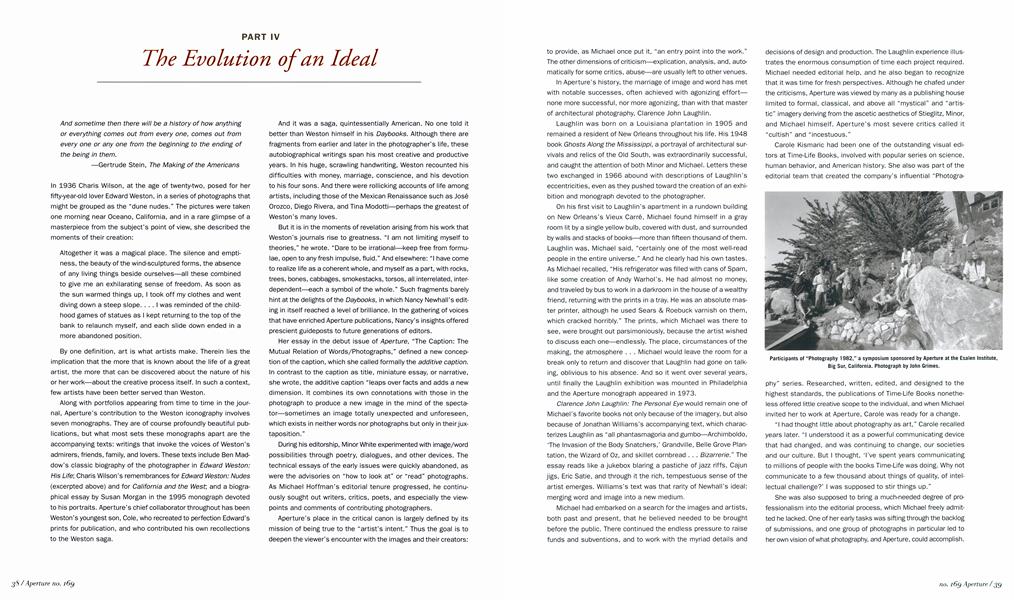
His own energies refreshed, Michael felt that Aperture, too, was ready for revitalization. He and Kismaric believed that there was a need for more meaningful dialogue among the arts, and together they organized an extraordinary conference of poets, performance artists, graphic artists, curators, writers, and critics, along with photographers William Christenberry, Ray Metzker, Linda O’Connor, Frank Gohlke, Sigfried Halus, and Raymond Depardon. The group convened at the Esalen Institute on California’s Big Sur coast in November 1982. In an ensuing manifesto, they recognized a “growing climate of public restraint, the complexities and dangers of the age, the prevalence of mechanization and dehumanizing technique, [which] encroach upon the individual, the society, and the human adventure itself.” Within this context, the group statement continued, “an artist is an awakener: to the surrounding world, to dimensions of the human spirit, and, when necessary, to the need for action.”
In subtle ways, the conference guided Aperture’s direction during the remainder of the decade and beyond. After Kismaric left Aperture in 1984 to pursue new creative challenges, a soft-spoken, dynamic young Englishman, Mark Holborn, was named editor. Michael enabled Holborn to pursue his passion for Japanese art and photography in three unprecedented publications, Black Sun: The Eyes of Four, featuring the photographs of Masahisa Fukase, Eikoh Hosoe, Daido Moriyama, and Shomei Tomatsu; BA.RA.KEI.: Ordeal by Roses, Hosoe’s controversial tribute to Mishima; and a volume devoted to the fantastic theater of Butoh. Marilyn Bridges’s amazing aerial studies of ancient earthworks were featured in the monograph Markings. Holborn also helped shepherd Nan Goldin’s The Ballad of Sexual Dependency through publication even as she brought its source, an uproarious, emotional slide show, with commentary, into Aperture’s Burden Gallery.
After Kismaric and Holborn, there was a considerable turnover of Aperture editors and guest editors: a succession of highly talented individuals, each of whom left their mark. These included Charles Hagen, Steve Dietz, Nan Richardson, Lawrence Frascella, Rebecca Busselle, Peggy Roalf, Michael Sand, and Andrew Wilkes. Under their helms through most of the 1980s, and then into the 1990s, the journal shifted to thematic approaches. These issues were devoted to such subjects as the relationship of photography and drawing, including a number of rapid-fire sketches by CartierBresson; to technology and transformation; to connoisseurs and collecting; to fashion photography; and to varieties and experiments in communal living.
It was during this period that Aperture also became a truly international journal of photography. Michael’s powers of persuasion had reached new heights when he wrested from the Communist bureaucracy in Czechoslovakia the masterpieces by a long-overlooked genius, Josef Sudek, for the exhibition and monograph Poet of Prague. The most influential and innovative photographers would be represented in issues of the journal devoted to France, Italy, Germany, Japan, Cuba, and Spain. India was a continuing subject of Aperture monographs, including the mammoth volume in tribute to the country’s golden anniversary of freedom from colonial rule, India: A Celebration of Independence.
Editorial stability was achieved—and editorial content grew yet more adventurous—when Melissa Harris, who had first joined Aperture in 1989, took over the journal, as well as selected book projects, in 1992. Melissa brought to the work a unique background that ranged from teaching multimedia collaboration at Yale University (her alma mater) to her editing job at Artforum magazine. Along with her breadth of interests in the arts, she also brought to Aperture deeply felt concerns about political, social, and moral issues. Harris challenged complacency and sanctimony as no previous editor had done. Early on, censorial objections were raised—and dismissed—by her fearless compilation issue/monograph “The Body in Question.” Later, Melissa brought to publication Eugene Richards’s dark yet compassionate chronicle of drug addition; Sally Mann’s poignant portrayals of childhood; Mary Ellen Marks’s edgy photoessays; Donna Ferrato’s exposé of domestic violence; Letizia Battaglia’s probing of mafioso evil rife in Sicily; the chaotic dynamism of bordertown life in Juárez: The Laboratory of Our Future, a photographic anthology with texts by Charles Bowden, Eduardo Galeano, and Noam Chomsky; and an issue and monograph devoted to the life, work, and terrible affliction from AIDS of the artist David Wojnarowicz. A champion of the dauntless eye, Harris also fostered definitive monographs on geniuses of other media, including dancer-choreographer Merce Cunningham and the controversial, worthy heir of Italian commedia dell’arte, Nobel laureate Dario Fo.
For editors, curators, and spectators, the power of fine photography is in large measure the power of surprise: “What I have never seen before,” as Carole Kismaric put it. This has nothing to do with the pursuit of faddish “newness” or of shock value for its own sake—all too often the purview of “art biz” in modish galleries. Surprise, as John Szarkowski has pointed out, is primarily about enlargement of vision and experience.
Space allows mention of only a few instances of such surprises in recent Aperture history. Among them: Young British photographer Nick Waplington, whose color profiles of working-class families in Nottingham unveiled a new dimension of intimate theater in documentary photography. Robert Glenn Ketchum’s color landscapes of the Tongass helped save the last North American rainforest from untrammeled development. Michiko Kon’s constructions from the wares of fishmongers of Japan brought new wit to still lifes. Mimmo Jodice’s lens refocused the mythical impressions of ancient Mediterranean civilization and the romance of presentday Paris. Joel-Peter Witkin’s comic-grotesque tableaux, which have been featured in the magazine, transmogrified studio photography. Graciela Iturbide unveiled dreamlike encounters with the commonplaces of Mexican life. And Neil Folberg, in Celestial Nights, created new thresholds of mystical contemplation.
And of the wordsmiths’ contributions. . . . Arthur Miller on his wife Inge Morath’s photography; Czeslaw Milosz on Czech photographer Josef Koudelka; Larry McMurtry on the rodeo scenarios of Louise Serpa; Adam Gopnik on Parisian life and times. There were the self-scripted playlets of Duane Michals, the self-captioned album of Allen Ginsberg. Writers who expanded the encounter with photographic experience notably included Szarkowski, John Berger, Susan Sontag, and Andy Grundberg. Insights from kindred media were offered up by David Byrne, Karen Finley, and John Waters. Acclaimed literary figures include Annie Proulx, Paul Bowles, Reynolds Price, Marguerite Duras, and V. S. Naipaul. And finally, there have popped up surprising contributors across a spectrum from Muhammad AN to Aung San Suu Kyi.
Aperture’s list of artists and writers is as varied and distinguished as contemporary world culture has to offer. These brief mentions are a fraction of the hundreds who have appeared in the journal and monographs. Such a plethora of omissions!
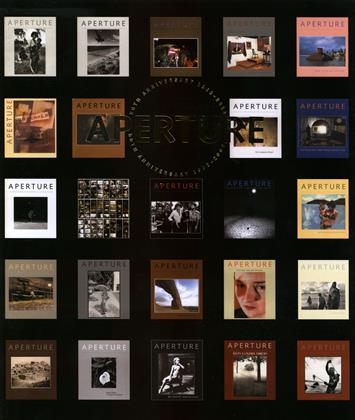
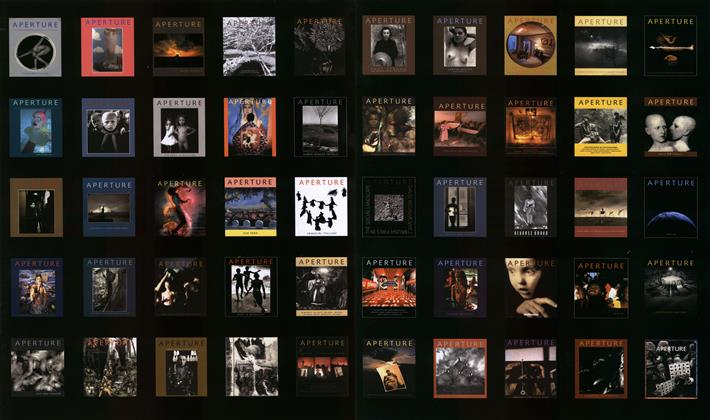
With the fiftieth anniversary approaching, Michael reflected on his own experience with Aperture as what he called the “evolution of an ideal.” It is an ideal never articulated to anyone’s intellectual satisfaction, but manifests in the artists and their work.
Evolution is a process of increase: of numbers, of complexity, of diversity. Evolution, in a word, is about more. To understand its workings, especially in terms of something as ambiguous as an ideal, it may be helpful to trace a lineage: in this instance, from the photo-reportage of Aperture’s activist-founder Dorothea Lange, to photography’s preeminent turn-of-the-twenty-first-century chronicler, Brazilian Sebastiào Salgado.
The parallels are obvious. Both Lange and Salgado have recorded the lives of workers, their families, and displacing forces beyond their control. Both are artists of the highest order, even as they
have wedded their imagery to social science; both have worked in close partnership with their spouses (for Lange, the social scientist Paul Taylor; for Salgado, the designer and manager of his projects, Lélia Wanick Salgado). Lange ranged across the United States during the peak years of the Depression; her subjects included the urban unemployed, tenant farmers, and families driven from farmlands by ecological disaster. Salgado has ranged the globe. If his subjects, like Lange’s, are workers and migrants, they are far more than victims of temporary circumstance. They have been irresistibly swept up in Tolstoyan shifts of history.
For Workers: An Archaeology of the Industrial Age, Salgado took his cameras into the plantations, factories, fishing villages, mines, slaughterhouses, oil fields, and shipyards in nearly a score of countries. His camera vision ranged from panoramas of tens of thousands of antlike miners in the gold-ore pits of Brazil to candid eye contact with young women on the tea plantations of Central Africa. Workers occupied Salgado for nearly seven years. He devoted the next six years to Migrations, traveling to forty countries where humanity by the tens of millions has been forced into the life of refugee, exile, and migrant by war, repression, poverty, and environmental catastrophe.
Migrations was published at the beginning of the new millennium, and it was also in 2000 that Melissa Harris undertook an evolutionary leap in the content of the journal. It was in response, she wrote in an editorial, “to the shifting boundaries between media, and to the remarkable range of cross-cultural experiences that photography now addresses.” With a bold transformation in design by Yolanda Cuomo, the new Aperture was to be increasingly diverse, with the “potential to motivate, to incite, to infuriate, to enrapture, to change minds, to change lives.”
Even as Michael was reflecting upon “the evolution of an ideal,” he was grumbling about his own personal evolution. Now in his fifties, he complained that he was becoming a curmudgeon. In fact, as old friends such as Haworth-Booth observed, quite the opposite was happening. Although his temper could still be mercurial, Michael was in fact becoming . . . well, almost mellowed. In 1998, Michael and Melissa were married. Two years later, Michael’s first grandchild, Isabel Katharine, the daughter of Michael’s son Matthew and his wife, was born in December 2000.
With the beginning of 2001, momentum gathered for the publications, exhibition, and other events marking Aperture’s fiftieth anniversary. Michael and Melissa were determined that the occasion should be focused upon the future. Melissa and her staff sent out requests for new work to more than one hundred artists. The Burden Gallery was closed to make space for laying out, selecting, and sequencing images. At the Millerton complex, longtime archivist and master conservator Anthony Montoya oversaw printing and framing of selected images. Wendy Byrne was at work
designing and re-designing journal issues devoted to the occasion. And throughout the New York headquarters, staff and interns were involved in fund-raising, publicity, scheduling, and the endless details of finance and bookkeeping. Meanwhile, the Foundation’s trustees were keeping watch, appropriately trustful but not without some anxiety: they, too, had reputations at stake. Michael, as ever, was involved in every single detail.
Then, in mid August of 2001, Michael was taken seriously ill and admitted to New York Hospital. Throughout the following weeks, including the horrible September of the terrorist attacks on Manhattan’s World Trade Center, he fought the illness. Still, at Aperture, the work continued, always awaiting Michael’s approval or changes. For nearly four decades, he had decided upon the selection and sequencing of photographs, the design, the printing, the hanging of exhibitions. It was inconceivable that Michael would not be back. But on November 23, the meningitis diagnosed exhausted even his seemingly invincible life force. Michael died of complications from the disease at age fifty-nine.
It seemed unbelievable, unthinkable, then and it still does months later, at the time of this writing. That Michael died. More than the passing of a single man, it was as if a roomful of animated, irreplaceable, utterly alive people had suddenly vanished, never to return. The shock, of course, was felt deeply at Aperture, but the work went on. The fiftieth anniversary took on special meaning as a tribute to the man who had made it possible.
On a personal note, I began the interviews with Michael which were to be the basis for this essay in February 2001 at Esalen. The next sessions took place at his Shekomeko farm in late July. On our final day of discussions, relaxing in the late afternoon with Leonard Cohen’s music in the background, I put to him a question I had raised often during our twenty-five years of collaboration and friendship: “Michael, why did you do this, devote your life to Aperture?” In the past, he’d shrugged it off, usually with: “I was unemployable anywhere else.” On this occasion, he did answer, and spoke of Stieglitz, Minor, Ansel, Nancy, Weston, and the other Founders and shaping artists of Aperture’s beginnings. He spoke carefully, as if he had been thinking about it for some time:
I’ve felt almost a sense of obeisance to these ghosts, these spirits that I’ve had the privilege of being related to, a responsibility in my act of service to provide for a continuation of their qualities, of their ideals.
And that was what he intended for Aperture’s fiftieth anniversary, to be a celebration of trust, of continuity, and above all of service to those artists who will make photography’s future.
The most important reason for me to come to Genoa is to tell people on the radio what really happens here, because official media do not tell the truth. -Man, Italy
People are still dying in Bhopal. Over 20,000 have died and those born after the disaster have growth and menstrual problems.
Over 120,000 are still suffering from chronic diseases of the eyes, brain, reproductive and immune systems.
Five thousand metric tons of chemicals were dumped into the ground inside and outside the factory-it's gone into the drinking water, the only source of drinking water for ten communities.
Union Carbide evades justice and now it has sold itself to Dow Chemical. -Man, India
For me, ecology and equality of all peoples are the same subject.
If you have a factory and employ thousands of people under the lowest conditions or you are dumping chemicals it's the same-you have no respect for life.
The economy is ruling the world. -Declined to reveal nationality
For work to be really alive to me, it has to engage with the world. I may talk about spiritual matters, I may talk about transcendental things. But to me, you don’t have those qualities without engaging in heaven and hell, because you don’t know one without the other. And I don’t mean to get into a Calvinist dichotomy here, or even to suggest that I see things totally in terms of darkness and light. Not at all. It’s only a metaphor for my concerns.
I think the greatest photographic work is that which has somehow engaged with the depths and the heights of the possibilities of our experience. . . .
—Michael E. Hoffman, from an interview with Robert Adams, Aperture 129, 1992
One view of photography is that it is a zen-like act which captures reality with its pants down—so that the vital click shows the anatomy bare. In this, the photographer is invisible but essential. A computer releasing the shutter would always miss the special moment that the human sensibility can register. For this work, the photographer’s instinct is his aid, his personality a hindrance.
—Peter Brook, Aperture voI. 13, no. 2, 1967
Given the lack of public skills in reading photographs, given that photographic content is sometimes buried in beauty, contemporary landscape photographers are often condemned to making pretty pictures. Dramatic clouds and sifting light can overwhelm more mundane information. Yet who can resist beautiful landscape pictures of one kind or another? Not I. The role of aestheticization is the thorniest issue within the already difficult process of communicating not only how a landscape looks, or seems, but how it is, and, most significantly, how it became that way. . . .
—Lucy R. Lippard, from “Outside (But Not Necessarily Beyond) the Landscape,” Aperture 150, 1998
Photographers who can teach us to love even vacant lots will do so out of the same sense of wholeness that inspired the wilderness photographers of the past twenty-five years (the deepest joy possible in wilderness is, most would agree, the mysterious realization of one’s alliance with it). Beauty,
Coleridge wrote, is based in “the unity of the manifold, the coalescence of the diverse.” In this large sense, beautiful photographs of contemporary America will lead us out into daily life by giving us a new understanding of and tolerance for what previously seemed only anarchic and threatening.
—Robert Adams, from “Inhabited Nature,” Aperture 81,1978
Photography’s potential as a great image-maker and communicator is really no different from the same potential in the best poetry where familiar, everyday words, placed within a special context, can soar above the intellect and touch subtle reality in a unique way.
—Paul Caponigro, Aperture \iol. 13, no. 1, 1967
You see, the extraordinary thing about photography is that it's a truly popular medium. . . . But this has nothing to do with the art of photography even though the same materials and the same mechanical devices are used. Thoreau said years ago, “You can’t say more than you see.” No matter what lens you use, no matter what the speed of the film is, no matter how you develop it, no matter how you print it, you cannot say more than you see. That’s what that means, and that’s the truth.
—Paul Strand, Aperture vol. 19, no. 1, 1974
Postpone judgment! When starting to read, experience or take part in a photograph (or picture of any kind) first put aside both like and dislike. Leave criticism to the last, or better still forget to criticize.
—Minor White and Walter Chappell, from “Some Methods for Experiencing Photographs,” Aperture vol. 5, no. 4, 1957
Warning: If experiencing a photograph can not be done with some of the abandon of a boy riding a bicycle, or children wading in the gutters after a rain, there is no reason to experience photographs.
Minor White and Walter Chappell from “Some Methods for Experiencing Photographs,” Aperture \iol. 5, no. 4, 1957