Work And Process
Elemental Vision: Matter, Paradox And Other Absorptions Of Doug And Mike Starn
ELEMENTAL VISION: MATTER, PARADOX AND OTHER ABSORPTIONS OF Doug and Mike Starn
WORK AND PROCESS
FREDERICK KAUFMAN
“{Chemistry is) that part of natural philosophy which relates to those intimate actions of bodies upon each other, by which their appearances are altered, and their individuality destroyed. ” -SIR HUMPHRY DAVY (1778-1829)
Begin with a burned piece of wood, disfigured by what consumed it, blackened by light, entirely unique, entirely common, a mass of pure carbon.
Fact about carbon: it conducts electricity.
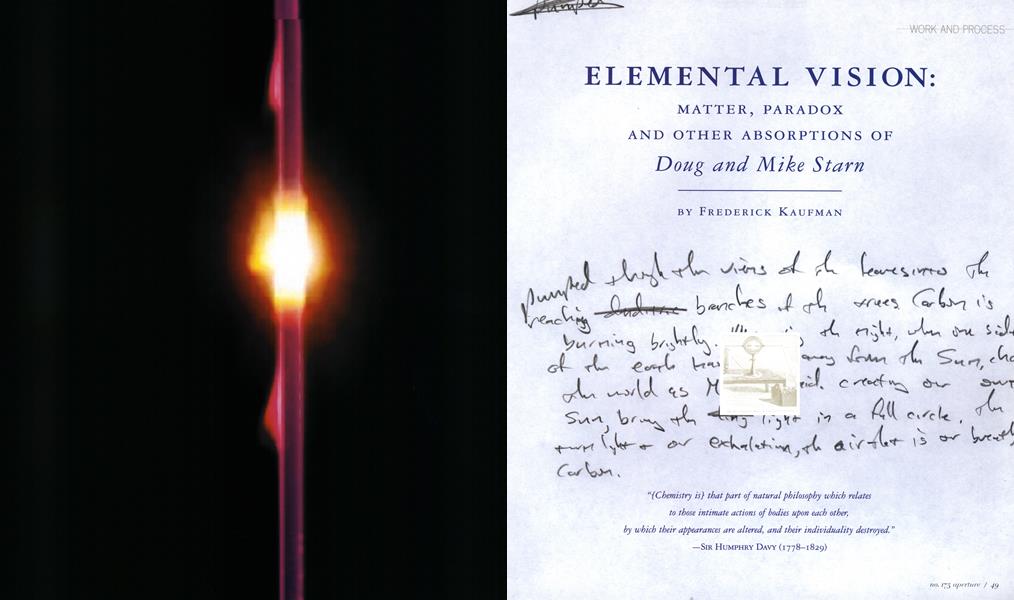
Now to Brooklyn, and not the best part: west of the Brooklyn-Queens Expressway, across the street from a ramshackle truck garage, inside a darkened space hung with monumental photographs. In the middle of Mike and Doug Starn’s studio stands a contraption that looks like it has been transported from some nineteenth-century mad scientist’s laboratory—which, in theory, it has. The Starns have been reading about chemistry, physics, botany, biology, the history of science. They have been contemplating the fact that nearly two hundred years ago a man named Humphry Davy, a close friend of William Wordsworth and Samuel Taylor Coleridge, used the power generated by a great voltaic battery of two thousand zinc plates to overwhelm the scientific world with the world’s first carbon-arc lamp. That contraption in the middle of the Starns’ studio duplicates the basic elements of Davy’s electrochemical apparatus: it is their own, modern carbon-arc lamp. When Mike Starn plugs it in, something hairraising happens.
In 1809, Davy reported in the Journal of the Royal Institution: “The communication between the points positively and negatively electrified was made in air rarefied . . . and by withdrawing the points from each other the discharge was made through six or seven inches, producing a most beautiful coruscation of purple light.”
In the Starns’ darkened studio, the electricity and the chemicals have coalesced into an empyrean radiance. The white-hot carbon filaments have arced and a seething bolt of lightning quivers between them. As though enraged by the fact it has been forced to reveal itself, the mesmerizing combustion hisses and sputters and sends up a cloud of poison gas and throws razor shadows against the towering walls of eerie photographs.
Davy used the carbon arc to decompose compounds, to strip them down to their essential elements. The Starns use the arc to enlighten the distillations of their own most recent compounds—mouthless moths, blind seers, dessicated leaves, dendritic trees—and to throw these images into sharp relief for anyone who enters their solar system. It is a victory for Doug and Mike Starn, this realization of their drive to cross disciplines, to ally art with science and philosophy, and then to display their comprehensive vision as one organic whole. Which is why black strips of humble carbon—reincarnated by blasts of electrons into a pillar of blinding light—are the sole source of illumination for their latest installation, “Gravity of Light,” now touring Europe.
As their choice of carbon-arc illumination makes clear, the Starns do not work to produce images of indexical likeness so much as they toil to create emblems. An emblem contains multitudes; an emblem suggests that all experience, and all intuition of all possible experience, might be contained within itself. The Starns know a burned piece of wood is only the most familiar of carbon’s numerous allotropes: smooth graphite, slick petroleum, hard diamond. Carbon provides scientific proof that structure does not define composition. A single, elemental idea can be expressed in many ways.
The Starns labor far beneath the apparent solidity and stability of matter; they twist and connect and project fundamental phenomena. To stand beside their carbon-arc lamp is to stand at the origin, a place where all matter, gravity, and light have returned to their primordial unity— and then been explosively released. It is to revisit the moment when the eyeless, mouthless attractions began, and the earliest, intricate ligatures of life and death. The carbonarc lamp illuminates the fearful symmetries of seemingly disparate emblems: trees, leaves, moths, the growth of synapses in the brain, and a Chinese monk called Ganjin.
The moths define the elemental force of attraction; their beauty is incidental. They are emblematic, enslaved by light as we are enslaved by that which we desire. “The gravity of light pulls them from nowhere,” note the Starns. Humble and blind, the moths flutter toward annihilation, toward blackness. Yet that very blackness, in the botanical philosophy of the Starns, is “both the void and the reservoir of what we need.” As void, blackness takes us beyond desire; as reservoir, blackness aligns with potential, the pure carbon of a burned piece of wood, waiting to be energized. So the moths perform a paradox.
Leaves, like moths, are avatars of light and darkness. “Carbon dioxide is inhaled on the underside of the leaf,” explain the Starns. Subsequent exhalations of oxygen leave the lustrous carbon traces that mark the artists’ “Black Pulse” series. Stripped, pared down, isolated, scanned, enlarged, refined, remapped—dead leaves have been processed into an elegiac realm: the elegy of ethereal carbon dioxide to plain, burned-out carbon, the elegy of light to darkness. Blackness flows into the viewer’s eyes, nerves, veins. The veins of these dead leaves pulse with soaked carbon, the black source of energy.
“Trees are transcribed thought,” the Starns say. “This is light written in the calligraphy of the sun.” Trees arc toward the source they cannot see, as our brains, in all their intricacy, seek what they cannot realize. The Starns have discovered that the dizzying bifurcations of synapses and the hauntingly fragile pattern of tree branches create nearly identical designs. Such extravagant mirrorings, uncannily reticulated, reveal our alliance to the systems within which we find ourselves. We, too, are emblems.
The Chinese monk Ganjin defines what the Starns call the “coincidence of opposites.” There his statue sits, smiling, content with its darkness—for Ganjin was blind. More than a thousand years ago he brought hierarchy and order to Japanese Buddhism so that the transcendental realms of philosophy could not only be contemplated, but lived. Ganjin saw the moral and ethical truths inherent within structure, he saw that spirit could become concrete, saw that every act—from the hailing of a friend to the consumption of a bowl of rice—had its necessary angel.
The Starns know that anything that absorbs light becomes black. They are struck by the esoteric unification of opposites. How else could the positive and negative poles of an electrical circuit create light?
Now the brothers are pushing forward, structuring the darkness with their own centripetal light, stretching toward new confluences, toward a time when the disciplines, now ridden with borders, constrictions, and subsets, will fuse. A time when physics, biology, and chemistry will realign with moral and aesthetic drives. And so they blast image-making to its core. They throw open the doors of the sealed laboratory to reveal the kinship of the animate and the inanimate, the familiar and the arcane, a lump of charcoal and a diamond. Their fated moths and fallen leaves and dark-lit trees recall our own longing for transmutation, even at the price of death. ©
Exhibitions of Doug and Mike Siam’s work will be on view at the Neuberger Museum of Art, Purchase College, State University of New York, through August 8, 2004, and at the Fargfabriken Kunsthalle, Stockholm in Spring 2004.
More From This Issue
-
 On Location
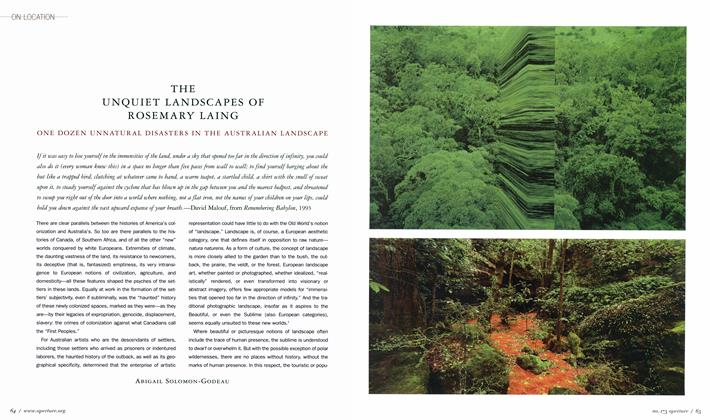
The Unquiet Landscapes Of Rosemary Laing
Summer 2004 -
 Roads Less Traveled
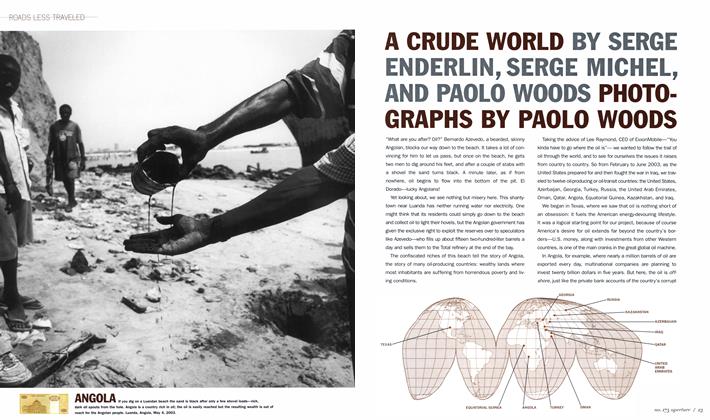
A Crude World
Summer 2004 -
 Profile
Donna Ferrato On Libido Road
Summer 2004 -
 Mixing The Media
Elaine Reichek Stitchellated Pics
Summer 2004 -
 Meetings
10 Years: From Analog To Digital: Zonezero
Summer 2004 -
 Notes
NotesNotes
Summer 2004
Frederick Kaufman
Work And Process
-
 Work And Process
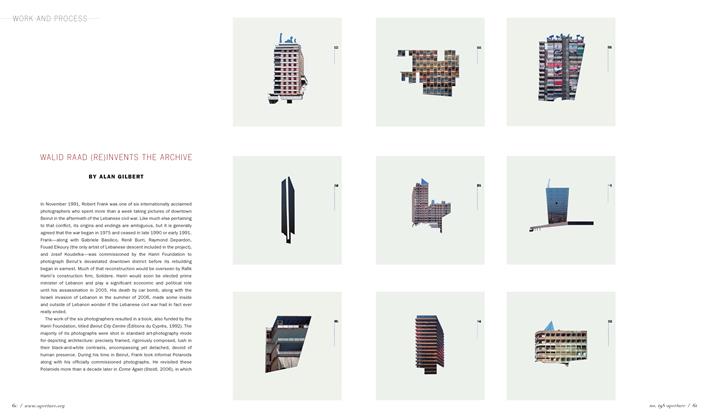
Walid Raad (re)invents The Archive
Spring 2010 -
 Work And Process
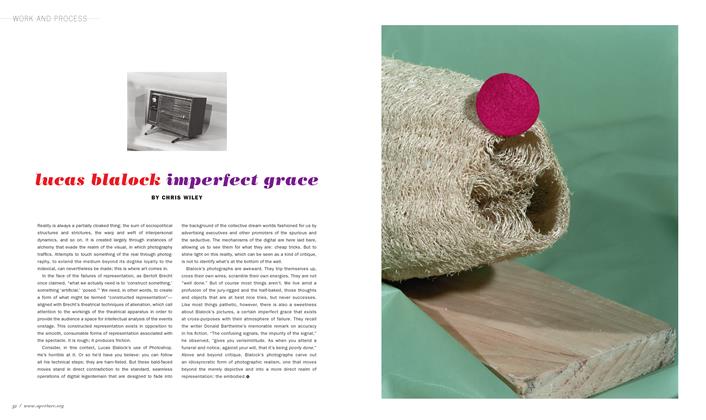
Lucas Blalock
Fall 2012 -
 Work And Process
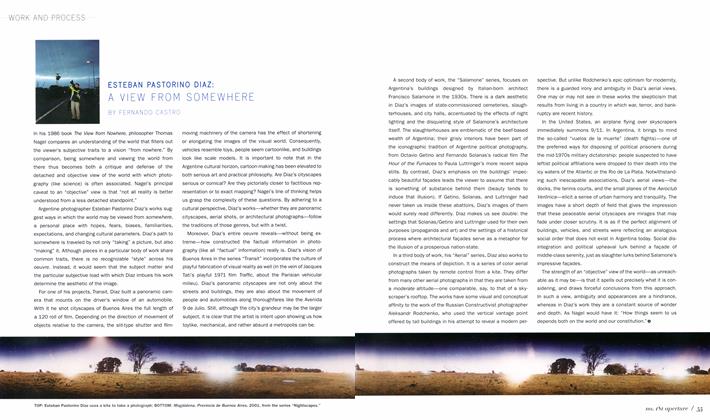
Esteban Pastorino Diaz: A View From Somewhere
Winter 2005 -
 Work And Process
Helen Sear Looking At Looking
Summer 2011 -
 Work And Process
Hara Mikiko Is As It
Winter 2007 -
 Work And Process
The Shadow Of The World James Welling's Cameraless And Abstract Photography
Spring 2008


