LAMENT OF THE IMAGES
MIXING THE MEDIA
ALFREDO JAAR AND THE ETHICS OF REPRESENTATION
ABIGAIL SOLOMON-GODEAU
In August of 1994, four weeks after the genocide in Rwanda had taken its course and an estimated one million Rwandese men, women, and children, mostly Tutsi, lay slaughtered, Alfredo Jaar arrived in Kigali with his assistant, Carlos Vásquez, bringing with them film, cameras, and other recording material. Jaar, a Chilean-born, New York-based artist of international reputation, was by no means the first foreigner to have arrived there with a camera. Throughout the previous three months, during which the genocide continued and the international community did nothing, photojournalists and TV cameramen had recorded the carnage, including footage broadcast on American television showing Tutsis hacked to death with machetes.
What distinguished Jaar’s presence on the scene was that he made his pilgrimage to the killing fields as an artist, not as a journalist. What did it mean for an artist, albeit one identified as “political,” to go to Rwanda as a self-appointed witness of the aftermath of genocide, and then, during the following four years, to make artworks based on that act of witnessing? How ought we to think about the use of catastrophe as the subject of art, and perhaps more important, to what ends are artistic practices such as Jaar’s directed?
Such questions are by no means new. They have been raised each time artists have taken on subjects such as the Holocaust, war, or other crimes against humanity as foci of their work, which is not to say that these questions necessarily have hard and fast answers. Obviously, much depends on the nature of the artwork itself, but visual art poses a set of issues that are not raised by textual forms. This is evident in the fact that fictional accounts of the Holocaust are numerous, but—outside of film— there are relatively few examples among the visual arts where genocide is the subject of the work. This disproportion in cultural production between textual and (nonfilmic) visual forms follows from the material specificity of the media involved. The individual reader of a poem or novel creates her own mental images of what is recounted on the page. Visual representation, however, especially in photographic form, is frozen once and for all, a static artifact that is far less amenable to the spectator’s own interiorized re-vision.
Moreover, divorced from duration and temporality and fixed on its paper or celluloid support, the photographic image is a kind of brute and speechless fact, an arrest of a sight, whose possible claim on the viewer generally endures only for the time of viewing. There are, of course, any number of photographers, including those designated as artists (I am thinking here of Sebastiäo Salgado), who represent catastrophe in the form of aestheticized photographic imagery: beautiful, poignant images of calamity, misery, and extremity. But this type of production tends not to acknowledge, or indeed manifest, much awareness of the ethical problems such forms of representation actually pose, including the problem of aestheticism itself. To these I shall return, but the explanatory limits of any given photographic image, its inability to indicate causality, has been critically noted at least since the 1930s. “Images,” Jaar has said, quoting the Catalán poet Vincenç Altaic», “have an advanced religion; they bury history.”1
Accordingly, for certain artists who address the catastrophic in its myriad incarnations and who desire their work to bear witness within the institutional spaces of art (and sometimes outside them), the fundamental issue could be defined as the ethics of representation. In other words, if the artist is to avoid the spectacularization of others’ catastrophe, what are the possibilities of representing it otherwise, especially when the camera is the medium? Furthermore, if, as critics such as Susan Sontag have argued, we have been effectively “inoculated” against the horror of photographs of mass death and suffering, insofar as such imagery has been ubiquitous for decades, what is the capacity of art addressing such subjects to foster affective knowledge and ethical responsibility?2
Given both the scale and availability of the visual archive of horrors, both man-made and natural, Sontag’s contention that regular exposure to such imagery produces its own form of anesthesia can hardly be dismissed. American relief agencies employ the term “compassion fatigue” to describe this deadening of empathetic capacities. Indeed, the massive charitable response to the 2004 tsunami disaster (a response that significantly dwarfed those prompted by the ongoing genocide in the Sudan, or by the current wars in Chechnya and Uganda) suggests that we respond more readily to natural catastrophes than to man-made ones. In part, this is itself ideological. By definition, nature’s depredations are no one’s fault, which would suggest that they more readily prompt feelings of empathetic identification (There but for the grace of God . .. ) that are rarely felt when the catastrophe is caused by human action, and also happens far away. Moreover, to the extent that for Westerners contemporary catastrophe appears as both endemic and— especially insidious—“natural” to the non-Western world, it becomes easy to relegate African or Asian catastrophes to the order of destiny, fatality, or cultural pathology.3
Jaar’s work has long been photographically based, but relatively few of his projects are constituted as series of discrete images; in this respect it would appear that Jaar has never considered photographs alone as sufficient to his purposes.4 His varied artistic practice often provides implicit criticism of the limits of photographic representation. In some cases, his work has refused the image altogether, as in his 1995 installation in Helsinki titled One Million Finnish Passports, which consisted of precisely that: one million passports, stacked in the gallery space, metaphorically representing the many people refused entry to Finland due to its restrictive immigration policies.
Jaar’s art, notwithstanding its subject matter, is art, and as such, it has at times been conceived in dialogue with other artists’ work. Signs of Life (1994), the first of Jaar’s works on the Rwanda genocide, consisted of a set of touristic Rwandese postcards, depicting scenic landscapes, exotic wildlife, and the like, salvaged from a ruined post office. Two hundred of these were mailed to various friends and associates upon Jaar’s arrival in neighboring Uganda. On the blank face of the card, adjacent to the recipients’ address, he sent a euphoric message of survival: "Justine Munarararungu is still alive!,” “Caritas Namazuru is still alive!,” “Jerome Uwanahoro is still alive!,” etc. (These were among the survivors he had met and interviewed.) In form, Signs of Life made pointed reference to the conceptual artist On Kawara’s 1969-70 postcard project, which consisted of messages to his friends succinctly characterizing his psychological state. Other references to contemporary artists (and filmmakers) are scattered through Jaar’s projects—for example, to Joseph Beuys, to Hans Haacke, to minimalists such as Donald Judd—sometimes such references are made in homage, sometimes as wry counterpoint.
None of Jaar’s subsequent Rwanda works offer the comfort in the exhilarating fact of survival that is the message of Signs of Life. By the time he produced Rwanda, Rwanda (1994), the second of the works in what ultimately became “Let There Be Light: The Rwanda Projects 1994-2000,” it was the crime of the genocide itself and the world’s indifference to it that had become the dominant theme. In this instance, it was exclusively the text that conveyed the message. A public art project commissioned by the city of Malmö, it consisted of a series of fifty light-boxes scattered throughout the city, bearing only the word Rwanda repeated vertically eight times in bold type. In this condensed format, the signs operated as an accusatory reminder of the failure of civilized Europe to intervene. Deployed on the clean and orderly streets and roadways of the city, they reminded passersby of the catastrophe elsewhere, and functioned as well as a kind of textual, exclamatory outcry, insofar as the country’s very name had become inescapably associated with mass murder and global indifference. To graphically indicate this indifference in the American context, Jaar later integrated into certain of his installations the weekly covers of News week that appeared during the three months of genocide (i.e., “Better than Vitamins: The Search for the Magic Pill,” “America’s Cup: Playing Host to the World,” “To Walk on Mars,” etc.)5
While Jaar’s earliest work rejected the notion of a purely photographic content as adequate for political comprehension, it is clear from his various interviews and writings that the experience in Rwanda served to put further in question the role of photography in the representation of catastrophe. Photographing a heap of decomposing bodies, such as that which Jaar confronted at the Ntarama Church, could in no way communicate the causes of what happened. “It would not make a difference,” Jaar remarked, “showing more images of the massacre, more images than had been seen in the media.”6
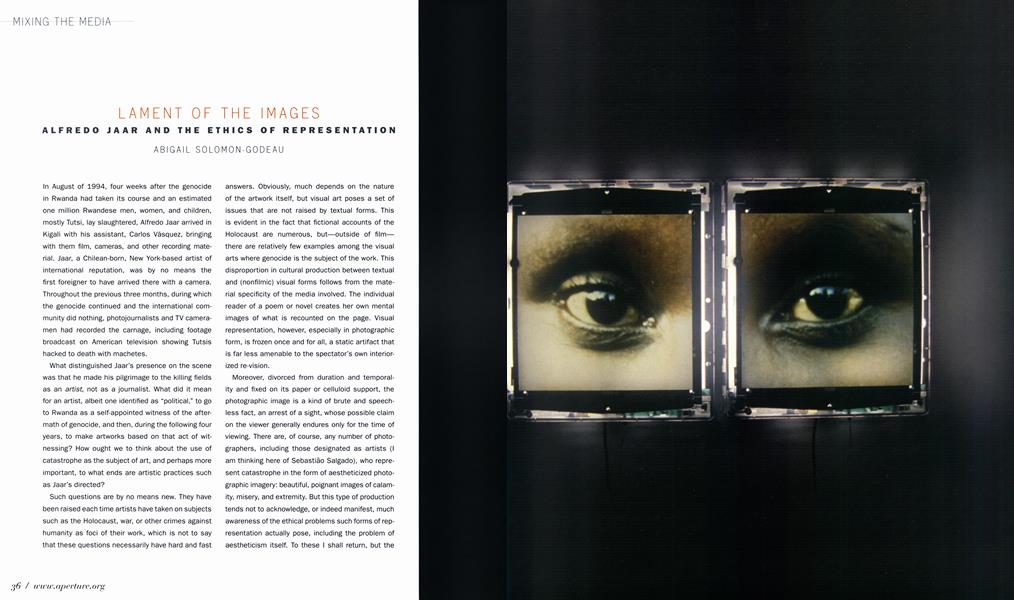
In 1996, Jaar produced an installation of the Rwanda works that he titled The Lament of the Images, a lament occasioned both by what the images depict, and by the manifest failure of photographic imagery, in most instances, to have prompted action or redress. Certain of Jaar’s Rwanda projects include a written chronological narrative of the course of the genocide and its most immediately identifiable causes. These texts, however, while crucial to the installations in which they feature (and necessary, moreover, to correct simplistic explanations of why the genocide occurred), are also partial elements within them. In one of the most powerful of the Rwanda works, The Eyes of Gutete Emerita (1996), produced in several versions, Jaar employed a single image, a 35mm transparency, depicting only the eyes of this individual woman. These are the eyes of the witness, the victim, the one whose experience of catastrophe is, in the final analysis, unrepresentable. The text of these installations reads as follows:
Gutete Emerita, 30 years old, is standing in front of a church where 400 Tutsi men, women and children were systematically slaughtered by a Hutu death squad during Sunday mass. She was attending mass with her family when the massacre began. Killed with machetes in front of her eyes was her husband, Tito Kahinamura, 40, and her two sons, Muhoza, 10, and Mati rigari, 7. Somehow, Gutete managed to escape with her daughter Marie Louise Unumararunga, 12. They hid in a swamp for three weeks, coming out only at night for food. Her eyes look lost and incredulous. Her face is the face of someone who has witnessed an unbelievable tragedy and now wears it. She has returned to this place in the woods because she has nowhere else to go. When she speaks about her lost family, she gestures to corpses on the ground, rotting in the African sun.
I remember her eyes. The eyes of Gutete Emerita.
In the third version of The Eyes of Gutete Emerita, which also utilized the running text, Jaar installed an overscale light-box in a darkened space. Upon the light-box were heaped one million 35mm slides of Emerita’s eyes. With loupes attached to the corners of the box, the spectator could examine any of the slides, and would soon realize that they were all identical. But the act of peering through the loupe functioned to make the viewer’s encounter intimate and private, her gaze meeting the gaze of Emerita.
In acknowledging that the trauma of the other is ultimately incommunicable, just as historical catastrophe is unrepresentable, Jaar continued the iconoclastic logic of earlier installations, such as Real Pictures (1995). This work comprised 372 linen photographic archival boxes, each containing one of his photographs of the traces of the genocide, sealed within. A written description of the interred photograph was attached at the top of each container, and the boxes were arranged in geometric configurations in a darkened room; the obscenity of genocide was thus located off-scene (which is, in fact, the etymological root of the word obscene.) The work of the work, as it were, is not to show us the evidence of massacres, but to spark in the viewer a personal interrogation of one’s place in relation to the genocide of which we had knowledge, just as the intimate encounter with the eyes of Emerita is in the nature of an irreconcilable collision between our circumstances and hers. In other of the Rwandese works, as well as those later projects, collectively titled “Let There Be Light,” utilizing text and similarly “unspectacular” images, Jaar makes allusion to the structural paradoxes of photography with respect to visual perception and knowledge. Jaar’s frequent use of illuminated light-box presentations of both image and text suggests a metaphoric deployment of radiant light, which is itself ambivalent: the illuminated image of commercial space, such as those on kiosks or in advertising imagery, is hardly the radiance of enlightenment, or the metaphoric light of reason.
The resonances of the biblical creation myth—beginning, of course, with light—for photography are obvious: light is both the medium and the agent of the photographic image. And although the symbolic aspects of light are, for the most part, those of perception, knowledge, and reason, as Plato cautions in his allegory of the cave, when the benighted prisoner leaves the cave with its shadow-play of illusion, the light of day is blinding, painful. There is a distance to go before the sunlit world is even perceptible. Plato also insists that the image, which is itself an illusion (as is the photograph: an illusion of presence), is a seductive lure. From this descends all manner of iconoclasms, including contemporary artistic practices that refuse the ostensible plenitude and allure of the photographic picture, the picture that we take for reality.
It is significant, therefore, that Jaar has again utilized the phrase from Genesis as the motto for one of his recent works, first shown at Documenta XI, 2002. In this installation, the spectator first enters a room in which three texts (composed with the writer David Levi Strauss), inscribed on mounted light-boxes, tell three stories. The first of the texts is datelined “Capetown, South Africa, 1990,” the date of Nelson Mandela’s release after twenty-eight years in prison. The final passage of the text reads as follows:
Nelson Mandela is released from prison, after 28 years of brutal treatment by the apartheid regime. The images of his release, broadcast live around the world, show a man squinting into the light as If blinded. . . . Mandela later said that Robben Island was “intended to cripple us so that we should never again have the strength and courage to pursue our Ideals.”
In the summer of 1964, Mandela and his fellow inmates in the isolation block were chained together and taken to a limestone quarry in the center of the island, where they were sent out to work breaking rocks and digging lime. The lime was used to turn the island’s roads white. At the end of each day the black men had themselves turned white with limedust. As they worked, the lime reflected the glare of the sun, blinding the prisoners. Their repeated request for sunglasses to protect their eyes was denied.
There are no photographs that show Nelson Mandela weeping on the day he was released from prison. It is said that the blinding light from the lime had taken away his ability to cry.
The second text, also a news item, details the monopolization of image access by Microsoft, which has purchased major picture archives such as UPI and the Bettmann Archive, as well as digital images of museum works all stored underground, giving Bill Gates the exclusive rights to some 65 million images, historical and contemporary. The third text is a news item datelined “Oct. 7, Kabul,” recounting the information that after launching its first air strikes against Afghanistan, the U.S. Defense Department secured exclusive rights to all available satellite images of Afghanistan and neighboring countries. This permitted the United States to control (i.e., censor) all images of the bombing and its effects on the ground.
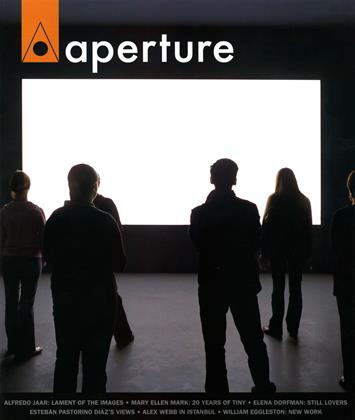
After reading these texts, the spectator passes into another space, on one wall of which is projected only a painfully bright white light, the effects of which are temporarily blinding. In one sense, the installation physically mimics Mandela’s and the other prisoners’ experience in the quarry. But it returns us as well to the metaphorics of vision and blindness, sight and insight, to what is obscured (censored imagery), controlled (ownership of the image), to the limits of both visuality and image. The excess of light, like the excess of images in our postmodern world, may well occlude the light of knowledge, the insight of knowledge. “The work,” Jaar said in an interview, “is a metaphor for the blindness in our society ... I believe we have lost the ability to see and be moved by images.”7 But as Plato insisted two thousand years ago, it is not by means of the image that moral, ethical, or political knowledge is produced. As Jaar’s works suggest, it is with respect to this acknowledged limitation that a heuristic but affective art of protest, contestation, or critique must invent its forms and shape its messages. ©
In conjunction with this article, Alfredo Jaar has produced a work specifically for Aperture’s website titled Roland, Susan, David and the Others. To view, please log onto www.aperture.org/magazine.
NOTES:
1 This citation served as the title of one of Jaar’s projects, a brochure that accompanied the installation Real Pictures at the Museum of Contemporary Photography in Chicago (1995).
2 Susan Sontag, Regarding the Pain of Others (New York: Picador, 2003). Certain of these arguments are in her earlier book, On Photography (New York: Farrar, Straus and Giroux, 1977).
3 Among the many useful correctives to this notion are Philip Gourevitch’s We Wish to Inform You that Tomorrow We Will Be Killed with Our Families: Stories from Rwanda (New York: Farrar, Straus, Giroux, 1998) and Linda Melvern’s A People Betrayed: The Role of the West in Rwanda’s Genocide (London and New York: Zed Books, 2000).
4 However, in 1999, Jaar organized (as curator) an exhibition with two accompanying catalogs titled Inferno and Paradiso. In the former were assembled photographs by photojournalists representing what they considered the single most hellish of their pictures; conversely, Paradiso consisted of pictures that evoked utopian or paradisiacal states or emotions. Predictably, in its catalog form, Inferno was a context-less series of images of war, starvation, and the like; Paradiso featured pictures of lovers, children, etc. It was as though Jaar’s practice as a curator only served to confirm his own more nuanced practice as an artist. See Inferno and Paradiso, ed. by Alfredo Jaar (Stockholm: BildMuseet, 1999).
5 Rwanda did not become a Newsweek cover story until three weeks after the Rwandan Patriotic Front had retaken the country. The story was thus about the enormous diaspora of Hutus fleeing the country and the nightmarish conditions in the refugee camps, including the epidemic of cholera that decimated the refugees, (i.e. “Hell on Earth: Racing Against Death in Rwanda,” Newsweek, August 1, 1994).
6 Quoted in Debra Bricker Balken, “Alfredo Jaar: Lament of the Images,” in Alfredo Jaar: Lament of the Images, exh. cat. (Cambridge, Mass.: List Visual Arts Center, MIT, 1999), p. 24.
7 From an interview by Pat Binder and Gerhard Haupt produced for Documenta XI, 2002.
April 6,1994: A plane carrying the presidents of Rwanda and Burundi is shot down above Kigali, the capital of Rwanda. Their deaths spark widespread massacres, targeting Hutu moderates and the minority Tutsi population, in Kigali and throughout Rwanda. The Rwandan Patriotic Front, which had been encamped along the northern border of Rwanda, starts a new offensive.
NEWSWEEK
April 12,1994: The interim Rwandan government flees Kigali for the town of Gitarama. Relief officials estimate that as many as 25,000 people have been killed in Kigali alone in the first five days of violence.
April 21, 1994: The United Nations Security Council Resolution 912 reduces the UN peacekeeping force in Rwanda from 2,500 to 270. 50,000 deaths.
April 30, 1994: At least 1.3 million Rwandans have fled their homes. More than 250,000 refugees cross the border into Tanzania, the largest mass exodus ever witnessed by the United Nations High Commissioner for Refugees. 100,000 deaths.
May 8, 1994: The Rwandan Patriotic Front gains control of most of northern Rwanda. As killings continue, hundreds of thousands of refugees flee to Zaire, Burundi and Uganda. 200,000 deaths.
May 22, 1994: The Rwandan Patriotic Front gains full control of Kigali and the airport. 300,000 deaths.
May 26, 1994: Deployment of the mainly African UN force is delayed due to a dispute over who will provide equipment and cover the cost for the operation. 400,000 deaths.
June 5, 1994: The United States argues with the UN over the cost of providing heavy armored vehicles for the peacekeeping force. 500,000 deaths.
June 10, 1994: The killing of Tutsis and moderate Hutus continues, even in refugee camps. 600,000 deaths.
June 17, 1994: France announces its plan to send 2,500 troops to Rwanda as an interim peacekeeping force until the UN troops arrive. 700,000 deaths.
June 22, 1994: With still no sign of UN deployment, the United Nations Security Council authorizes the deployment of 2,500 French troops in southwest Rwanda. 800,000 deaths.
June 28, 1994: The UN Rights Commission's special envoy releases a report stating that the massacres were pre-planned and formed part of a systematic campaign of genocide. July 4, 1994: French troops establish a so-called safe zone" in the southwest of Rwanda.
July 8, 1994: As the Rwandan Patriotic Front advances westward, the influx of displaced persons into the so-called `safe zone" increases from 500,000 to 1 million within a few days. 900,000 deaths.
July 12, 1994: An estimated 1.5 million Rwandans flee toward Zaire. More than 15~OOO refugees cross the border every hour and enter the town of Goma, which becomes the largest refugee camp in the world. A cholera epidemic sweeps through the camps in and around Goma, killing an estimated 50,000 more people.
July 21, 1994: The United Nations Security Council reaches a final agreement to send an international force to Rwanda. One million people have been killed. Two million have fled the country. Another two million are displaced within Rwanda.
August 1, 1994: Newsweek magazine dedicates its first cover to Rwanda.
More From This Issue
-
 Before The Lens
Tiny-Erin Photographs By Mary Ellen Mark
Winter 2005 -
 On Location
Istanbul Portfolio By Alex Webb
Winter 2005 -
 Work And Process
Esteban Pastorino Diaz: A View From Somewhere
Winter 2005 -
 Roads Less Traveled
Elena Dorfman: Still Lovers
Winter 2005 -
 Work In Progress
William Eggleston Las Pozas
Winter 2005 -
 Festivals
Fashion And Style In Photography, Moscow
Winter 2005
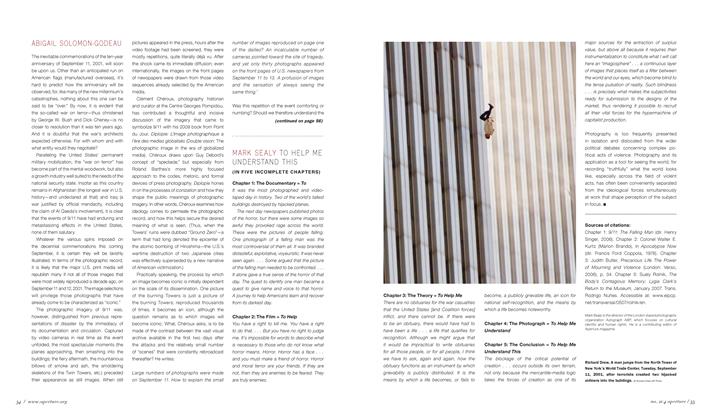
Abigail Solomon-Godeau
Mixing The Media
-
 Mixing The Media
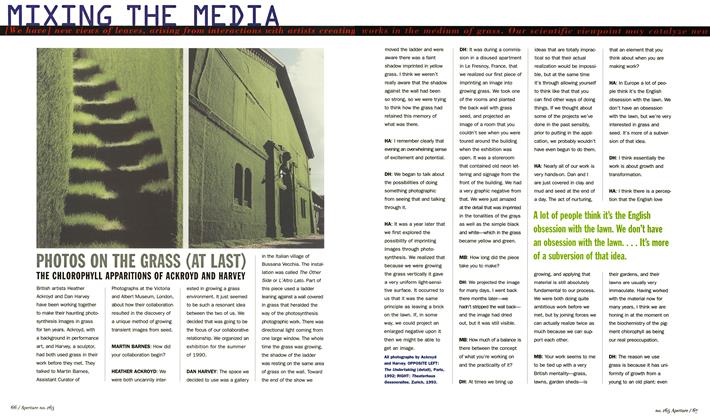
Photos On The Grass (at Last)
Winter 2001 -
 Mixing The Media
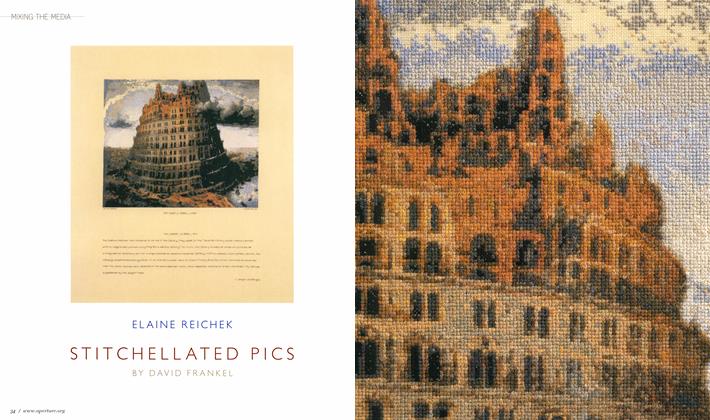
Elaine Reichek Stitchellated Pics
Summer 2004 -
 Mixing The Media
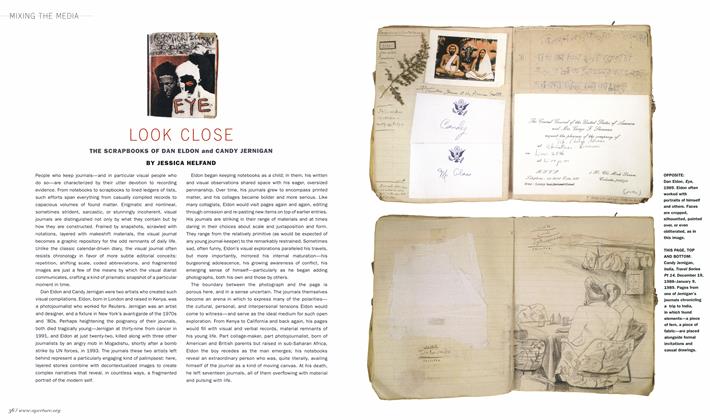
Look Close The Scrapbooks Of Dan Eldon And Candy Jernigan
Spring 2009 -
 Mixing The Media
Hans-Peter Feldmann A Paradise Of The Ordinary
Summer 2011 -
 Mixing The Media
Tibor Kalman’s Use Of Photography
Spring 2000 -
 Mixing The Media
The Masculine Mystique
Summer 2007


