Essay
Children Of The Revolution Contemporary Iranian Photography
CHILDREN OF THE REVOLUTION CONTEMPORARY IRANIAN PHOTOGRAPHY
ESSAY
ANTHONY DOWNEY
The revolution started with small streams and suddenly the small streams came together and It became like a huge river. I went to the streets of Tehran and started photographing. —Abbas
The Iranian revolution in 1979 saw the departure of Mohammad Reza Pahlavi, the Shah of Iran and its ruler for thirty-eight years, and the return, after fourteen years in exile, of Ayatollah Ruhollah Khomeini. The revolution, exactly three decades ago this year, is considered by many today to be one of the key moments— notwithstanding the protests and other events following last June's elections in Iran—in the history of the Middle East. Alongside the Iranian hostage crisis (which lasted from November 1979 to January 1981), it was also a significant factor in the souring of political relations between the West and Iran. Ignominiously included in George W. Bush’s somewhat arbitrary but nonetheless incendiary “axis of evil,” and internationally demonized for its ambitions to be a nuclear state, Iran has become something of a pariah nation in the years since the revolution.
An estimated six million Iranians turned up to greet Ayatollah Khomeini on that fateful day in 1979 and, although economic downturn and a disastrous war with Iraq were to follow, the initial sense of euphoria within the country was undoubted. The Iranian photographer Abbas, previously known for his photojournalism in Biafra and Vietnam, caught not only the events surrounding the ayatollah’s arrival but those leading up to it and the ominous signs of the repression that was to follow, including a photograph of the executed ex-Prime Minister Amir Abbas Hoveyda and a prescient image of an ammunition belt with a photograph of Ayatollah Khomeini attached to it.
The unprecedented outpourings of gratitude that greeted the ayatollah’s return from exile found a counterpart in the West’s equally dumbfounded bewilderment at such scenes. A decade after the revolution, when Ayatollah Khomeini was laid to rest in the Behesht-e Zahra graveyard (where he had arrived upon his return to Iran ten years previously), the crowds were again frenetic; thousands were injured on the day and eight people were reportedly left dead in the crush to touch his coffin. To the Western media, such idolatrous behaviour was yet another example of the fanatical mindset of the Iranian people. Time magazine, which had named Ayatollah Khomeini 1979’s “Man of the Year," noted that his funeral “ignited an emotional outpouring from his fanatical followers” and referred to the events as “bizarre, frightening—and ultimately incomprehensible.” In this reductive interpretation, Time’s reporting might serve as an epigraph to (though one hopes not an epitome of) the West’s continued attitude to postrevolutionary Iran: for many, the country and its politics are still bizarre, frightening, and ultimately incomprehensible.
In truth, the facts of the matter, as is invariably the case, are not so clear cut and even a cursory overview of contemporary Iranian photography, I want to suggest here, can help to provide precisely the insight and conceptual purchase that are missing from these abbreviated views of modern-day Iran. To position contemporary Iranian photography as an ameliorative of sorts to Western-mediadriven images of apparent fanaticism and cultural insularity is not, however, to promote an instrumentalist logic whereby such images become political in their very countering of political demagogy. Nor is it to suggest that these images somehow give up the “truth” of modern-day Iran to our ever-curious Western sensibilities—a suggestion that chimes with neo-Orientalist notions of a mysterious East that will inevitably yield itself to our scrutiny. Rather, the photographers examined here, in the sheer variety of their subject matter and approaches, reveal a side to life, both within modern Iran and beyond its borders, that deals with issues that are far from foreign to neo-liberal democracies or so-called secular societies: the role of women in society, youth culture, sexuality, rebellion, human rights, consumerism, traditionalism, and globalization— issues, in sum, that concern us all and yet remain inflected by the milieu in which they are produced, disseminated, and exchanged.
One of the clearest signs of the evolving demographics of Iran—one that is seldom addressed or discussed in the West— is its surprisingly youthful population, and that population’s emergence as a cultural force in Iranian politics. In the work of Amirali Ghasemi, we witness not only the private spaces of Iranian culture, where parties are often held out of earshot of the religious police, but the ongoing cat-and-mouse game that youths play the world over with figures of authority. Following from Coffeeshop Ladies (2004-05), a series that examines the public spaces of Tehran’s nightlife, Ghasemi’s Tehran Remixed: Party photographs of 2005 show young Iranians doing what most young people do: enjoying themselves and one another. The vital difference in these images is that Ghasemi’s subjects have had their faces and any other marks of identification bleached out. It is an act of concealment that protects the photographer’s subjects, but also brings into play the issue of artistic self-censorship and the ongoing state surveillance of the Iranian population.
This subject of surveillance is likewise a feature of Kian Amani’s images of couples canoodling on a park bench. Shot from above, Amani’s photographs mimic the angle of surveillance photography, and in so doing would initially appear to be complicit in its panoptic rhetoric; however, the narrative that unfolds is one of defiance in the face of such technologies and social mores. Following a sequence in which the courting couple are approached by a policeman and led away, a second couple duly takes their place and the business of life goes on as before.
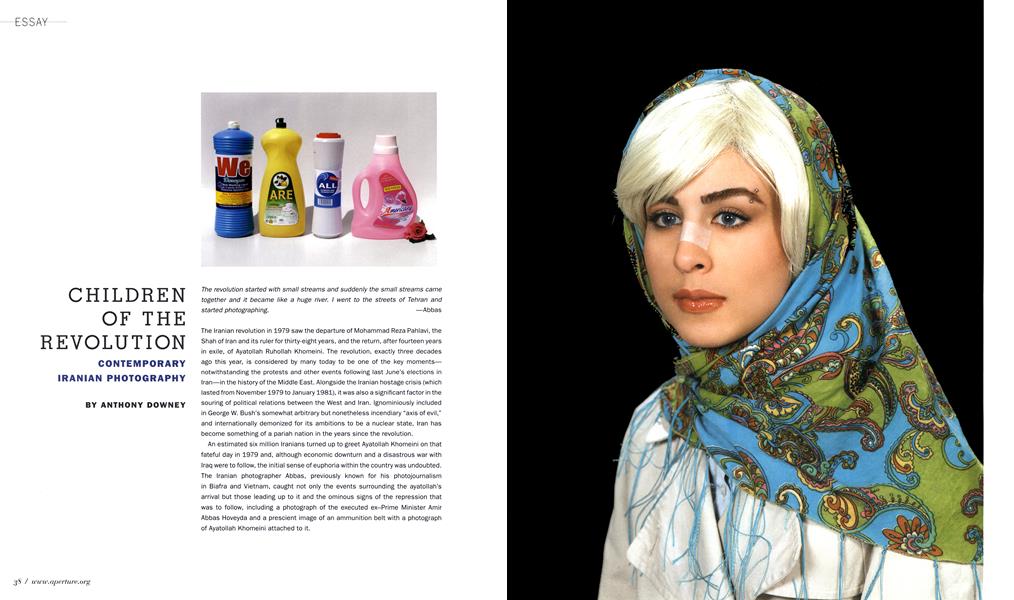
Both Ghasemi and Amani could be seen as exploring the often restrictive laws of Iran in relation to its youthful population, and yet both are also representing forms of defiance to such laws. A further sense of this defiance can be likewise seen in Shirin Aliabadi’s Miss Hybrid series (2006), which explores the fashion among Iranian women for customizing their hijab into a form of cultural rebelliousness. The hijab, which is defined by Islamic legal systems as that which covers everything except the face and hands in public, is the subject of much controversy. An increasingly contested sign of Muslim consciousness, the hijab has come to denote different things to different people. In the West, it has been secured in the popular imagination as a sign of women’s repression in Islamic societies, and yet, in the guise of the veil, it is also seen as a signifier of both the so-called other’s unavailability and coterminous sexual coyness. It is easy to forget that the garments that come under the hijab dress code range from the khimar{or shaylah), which covers only the head, to the chador, a loose-fitting cloak worn by many Iranian women in public spaces, to the burka (or Afghan chadri), which covers the entirety of the body, sometimes including the eyes. Aliabadi’s images show the khimar and its many manifestations, as well as the fashion among young Iranian women for facial piercings; bleached hair; blue, green, or gray contact lenses; and nose-reshaping surgery. These are not the images we in the West usually associate with young women in Iran. Aliabadi’s work, drawing upon the notion of cultural hybridization, displays a series of physical transformations that are not only popular among Iranian women but also represent signifiers of a cultural rebellion that is being played out on a global context.
Another clear sign of cultural transformation is the pervasive and conspicuous consumerism that underpins both Western and indeed Iranian society. This trend is borne out in Aliabadi and Farhad Moshiri’s series Operation Supermarket (2006), in which everyday items have been repackaged to display messages that often remain sublimated. In one of the images from that series, We Are All Americans (2006), we get a sense of the way in which capital and goods have no boundaries in a globalized world order, just as youth fashions and fads refuse borders. Contrary to popular Western perceptions, Iranian women are not required to wear full chador, although many do. Others choose to maintain the government’s requirement for modesty in public spaces by wearing a combination of headscarf and long-sleeved overcoat (known as the manteau or “Persian coat"). The hijab has, however, been a thematic mainstay in the work of Shirin Neshat, who used it throughout her series Women of Allah (1993-97). It also appears in Katayoun Karami’s 2005 Stamp (Me and My Mother), a complex work that examines the history of the chador but also familial links and time itself. Karami’s photograph of her mother, taken in prerevolutionary days, conforms with apparently Western styles of dress, while Karami’s self-portrait is more in keeping with postrevolutionary dress; both images appear on distressed stamps that look like passport photographs. Although her self-portrait was taken thirty years after the photograph of her mother, it is Karami who (to Western eyes) seems strangely dated.
In Shadi Ghadirian’s series Qajar(1998-2001) and Like Everyday (2000-02) there is a further sense of datedness when she looks at the semiotics of a form of portraiture that was popular throughout the royal Qajar dynasty, which ruled Iran from 1794 to 1925. The backdrops to Ghadirian’s images recall those that were used throughout the Qajar era and there is a fascinating history to be told about royal patronage of photography and its arrival in Iran in the 1840s; however, as much as Ghadirian’s work is drawing upon that history, it is also interjecting modern items, associated with the westernization of Iranian culture, such as mountain bicycles and stereo systems. History and a hybrid form of modernity intersect here with the subject of women, and it is the
representation of women that remains central to any discussion of modernity in Iran.
The role of women in Iranian society is likewise a feature of Abbas Kowsari’s Dragnet Tehran of 2005, a series of images that explore the training of an all-female police unit in Tehran that had the blessing of Iran’s current spiritual leader, Ayatollah Sayyed Ali Khamenei. There is something undeniably incongruous in images of chador-bedecked women assembling rifles while blindfolded, speeding around in pursuit vehicles, and rappelling down the outside of buildings fully armed. And yet this double-take likely has more to do with our own view of the chador and perhaps even the notion of “women’s work” as we see it in the West.
Viewers are in for another double-take with Newsha Tavakolian’s portrait of Maria, formerly an Iranian truck driver by the name of Asgar. Maria, following a sex-change operation, was “outed” by a newspaper and forced into something of an internal exile in her homeland. Although it is well known that homosexuality is a crime punishable by death in Iran, less well known is the fact that more sex-change operations are carried out there than any other nation in the world apart from Thailand. It is perhaps also less known that when a transsexual has undergone sex reassignment in Iran they thereafter legally become the sex they have assigned themselves— and that all this stems from a book written by Ayatollah Khomeini in 1963, which stated that there was no religious injunction against corrective surgery. This view is upheld by Iran's current Supreme Leader, Khamenei, and the Iranian government still provides up to half the cost for those needing financial assistance for sexreassignment surgery. Of course, such apparent liberalism may have much to do with the fact that the ambiguities associated with homosexuality need to be addressed in a state known for its piety. However, the fact remains that gender reassignment not only is permitted by the Iranian government but is in part paid for and legally sanctioned thereafter.
In the early 1960s, in response to a question about what he perceived to be the greatest threat to governments and statesmen alike, then-Prime Minister of Britain Harold Macmillan famously replied: “Events, dear boy, events.” The world will always throw surprises at you and your control over them will be limited; that much, at least, cannot be gainsaid. Recent events in Iran, unfolding as I was finalizing this article in July of this year, amply demonstrated such sentiments.
Whatever the outcome of these largely peaceful protests against what is widely considered to have been a rigged election, it has become apparent that one of the key elements throughout the upheaval has been the use of social-networking sites such as Facebook and Twitter (largely the preserve of the young), and text messaging. Videos and digital images, alongside photographs of demonstrations and shootings, circulate almost immediately through the Internet. And in the absence of foreign journalists,
Iranian photojournalists (including Tavakolian, who has been covering Iran since 2001 for Polaris Images), routinely represent these events to the watching world. A number of photographers mentioned above, moreover, have been arrested and subjected to beatings and intimidation during the recent upheaval.
The photographic image, now largely a digital phenomenon, still has a part to play in the ongoing growing pains of today’s Iran, as it did in the first Iranian revolution. It is within this context, finally, that we might suggest that culture, as a form of exchange and in opposition to political and media-inspired rhetoric, has a way of opening up and disabusing us of our preconceptions. And this is nowhere more clearly illustrated than when we look at the diversity of contemporary Iranian photography and how it addresses both local issues that are pertinent to Iran, not to mention the stability of the so-called Middle East (and the world at large), and the broader concerns of global photographic practices.©
This issue of Aperture went to press in July 2009, during the tumultuous aftermath of Iran’s June 12 election. For updates to this article, as well as further images by Iranian photographers, please visit our website: www.aperture.org.

More From This Issue
-
 Dialogue
Nick Knight: Showman
Winter 2009 -
 Dialogue
Robert Adams Summer Nights, Walking
Winter 2009 -
 Archive
Raymond Cauchetier & The French New Wave
Winter 2009 -
 Mixing The Media
The World According To Maira
Winter 2009 -
 Work And Process
Songs Left Out Of Nan Goldin's Ballad Of Sexual Dependency
Winter 2009 -
 Work In Progress
Carrie Mae Weems History And Dreams
Winter 2009