STATE OF EXCEPTION
THEME AND VARIATIONS
CONTEMPORARY PHOTOGRAPHY FROM TAIWAN
BEN SLOAT
When asked in an interview to comment on being an artist in Taiwan, the photographer and filmmaker Chieh-Jen Chen says:
Taiwan is a state of exception; it isn't considered a country by the international community, yet has its own democratically elected government. Once when my work was exhibited in Shanghai, the label next to the artwork said I was from “Taipei, China.” Later the label was changed to “Taiwan” by a museum visitor, then changed to “China,” and then changed several times again. In the end, the label was covered with traces of this dispute over nationality. . . . Being a Taiwanese artist is the same as being a person without a clear national identity, but I don’t think this is necessarily negative. At least this often makes me aware of my marginal status, and allows me to consider many different issues.
The “state of exception” Chen describes in Taiwan reflects the complexity of the island nation’s recent history and contemporary context. The majority of the population is descended from emigrants from China’s Fujian Province hundreds of years ago; these people consider themselves to be ethnically Taiwanese. World War II brought an end to a half-century-long colonial period under the Japanese, after which Taiwan fell under the rule of Chiang Kai-shek and the Kuomintang (KMT). After a defeat by the Communists in the Chinese Civil War, the KMT fled to Taiwan, and hostilities began with the People’s Republic of China (PRC) over Taiwan’s sovereignty. In 1971 the KMT lost its seat at the United Nations—and formal relations with nearly the entire world community—to the PRC. The KMT’s oneparty rule, which would remain unaltered in Taiwan until the 1990s, included four decades of political suppression and martial law— from 1949 to 1987—known as the period of White Terror.
Works by contemporary Taiwanese photographers who came of age during that period of martial law reveal an unmistakable tension between the concept of the individual and his or her presumed role in society. Magnum photographer Chien-Chi Chang sees a “Taiwanese way of survival, given the influences and the factors. Things I don’t see elsewhere—it’s notjust in the arts and culture, it’s everywhere, but it’s hard to define.”
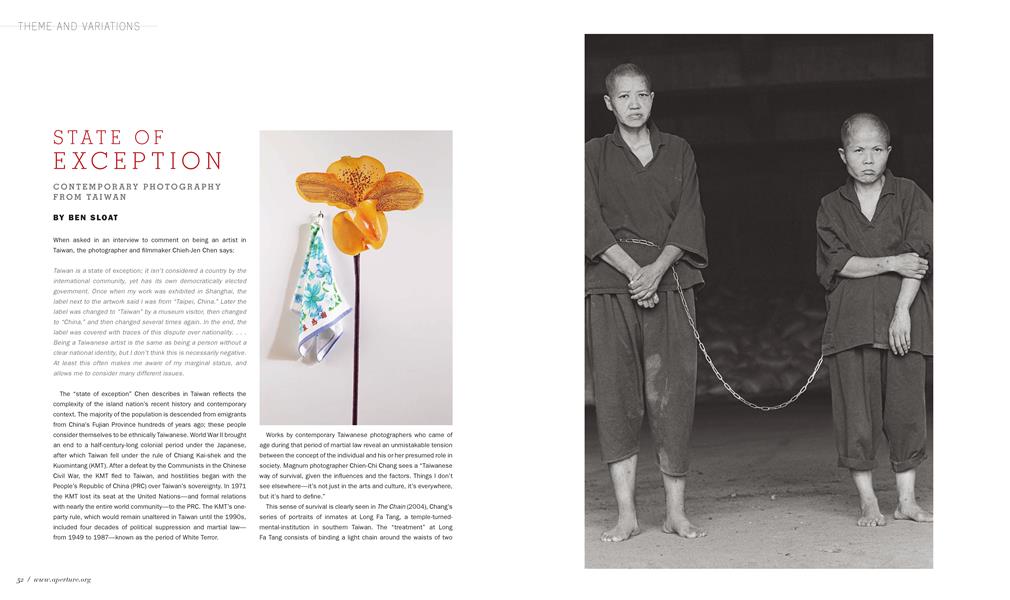
This sense of survival is clearly seen in The Chain (2004), Chang’s series of portraits of inmates at Long Fa Tang, a temple-turnedmental-institution in southern Taiwan. The “treatment” at Long Fa Tang consists of binding a light chain around the waists of two patients, one severely mentally disabled, the other more stable. No medication or formal therapies are administered, and the patients spend their time tending to the largest chicken farm in Taiwan, effectively working as indentured servants. The four dozen portraits in The Chain are poignant, tragic, and utterly startling. The patients here are clearly traumatized, and the closely cropped portraits re-emphasize their confinement. Nameless and anonymous, each struggles physically against the boundaries of an undetermined normalcy and against the spectacle of being seen. Chang parallels the physical chain of the Long Fa Tang patients with that of societal pressures in Taiwan: “There’s always this visible chain and this invisible chain,” he says. “The invisible chain could be a ritual ... a bondage, an obligation.”
With a cultural system founded on the Confucian tenets of personal propriety and filial piety, the “invisible chain” extends to multiple aspects of Taiwanese society. Responding to pressure from his family to get married, Chang has published two books about the institution of marriage in Taiwan. I Do I Do I Do (Ivy Liu/ Premiere Foundation, 2002) is a humorous look at the emotions and absurdities surrounding the formal wedding process, while Double Happiness (Aperture, 2005) is a sobering examination of Taiwanese men taking foreign brides from South Asia in brokered marriages. A subtext to the latter book is the assumed demand for a traditional (and sexist) model of marriage that is unappealing to many modern Taiwanese women.
Conversely, the significance of filial piety and ancestor reverence is explored in Family Parade (1995-96), Shun-Chu Chen’s series of family photographs covering the exterior of a ruined family home. On the experience of family images as vessels for nostalgia as well as for the location of self, Chen reflects: “When there is a fear of death, I feel some sort of salvation from these memories, these images.”
While the prisoners of Chang’s Chain evince the complete loss of identity in the midst of an institutional bondage, Chen associates the rituals and bonds of family as the site of personal renewal. Covering a large family tomb with grids of photographs of plastic flowers in Flower Ritual (2001), Chen employs the glossy permanence of both the fake flower and the photograph itself, twin mechanisms that seem to defy the fact of death.
Another layer of Taiwan’s recent history has been its rapid economic growth, known as the “Taiwan Miracle,” which has helped to propel the country from an agrarian society to one of high-tech industry. In this regard, Taiwan is aligned with Hong Kong, Singapore, and South Korea—known together as the “Four Asian Tigers”—each with highly developed economies as a result of massive industrialization between the 1960s and 1990s. The embrace of technology and development has had manifold effects on the Taiwanese imagination, on one hand enhancing the country’s global status as an economic force (despite its political state of exception), but also creating massive cultural transformations that potentially discard the past.
Jui-Chung Yao describes aspects of his work as preserving elements of culture from “the inhalation of the black hole of history.” Reflecting on the recent political past, images from his 2007 series Liberation of Taiwan are modeled after military propaganda posters. Here the artist poses as a Red Army soldier, floating above various Taiwanese landmarks: a pointed remark about China’s ongoing influence over his country. In an interview, Yao states: “Being a Taiwanese artist... it is impossible for me to depart, in reality or in historical perspective, from the West or China. Though it is kind of fatalistic to say so, the destiny of Taiwan is inevitably connected with these two immense powers.”
Yao turns his attention to industrialization with Roaming around the Ruins (1991-2005), a collection of four photographic projects in which the camera functions as a historical witness to Taiwan’s changing visual fabric. Abandoned factory buildings appear as desolate and grand in one of these four parts, The Civilization Built by Skeleton: vestiges of Taiwan’s initial thrust into the global economy through low-level manufacturing. Another of the component projects, Gods & Idols Surround the Border, presents a collection of Taoist and Buddhist relics and animist idols that comprise the visual landscape of religion in Taiwan. Of this work Yao states: “I was trying to deliver a kind of illusion [that] originated from the local Taiwanese spirit.”
A parallel illusion can be seen in the high-paced lifestyle of Taiwan’s ultramodern cities, whose complex cultural layering ChienChi Chang has described as “like a double exposure, sometimes a triple exposure. Things I don’t expect, they co-exist right next to each other.”
Confronting the urban lifestyle of contemporary Taiwan, l-Chen Kuo’s Lose Contact (2006) begins with the camera facing downward at street level as the artist traverses a busy crosswalk in Taipei. Attached to a balloon, the camera suddenly rises to the level of rooftops as it journeys skyward. As whole neighborhoods are eventually visible, the image transmission of the camera begins to decline, eventually becoming an abstraction until only static is seen and the camera is lost. Kuo’s gesture may be viewed in multiple ways: as a mode of surveillance; as an exploration of the urban surroundings, from close-up to distanced; as a reformatted image of landscape in the digital age; and as a meditation on the uses, limits, and disposability of technological practice.
Perhaps the most internationally recognized Taiwanese artist is Chieh-Jen Chen, who has worked for three decades in photography and film, with a focus on those aspects of history, power, technology, and identity that have affected Taiwan as a whole. Early Chen photographs were based on historic images of torture taken by Westerners; the artist digitally removed the prisoners and inserted multiples of himself being decapitated, chained, or bound in a cage. This act serves as a reversal of authority, erasing the subject of torture and the camera’s gaze, and turning it instead onto the perpetrators.
Chen’s interest in photography comes from its history in the region:
In the mid '90s, I was interested in how non-Western regions were photographed, and how these regions, as objects of Western photography’s gaze, were admitted into the history of photography. The most extreme example was Westerners photographing torture in the East. . . . These victims of torture had no choice but to become the photographed. In their dying moments, they couldn’t escape the prying gaze of the camera, and so these images were forever frozen in photographic medium. . . . For a period of time, I focused on how to use a computer to thaw these frozen images of torture, and the possibility of their re-narration. It presents the East’s experience of injury and reflects the West’s history of colonization.
One particular photograph of lingchi (a punishment in imperial China, also known as “death by a thousand cuts”), shot by a French soldier in 1904 and made famous by French philosopher Georges Bataille in his book Les Larmes d’Eros (The Tears of Eros; 1961), depicts a victim bound to a post in the middle of a crowd. As he looks skyward in an opium-induced delirium, two large wounds on his torso reveal his inner chest cavity while his executioners continue to slice his body. Framing the original image as a “swirling tempest sweeping us into complex viewing rites and power issues,” Chen’s 2002 film Lingchi: Echoes of a Historical Photograph restages the original scene with actors, his slow-moving camera scrutinizing the multiple parties involved. The executioners methodically sharpen their knives, the weary prisoner is force-fed a liquid opiate, a heavy rain begins to fall on the silent crowd. Most disarming is the camera’s point of view, not a passive observer but an active accomplice to the unfolding historical violence. Stunted and powerless, the camera looks upon the scene with both incrimination and guilt.
Distilling the theme of the individual in relationship to a surrounding power that defines him (rather like a small country at the mercy of larger ones that define its political world), Chen snuck into shuttered industrial sites to make his films Factory (2003) and Bade Area (2005). For Factory, Chen invited laid-off garment workers he met during the making of Lingchi to return to their former site of employment, filming them enacting the daily rituals of their previous occupation over a full workweek. As they interact with the nowabandoned machinery and objects of industry, their simulated labor becomes a gesture of defiance against their economic exploitation. In contrast, the isolated temporary workers shown in Bade Area scrounge slowly and deliberately, working aimlessly in the derelict buildings of a once-idealized industrial locale.
Chen’s more recent films engage the various political conditions that have come to define Taiwan. Military Court and Prison (2007-8) looks at the unseen locations that held political prisoners during Taiwan’s White Terror. Empire’s Borders (2008-9), meanwhile, looks at the disempowerment of Taiwanese applying for American visas and at the current subjugation of Chinese and Southeast Asian brides attempting to enter Taiwan.
Chen says: “Everyone views other cultures through their own cultural bias, not only Westerners. . . . The process of exchange between cultures often starts from mutual misunderstanding, but this misunderstanding is also the starting point for communication.”©
The author wishes to thank the Fulbright Scholar program and the American Institute in Taiwan for their support during the research and writing of this essay.
More From This Issue
-
 Witness
Lynsey Addario At War
Winter 2010 -
 Portfolio
Roger Ballen The Asylum
Winter 2010 -
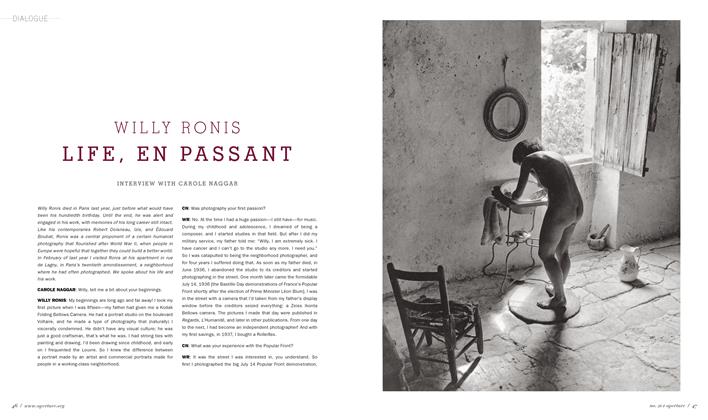 Dialogue
Willy Ronis Life, En Passant
Winter 2010 -
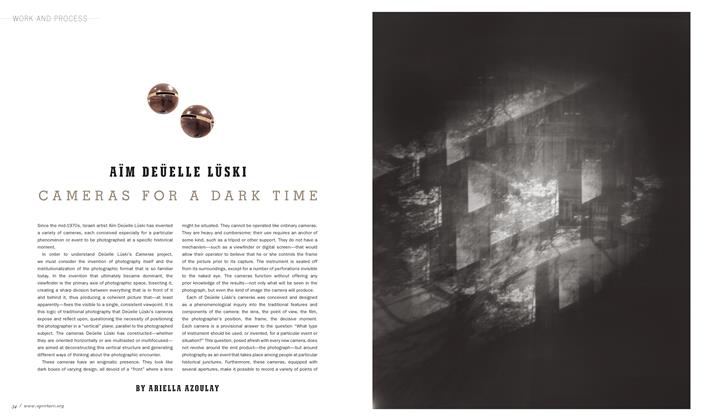 Work And Process
Aïm Deüelle Lüski Cameras For A Dark Time
Winter 2010 -
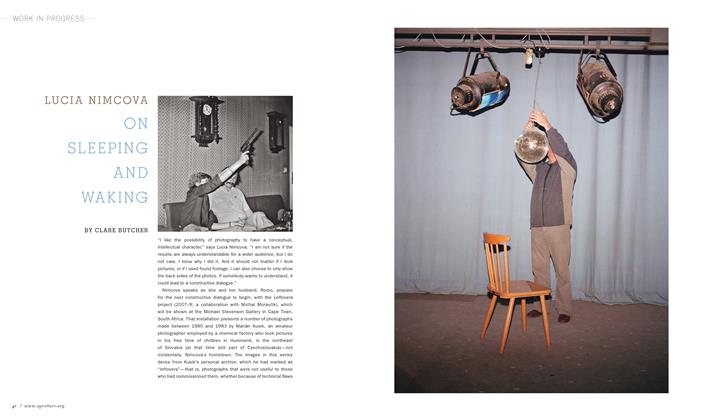 Work In Progress
Lucia Nimcova On Sleeping And Waking
Winter 2010 -
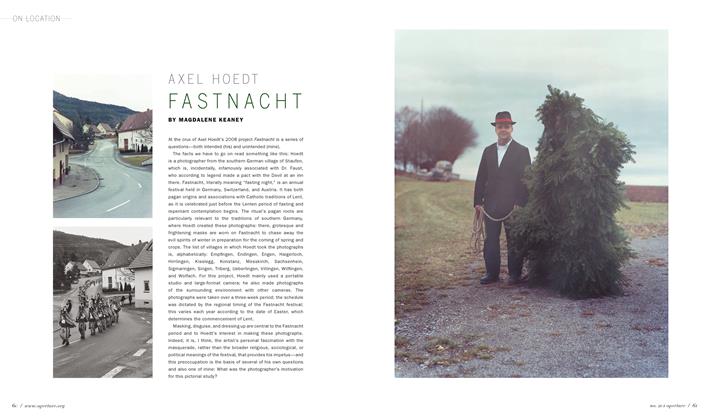 On Location
Axel Hoedt Fastnacht
Winter 2010
Theme And Variations
-
 Theme And Variations
A Word About Angels
Spring 2002 -
 Theme And Variations
America:nowandhere
Fall 2010 -
 Theme And Variations
A Calamity Of Heart
Fall 2010 -
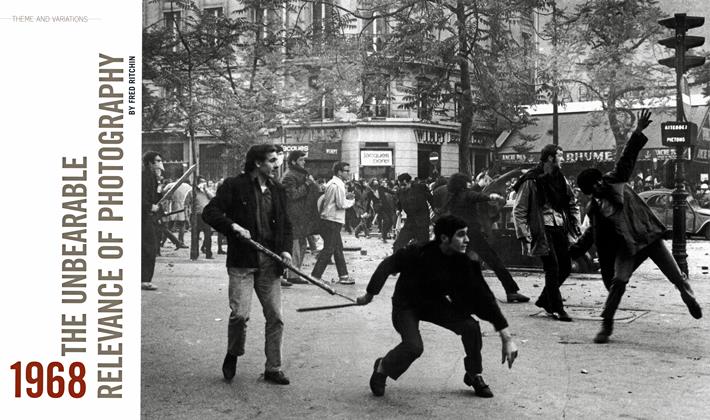 Theme And Variations
1968 The Unbearable Relevance Of Photography
Summer 2003 -
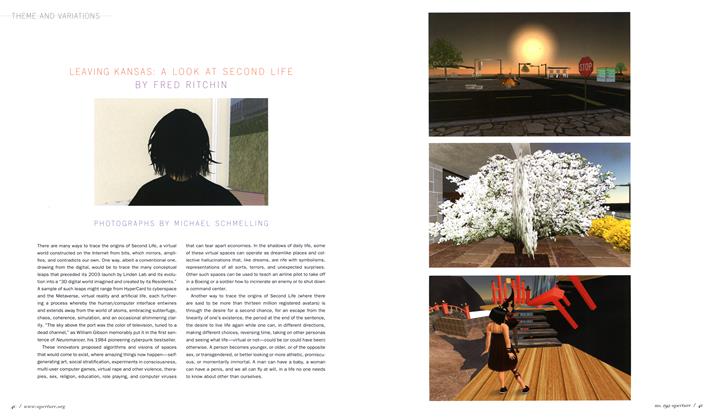 Theme And Variations
Leaving Kansas: A Look At Second Life
Fall 2008 -
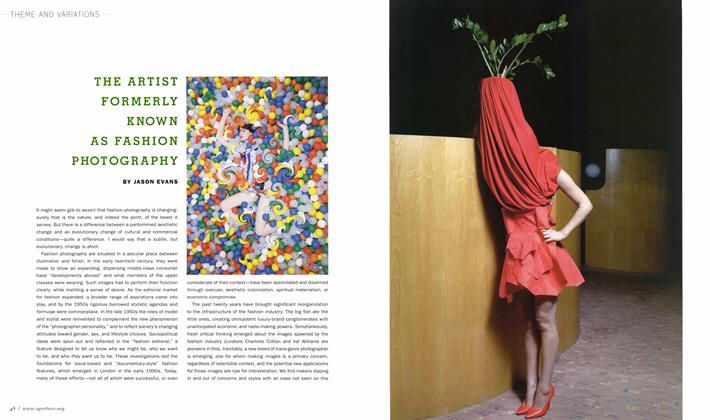 Theme And Variations
The Artist Formerly Known As Fashion Photography
Summer 2009


