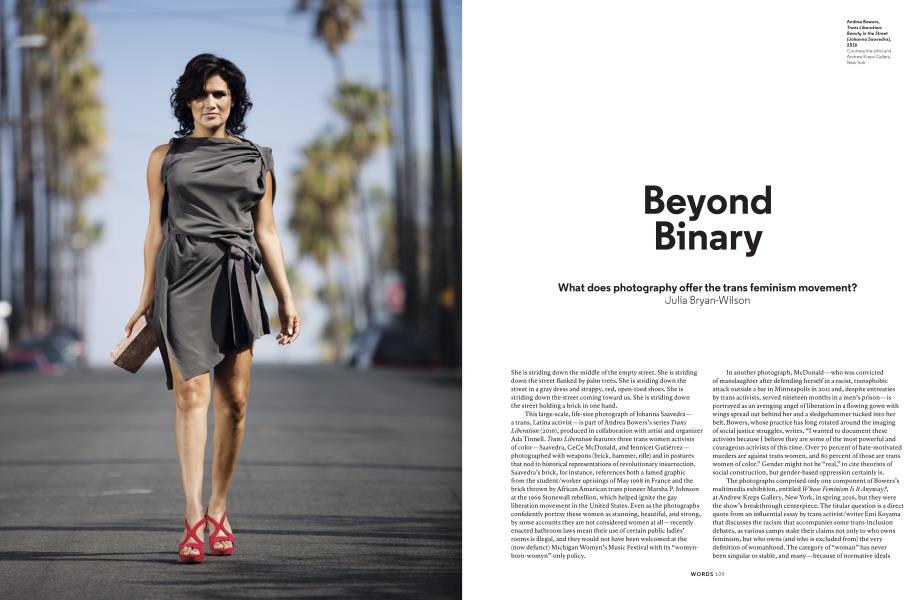
She is striding down the middle of the empty street. She is striding down the street flanked by palm trees. She is striding down the street in a gray dress and strappy, red, open-toed shoes. She is striding down the street coming toward us. She is striding down the street holding a brick in one hand.
This large-scale, life-size photograph of Johanna Saavedra— a trans, Latina activist—is part of Andrea Bowers’s series Trans Liberation (2016), produced in collaboration with artist and organizer Ada Tinned. Trans Liberation features three trans women activists of color—Saavedra, CeCe McDonald, and Jennicet Gutiérrez— photographed with weapons (brick, hammer, rifle) and in postures that nod to historical representations of revolutionary insurrection. Saavedra’s brick, for instance, references both a famed graphic from the student/worker uprisings of May 1968 in France and the brick thrown by African American trans pioneer Marsha P. Johnson at the 1969 Stonewall rebellion, which helped ignite the gay liberation movement in the United States. Even as the photographs confidently portray these women as stunning, beautiful, and strong, by some accounts they are not considered women at all—recently enacted bathroom laws mean their use of certain public ladies’ rooms is illegal, and they would not have been welcomed at the (now defunct) Michigan Womyn’s Music Festival with its “womynborn-womyn”-only policy.
In another photograph, McDonald—who was convicted of manslaughter after defending herself in a racist, transphobic attack outside a bar in Minneapolis in 2011 and, despite entreaties by trans activists, served nineteen months in a men’s prison—is portrayed as an avenging angel of liberation in a flowing gown with wings spread out behind her and a sledgehammer tucked into her belt. Bowers, whose practice has long rotated around the imaging of social justice struggles, writes, “I wanted to document these activists because I believe they are some of the most powerful and courageous activists of this time. Over 70 percent of hate-motivated murders are against trans women, and 80 percent of those are trans women of color.” Gender might not be “real,” to cite theorists of social construction, but gender-based oppression certainly is.
The photographs comprised only one component of Bowers’s multimedia exhibition, entitled Whose Feminism Is It Anyway?, at Andrew Kreps Gallery, New York, in spring 2016, but they were the show’s breakthrough centerpiece. The titular question is a direct quote from an influential essay by trans activist/writer Emi Koyama that discusses the racism that accompanies some trans-inclusion debates, as various camps stake their claims not only to who owns feminism, but who owns (and who is excluded from) the very definition of womanhood. The category of “woman” has never been singular or stable, and many—because of normative ideals
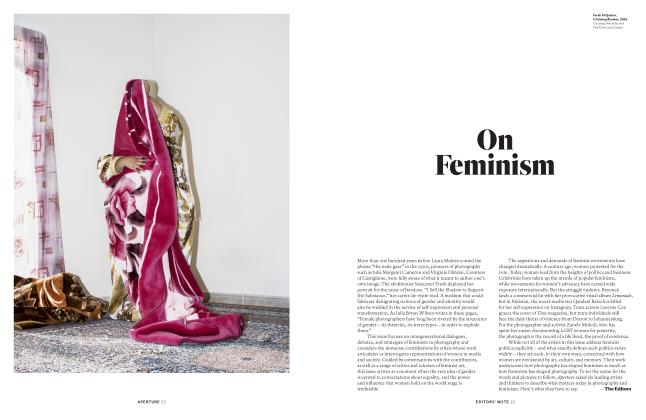
Female photographers have long been riveted by the structures of gender—its theatrics, its stereotypes—in order to explode them.
about anatomy, about body size, about race, about age, about disability—have been barred from its rigid confines. Trans women of color continue to fight hard to change these conversations, fights allegorized in these portraits by the weapons wielded by Saavedra, McDonald, and Gutiérrez.
Bowers is perhaps most well known for her carefully wrought drawings (some of which were on display in Whose Feminism Is It Anyway?), but to document these figures as mythic heroines she turned decisively to photography, with its special capacities to depict not only the purported “real” but also to render visible “unreal” or fictive states of being. It is one of the first lessons to impart in any history of photography class: despite the vaunted truth value of a photograph, it is always the result of a partial, packaged, and framed viewpoint. The photograph’s alleged transparency is as mediated and produced as any other form of representation.
In a related vein, these photographs perform a denaturalizing function. Trans activism asks us to rethink the supposed truth of the binary gender system—one that sorts people at birth into two inviolable categories (boy or girl) and permits no crossing between them during a lifetime. In addition, sexist systems of inequality privilege men above women, as well as masculine above feminine; to counteract these strictures, trans feminism advocates for the flourishing of a range of genders and promotes solidarity between all kinds of women, including those who were born female and those who were not. Trans feminism also considers how gender intersects with race, class, ability, and age. It is thus worth asking: What does photography as an artistic resource, a visioning technology, and a tool of activist organizing have to offer the trans feminist movement? Current debates about the porousness and flexibility of gender identities hinge in part on questions of visibility and self-presentation—that is, how one looks, as well as how one looks back, is crucial. These are issues that photography is uniquely suited to address.
Indeed, Bowers is one of several cisgender—that is, nontrans—female photographers who have trained their lenses on trans women (as well as trans men) to ask questions about the politics of representation and to challenge assumptions about the potency of appearance and the gendered gaze. In the early 1980s, during the grip of General Augusto Pinochet’s rule in Chile, photographer Paz Errázuriz embarked on a project in which she took pictures of trans prostitutes working in clandestine brothels in Santiago and Talca. As part of her larger effort to resist the dictatorship and its brutally enforced norms, Errázuriz photographed marginalized subjects such as circus performers and those confined to psychiatric hospitals. The resulting series,
La manzana de Adán (Adam’s apple, 1982-87), shows the intimacies fostered by queer men and trans women in the chosen families formed within brothels. Decades before the rise of the phrase trans feminism and the increased mainstreaming of (some) trans bodies, Errázuriz’s La manzana de Adán sought to capture Chilean trans women without shame or stigma. Shot within domestic interiors, with many of her subjects staring frankly into the camera, the images dignify rather than spectacularize.
It could be argued that female photographers have long been riveted by the structures of gender—its theatrics, its stereotypes—in order to explode them. Artists as varied as Claude Cahun, Hannah Hoch, Paola Peredes, Cindy Sherman, and Lorna Simpson, working across the span of the twentieth century, have used photography to interrogate how gender acts in conjunction with other categories of difference (including race, class, and sexuality) and to disrupt conventions of femininity.
Some have sought out trans subjects because of their subcultural or nonnormative jolt—Diane Arbus, for instance, with Miss Stormé de Larverie, the Lady Who Appears to be a Gentleman, N.Y.C. 1961,
a portrait of a dapper figure seated on a park bench. (De Larverie, a queer, biracial drag king, would go on to be a crucial catalyst in the 1969 Stonewall pushback against the police.)
But there is arguably a difference between Arbus’s early 1960s fascination with trans identities as a visual shorthand for deceit, surprise, and transgression and the approaches taken by the post-gay liberation work of Bowers and Errázuriz. They do not rely on titles to invert assumptions about how clothes, hair, and posture might or might not securely “match” an underlying body. Rather, they grasp that one promise of portrait photography is that it can particularize, that it can give us some access, however compromised, to the individual details of the person. (Yes, the camera can flatten people into types, but it can also lend texture to their specificity.) When cisgendered female photographers aim their cameras at trans bodies (whether male, female, both/and, or neither/nor), different questions—but still pertinent questions— about the gaze, gender, and power are raised. Thus it is vital that trans-identified artists and photographers like Juliana Huxtable and Serena Jara are also documenting themselves and expanding discourses around the aesthetics of embodiment. And Zackary Drucker and Rhys Ernst’s 2008-14 series Relationship presents the two artists and their partnership as they crossed, in opposing directions, the mobile line between male and female.
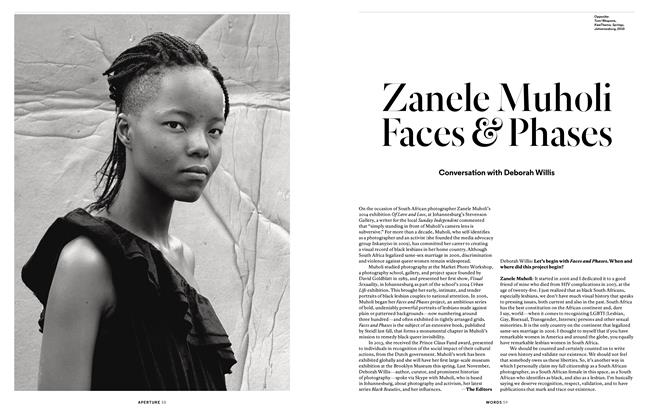
Among the most celebrated recent images of trans women are those taken by black, South African, lesbian photographer Zanele Muholi. Since the early 2000s, Muholi has created meticulous studio portraits of black LGBT-identified people. In one, Yaya Mavundla, Parktown, Johannesburg (2014), a woman with a come-hither smile wears a tangle of necklaces, her hands placed on her upper thigh; a black garment swoops around her torso and hips, and swings out behind her in a flourish. In another image of defiant glamour, a woman wearing only high-waisted shorts and a striped hat turns
to face the lens. The woman’s expression conveys authority, self-possession, and trust in the photographer, as well as, by extension, in us as viewers. Given the violence experienced by many queer and trans folks in South Africa—and elsewhere— Muholi considers her photography to be a form of what she calls “visual activism.”
With its abilities to make everyday details vivid, and to provide the stage for imaginative excesses, photography plays an important role in the simultaneous construction, and dismantling, of the boundaries of “woman.” How might these photographic expressions of trans visibility shape, or potentially contribute to, the debates around accepting trans feminism, as part of the ongoing struggle for equality? The stakes of these debates, and these visibilities, are high—for many trans women of color, they can be a matter of life and death. Look again at the photo of Saavedra dressed to kill with the brick in her hand: she is striding down the street and she is unstoppable.
Julia Bryan-Wilson is Associate Professor of Modern and Contemporary Art at the University of California, Berkeley.