History Is Ours
Protest, revolt, and visual politics
Eva Diaz
For a woman living today, nostalgia strikes me as a WTF move.
I mean, helloooo ladies! Women are better off in the twenty-first century than we ever were before. Many, but still not all of us, enjoy a host of rights and freedoms that were unavailable even during our mothers’ youths. Pulling back a few generations ago to first-wave feminist struggles, I know few women who long for the days when we were treated as de jure minors: politically disenfranchised, refused property rights and access to higher education, our free movement in public space denied, our lives largely circumscribed by domestic labor and child-rearing.
Rights for women to be treated as equal citizens have been won over many centuries, a process requiring countless protests and demands for recognition, and in struggles marred by frustration and defeat. Yet equality has not been accomplished. Parity in wages and income between men and women has not been attained, and sexism and violence against women are still prevalent. Hell, studies show that women are still doing more housework than men.
Because feminist struggles continue, the task of historical study remains a crucial element in directing future efforts toward both equal opportunities and equal outcomes. In this goal, photography has played a key role. Much has been made about the temporal paradox of photography, the manner in which every photograph is a document, a witness, even, of a past moment. Of course, an artwork in any medium exists in multiple chronologies, having been painted, cast, carved, or whatnot at some time in the past and then viewed
at various moments historically, then in the present, and again possibly in the future. But in offering an indexical, seemingly evidentiary record of a prior event, photography straddles temporalities in a way that makes looking at a photograph an encounter with the fleeting nature of time itself, as critics from Siegfried Kracauer to Roland Barthes have noted. In documenting the history of feminism, photography both periodizes past struggle and highlights the radical claims made in the past that are still unattained.
The histories of feminism and photography are firmly intertwined; one could even argue that they are projects birthed by modernity. The word feminism was coined by the utopian thinker Charles Fourier in 1837 féminisme in the original French). William Henry Fox Talbot took what is thought to be the first photographic image in 1834, a technique that he refined and patented as the calotype in 1841. Though photography may be slightly older than the word feminism, the popularization of the concept of equality for all women (not merely the noble) is credited to Mary Wollstonecraft, whose 1792 treatise^ Vindication of the Rights of Woman drew on the successes of the American and French revolutions to argue that universal education would foster women’s equality.
In the twentieth century and into the present, a close relationship between photography and feminist organizing emerged. Three approaches predominate. First, photographic
WORDS
documentation plays a central role in the work of women artists, often as a strategy for recording performance practices in which tropes of gender identity are explored and challenged—Claude Cahun, Mierle Laderman Ukeles, Valie Export, Adrian Piper,
Martha Wilson, and Cindy Sherman come to mind. Secondly, appropriative practices, often those that critique the manner in which gender roles are presented in mass media and advertising, have been deployed by artists in photomontage practices since the mid-içnos—think Hannah Hoch and Martha Rosier. Thirdly, the accumulative nature of photography has been explored by artists to create archives proposing counterhistories that include events neglected by dominant culture’s focus on the accomplishments of men—the works of Mary Kelly and Sophie Calle are prominent here.
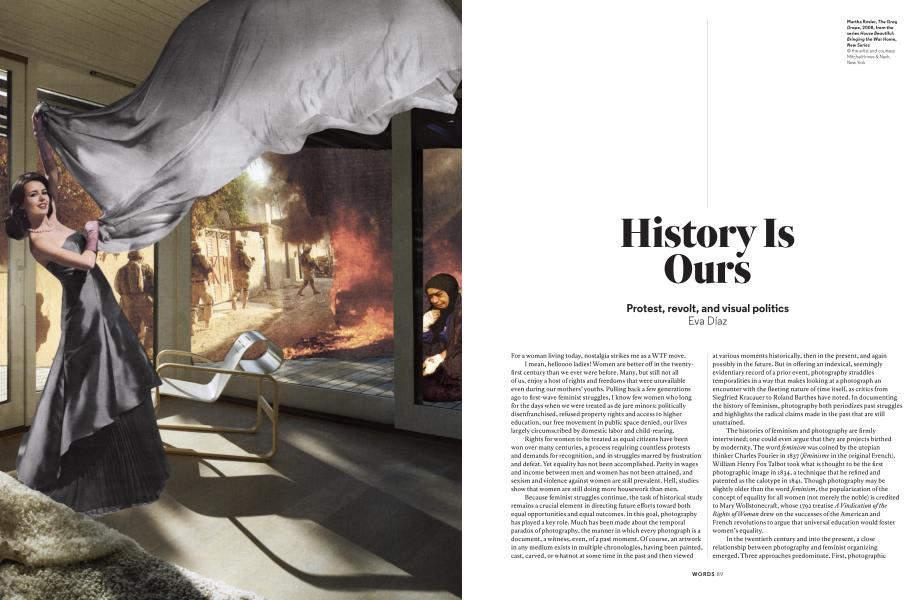
If we consider the demands for equality on a spectrum in which protest constitutes the most public and therefore most self-publicizing aspect, then the means by which women have used photography to document actions critical of patriarchy, as well as to redeploy the codes of advertising’s publicity machine, are numerous. Rosler’s series House Beautiful: Bringing the War Home (ca. 1967-72), in which she juxtaposes images from girly magazines and interior decorating layouts with those ofVietnam War atrocities, has served as a catalyst for young artists in recent years, particularly in making connections between the stereotyping visual cultures of women’s magazines and pornography and the violent imagery of foreign conflict. Revisiting the series in 2004 and 2008, Rosier paired fashion shots with images from the Iraq and Afghanistan wars, making connections between objectification and consumption, sexism and violence.
All art production is fraught with the problem of publicity as the condition for bringing a work into public consciousness. Work that advocates for social change bears a further pressure of speaking to constituencies that may not define themselves as art audiences.
As cultural critic Chantal Mouffe has argued, while art can certainly be political, it is hardly ever politics. The tension between the often collective nature of protest and the sometimes singular authorship behind a work produced for art venues is at the root of many of the practices invested in feminist politics. Recent works by artists Andrea Geyer, Sharon Hayes, and Goshka Macuga move in a space where these seeming contradictions become the enabling conditions for a critique of male power that references the history of feminist protest while simultaneously using tactics developed by those self-same protests. Though the airing of grievances that we call “protest” is burdened with problems of timeliness, historical specificity, and obsolescence, these artists look to neglected moments of the past because neglect is one of the means by which women have been obscured from artistic and political narratives.
In her works, Andrea Geyer has attempted to recover lost or repressed stories of female creativity and authorship. An example is her 2004-8 projects on the model, actress, and writer Audrey Munson, who posed for many public monuments around New York City in the 1910s. In Queen of the Artists’ Studios: The Story of Audrey Munson (2007), Geyer documents Munson’s appearances in public sculptures for which she served as model and presents numerous photographic and text works exploring the aftermath of Munson’s abbreviated career, when she was institutionalized in an insane asylum in upstate New York.
Geyer’s Insistence (2013), a fifteen-minute video, presents a photographic archive the artist assembled when she began conducting research on three women pivotal to the founding of the Museum ofModern Art—Lillie P. Bliss, Abby Aldrich Rockefeller, and Mary Quinn Sullivan—while weaving in images of other women central to the history of modernism who have also been ignored.
The video uses a single camera pointed at a worn wooden tabletop. As the video begins, Geyer’s hand is seen placing postcard-size
The collective nature of protest becomes a gesture of remembrance.
reproductions of photographic portraits of women, and reproductions of artworks of and by women, upon the table, creating a pile as the video progresses. Interspersed among these images are shots of suffragists and scenes of “modern” women from early twentiethcentury illustrated magazines. In a spoken voice-over, Geyer tells stories of women as arts patrons juxtaposed with considerations on identity and history taken in part from a lecture by Gertrude Stein called “Portraits and Repetition.” Some of Geyer’s subjects, such as Frida Kahlo, Emma Goldman, Amelia Earhart, Isadora Duncan, and Georgia O’Keeffe, may be familiar to viewers, whereas the images of others trigger a curiosity to identify these intriguing women. By the end of the video the teetering stack contains approximately 350 photographs.
Geyer showed the work at the Museum of Modern Art in 2015 alongside a mural-sized, hand-drawn flow chart titled Revolt, They Said (2012-ongoing). On the chart, Geyer attempts to map the personal, professional, and political connections between women like those she showed in Insistence, telescoping out from the women associated with MoMA’s founding moment in 1929 to connections between artists and political figures of the period. With 850 women incorporated in the drawing, the work is a monument to the central role of women in stories of aesthetic transformation and political revolution. According to Geyer, it is a “blueprint for how social change happens.”
Sharon Hayes has collaborated with Geyer on several projects, including the 2010 exhibition History Is Ours, which showcased recent feminist art projects. Hayes likewise emphasizes the archival in her work, though she draws on the tradition of women performing actions in public spaces as a challenge to gender norms, male power, and the patriarchal monopoly on authorship. For Hayes’s series In the Near Future (2009), she had herself photographed in public spaces carrying placards from historical protests, such as one that reads “I AM A MAN,” from the 1968 Memphis sanitation workers’
strike, and another demanding “Ratify E.R.A. NOW!,” from the failed struggle to adopt the Equal Rights Amendment in the late 1970s. Hayes’s photographs, depicting herself as a lone picketer/protester adopting a pastiche of historical issues, bring up discomfiting issues of artistic agency and political efficacy, as the collective and performative nature of protest becomes a gesture of remembrance. However, the sense of these issues’ asynchronous “pastness” only serves to empower the often unresolved demands of those prior protests. As Hayes notes, publicity means “making something publicly appear,” and her work reinserts these seemingly distant moments of leftist struggle back into contemporary consciousness and conscience.
Hayes’s work often balances on the knife-edge of political solidarity and individual complaint. Her video piece In My Little Corner of the World, Any one Would Love You (2016) features several individuals filmed in their homes as they read letters to the editor published in lesbian newsletters from the 1950s to the 1970s. The tone of the letters ranges from querulous to flirtatious, resigned to strident, a reminder of a period in which a community of feminist lesbians was first coming into political self-consciousness and public visibility, the same moment that that camaraderie was fracturing into various subgroups constituted by race, class, or butch/ femme identities.
Richerche: three (2013), a thirty-eight-minute video shown in the 2013 Venice Biennale, addresses issues of feminism, community, protest, and identity as they live in the microcosm of the college campus. Filmed with the participation of a group of thirty-five students at Mount Holyoke College, a traditionally women’s college in western Massachusetts, Hayes’s work uncovers the fault lines among a supposedly uniform population. In the work, Hayes asks a series of questions to the students, arranged in a line before the camera. Doing her best Phil Donahue impression, Hayes brings her handheld mic close to each of her interlocutors as she asks them personal questions about sex, political participation, social justice, and the future of feminism. Increasingly, her subjects appear uncomfortable with each other’s answers. Tensions flare in the last few minutes of the video when an argument between several students erupts. One student argues that feminist struggles have provided an umbrella for combating the victimization of women and children, while another waves off feminism as a form of cultural imperialism seeking to conform other cultures around Western values.
Like New York-based artists Geyer and Hayes, Polish-born, London-based Goshka Macuga emphasizes the performative and documentary qualities of photography in her work, while simultaneously drawing on the appropriative tradition of
feminist photomontage. In recent works that were shown together at the New Museum in New York in 2016, Macuga creates photo collages from appropriated images she has then woven into wall-size fabric tapestries. In her work Death of Marxism, Women of All Lands Unite (2013), Macuga uses photographs that the self-taught Czech photographer Miroslav Tichÿ surreptitiously took of women in his small village of Kyjov over several decades beginning in the 1960s. To produce his pictures Tichÿ employed clunky, homemade cameras (which many thought were toys) to spy on women changing at the local pool, for example, or merely to capture women walking around on local streets.
Macuga combines life-size images of these women from Tichÿ’s work into a grouping gathered around the monumental bust of Karl Marx that adorns his grave. Rather than existing as subjects/ victims of Tichÿ’s somewhat creepy voyeurism, the women are shown interacting with the grave site, one cleaning it with a broom, others contemplating it. Riffing off Marx and Engels’s famous slogan from The Communist Manifesto—“Workers of the world unite, you have nothing to lose but your chains”—Macuga’s substitution of women for workers throws into relief the sometimes precarious role of women in progressive political struggles, tacitly subsumed in the category of worker but historically excluded from equal political participation.
In Death of Marxism, Women of All Lands Unite, the tapestry unfurls from the wall onto the floor, occupying approximately ten square feet of space in front of the wall. In this horizontal section of the work Macuga appropriates parts of Tichÿ’s photographs that depict a picnic on a bed of grass, with a book and a spray of clothes scattered about. Upon this blanket of the tapestry a pair of live female performers, dressed in flesh-colored unitards embellished with sketchily drawn “nude” contours of their breasts and limbs, lounge around reading books or acting as a continuation of the audience of the women depicted in the wall-bound portion. The imperative of the title becomes a depiction of a kind of radical leisure instantiating the goal of a world beyond onerous work and the extraction of surplus value from labor that Marx and Engels proposed.
Gains in social equality can be precarious. In the face of conservative challenges to female empowerment, the high crests of activism, organizing, and protest must be reflected upon in order to prevent the rollback of hard-won victories. To make work about these struggles means possessing a knowledge of history, of the key figures and actions that have made demands for the gradual dismantling of patriarchy and male privilege. It helps that these artists use the tools of protest not only to demand change, but also to reconstruct the world as other women might want to live in it.
Eva Diaz is Associate Professor, History of Art and Design, at the Pratt Institute.