Katharina Gaenssler
Katharina Gaenssler
Yvonne Bialek
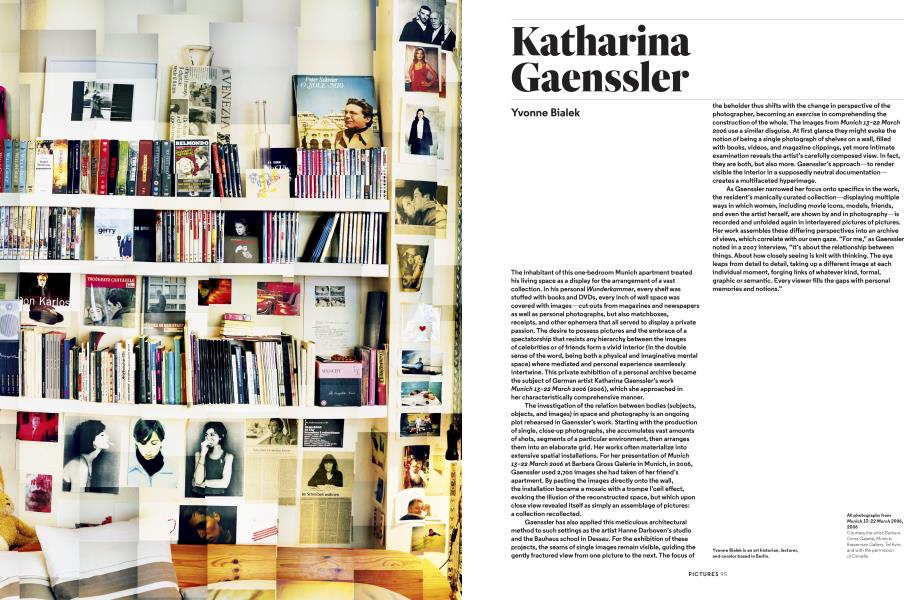
The inhabitant of this one-bedroom Munich apartment treated his living space as a display for the arrangement of a vast collection. In his personal Wunderkammer, every shelf was stuffed with books and DVDs, every inch of wall space was covered with images—cut-outs from magazines and newspapers as well as personal photographs, but also matchboxes, receipts, and other ephemera that all served to display a private passion. The desire to possess pictures and the embrace of a spectatorship that resists any hierarchy between the images of celebrities or of friends form a vivid interior (in the double sense of the word, being both a physical and imaginative mental space) where mediated and personal experience seamlessly intertwine. This private exhibition of a personal archive became the subject of German artist Katharina Gaenssler’s work Munich 13-22 March 2006 (2006), which she approached in her characteristically comprehensive manner.
The investigation of the relation between bodies (subjects, objects, and images) in space and photography is an ongoing plot rehearsed in Gaenssler’s work. Starting with the production of single, close-up photographs, she accumulates vast amounts of shots, segments of a particular environment, then arranges them into an elaborate grid. Her works often materialize into extensive spatial installations. For her presentation of Munich 13-22 March 2006 at Barbara Gross Galerie in Munich, in 2006, Gaenssler used 2,700 images she had taken of her friend’s apartment. By pasting the images directly onto the wall, the installation became a mosaic with a trompe l’oeil effect, evoking the illusion of the reconstructed space, but which upon close view revealed itself as simply an assemblage of pictures: a collection recollected.
Gaenssler has also applied this meticulous architectural method to such settings as the artist Hanne Darboven’s studio and the Bauhaus school in Dessau. For the exhibition of these projects, the seams of single images remain visible, guiding the gently fractured view from one picture to the next. The focus of
the beholder thus shifts with the change in perspective of the photographer, becoming an exercise in comprehending the construction of the whole. The images from Munich 13-22 March 2006 use a similar disguise. At first glance they might evoke the notion of being a single photograph of shelves on a wall, filled with books, videos, and magazine clippings, yet more intimate examination reveals the artist’s carefully composed view. In fact, they are both, but also more. Gaenssler’s approach—to render visible the interior in a supposedly neutral documentation— creates a multifaceted hyperimage.
As Gaenssler narrowed her focus onto specifics in the work, the resident’s manically curated collection—displaying multiple ways in which women, including movie icons, models, friends, and even the artist herself, are shown by and in photography—is recorded and unfolded again in interlayered pictures of pictures. Her work assembles these differing perspectives into an archive of views, which correlate with our own gaze. "For me,” as Gaenssler noted in a 2007 interview, "it’s about the relationship between things. About how closely seeing is knit with thinking. The eye leaps from detail to detail, taking up a different image at each individual moment, forging links of whatever kind, formal, graphic or semantic. Every viewer fills the gaps with personal memories and notions.”
Yvonne Bialek is an art historian, lecturer, and curator based in Berlin.
PICTURES