Pictures
Bill Gaskins
Bill Gaskins
Andrianna Campbell
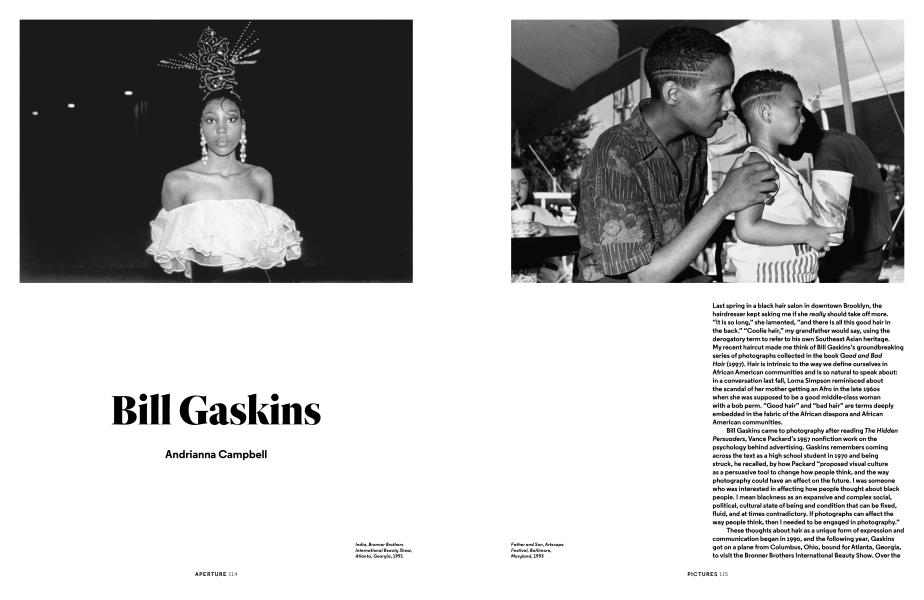
Last spring in a black hair salon in downtown Brooklyn, the hairdresser kept asking me if she really should take off more. "It is so long,” she lamented, "and there is all this good hair in the back.” "Coolie hair,” my grandfather would say, using the derogatory term to refer to his own Southeast Asian heritage. My recent haircut made me think of Bill Gaskins’s groundbreaking series of photographs collected in the book Good and Bad Hair (1997). Hair is intrinsic to the way we define ourselves in African American communities and is so natural to speak about: in a conversation last fall, Lorna Simpson reminisced about the scandal of her mother getting an Afro in the late 1960s when she was supposed to be a good middle-class woman with a bob perm. "Good hair” and "bad hair” are terms deeply embedded in the fabric of the African diaspora and African American communities.
Bill Gaskins came to photography after reading The Hidden Persuaders, Vance Packard's 1957 nonfiction work on the psychology behind advertising. Gaskins remembers coming across the text as a high school student in 1970 and being struck, he recalled, by how Packard "proposed visual culture as a persuasive tool to change how people think, and the way photography could have an effect on the future. I was someone who was interested in affecting how people thought about black people. I mean blackness as an expansive and complex social, political, cultural state of being and condition that can be fixed, fluid, and at times contradictory. If photographs can affect the way people think, then I needed to be engaged in photography.”
These thoughts about hair as a unique form of expression and communication began in 1990, and the following year, Gaskins got on a plane from Columbus, Ohio, bound for Atlanta, Georgia, to visit the Bronner Brothers International Beauty Show. Over the next six years, Gaskins visited eight other cities. Touring to these different places, he encountered a range of subjects and regional hairdos.
PICTURES
Tender and close moments, such as in Father and Son, Artscape Festival, Baltimore, Maryland (1993), are where we find Gaskins’s relationship to his subjects. Some styles are striking, like the fierce frontal poses set off by the rounded towers of hair in Tamara and Tireka, Easter Sunday, Baltimore, Maryland (1995). Their clothes set up a contrast between the girls: Tamara in dark leather and Tireka in a lighter fabric. Yet, they look so similar: their eyes at equal level, their hair piled high in crisp dark crimps, their long, dangling earrings acting as counterweights. Gaskins’s careful composition even exposes the particularities inherent in the industrial waterfront of Baltimore stretching across the back of the frame.
"Zora Neale Hurston was quoted as saying, ’All my skinfolk ain’t kinfolk,”’ Gaskins said. "I’ve experienced the perception of having the advantage—perhaps an unfair one in the view of some—of a so-called insider status as a black artist making portraits of black people through photography, as if the subjects of my portraits are all family members. This is an essentialist view of blackness that obscures the social, psychological, and sensory tools and skills required for me or any photographer to work in portraiture successfully.”
Gaskins peered in from the margins, but it is where he aimed his camera that seems most telling. After all, one of the few popular books written by an African American woman in the nineteenth century is Eliza Potter’s 1859 A Hairdresser's Experience in High Life, which documents her travels working as a hairdresser for white families during slavery. For Potter, as well as for Gaskins—who grew up over a century later—hair standards have been set according to the dominant culture, with African American hair culture documented at its peripheries; and yet, can we conceive of Bo Derek without her braids, or of the 1990s without the iconic box haircut?
Gaskins’s photographs speak to traditions in various black communities going back over a hundred years: styles and hairdos that have only in recent decades become the focus of attention (think of the 1999 Chris Rock documentary Good Hair). His project extends beyond recuperation, or even the persuasive impulse that spurred its naissance. Good and Bad Hair reveals his ability to capture the range of these interpersonal images— from graceful to glamorous—which enables their ongoing resonance in our present time.
Andrianna Campbell is a scholar, independent curator, and a doctoral candidate in art history at the Graduate Center, CUNY.