Front
Day Jobs
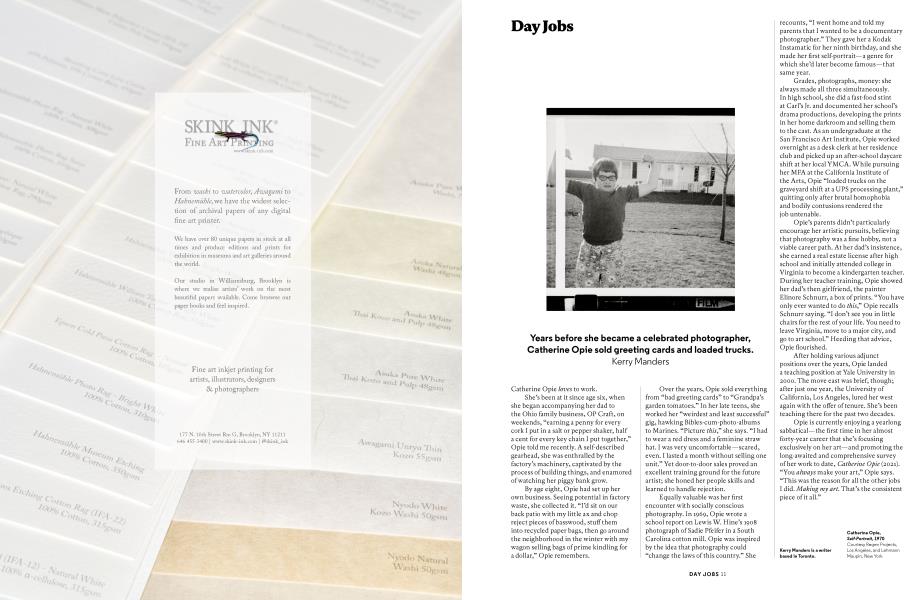
Years before she became a celebrated photographer, Catherine Opie sold greeting cards and loaded trucks.
Day Jobs
Front
Years before she became a celebrated photographer, Catherine Opie sold greeting cards and loaded trucks.
Kerry Manders
Catherine Opie loves to work.
She’s been at it since age six, when she began accompanying her dad to the Ohio family business, OP Craft, on weekends, “earning a penny for every cork I put in a salt or pepper shaker, half a cent for every key chain I put together,” Opie told me recently. A self-described gearhead, she was enthralled by the factory’s machinery, captivated by the process of building things, and enamored of watching her piggy bank grow.
By age eight, Opie had set up her own business. Seeing potential in factory waste, she collected it. “I’d sit on our back patio with my little ax and chop reject pieces of basswood, stuff them into recycled paper bags, then go around the neighborhood in the winter with my wagon selling bags of prime kindling for a dollar,” Opie remembers.
Over the years, Opie sold everything from “bad greeting cards” to “Grandpa’s garden tomatoes.” In her late teens, she worked her “weirdest and least successful” gig, hawking Bibles-cum-photo-albums to Marines. “Picture this” she says. “I had to wear a red dress and a feminine straw hat. I was very uncomfortable—scared, even. I lasted a month without selling one unit.” Yet door-to-door sales proved an excellent training ground for the future artist; she honed her people skills and learned to handle rejection.
Equally valuable was her first encounter with socially conscious photography. In 1969, Opie wrote a school report on Lewis W. Hine’s 1908 photograph of Sadie Pfeifer in a South Carolina cotton mill. Opie was inspired by the idea that photography could “change the laws of this country.” She recounts, “I went home and told my parents that I wanted to be a documentary photographer.” They gave her a Kodak Instamatic for her ninth birthday, and she made her first self-portrait—a genre for which she’d later become famous—that same year.
Grades, photographs, money: she always made all three simultaneously.
In high school, she did a fast-food stint at Carl’s Ir. and documented her school’s drama productions, developing the prints in her home darkroom and selling them to the cast. As an undergraduate at the San Francisco Art Institute, Opie worked overnight as a desk clerk at her residence club and picked up an after-school daycare shift at her local YMCA. While pursuing her MFA at the California Institute of the Arts, Opie “loaded trucks on the graveyard shift at a UPS processing plant,” quitting only after brutal homophobia and bodily contusions rendered the job untenable.
Opie’s parents didn’t particularly encourage her artistic pursuits, believing that photography was a fine hobby, not a viable career path. At her dad’s insistence, she earned a real estate license after high school and initially attended college in Virginia to become a kindergarten teacher. During her teacher training, Opie showed her dad’s then girlfriend, the painter Elinore Schnurr, a box of prints. “You have only ever wanted to do this” Opie recalls Schnurr saying. “I don’t see you in little chairs for the rest of your life. You need to leave Virginia, move to a major city, and go to art school.” Heeding that advice, Opie flourished.
After holding various adjunct positions over the years, Opie landed a teaching position at Yale University in 2000. The move east was brief, though; after just one year, the University of California, Los Angeles, lured her west again with the offer of tenure. She’s been teaching there for the past two decades.
Opie is currently enjoying a yearlong sabbatical—the first time in her almost forty-year career that she’s focusing exclusively on her art—and promoting the long-awaited and comprehensive survey of her work to date, Catherine Opie (2021). “You always make your art,” Opie says. “This was the reason for all the other jobs I did. Making my art. That’s the consistent piece of it all.”
Kerry Manders is a writer based in Toronto.