Jim C. Nedd
Carnival
Daniel Berndt
Reflecting on the relationship between oral tradition, history, and power, Jim C. Nedd’s work asks how cultural and visual codes, along with mythology and customs, serve as forms of both resistance and belonging. Born in Italy and now residing in Milan, Nedd spent most of his childhood in Colombia. While his mother remained in Europe to support her family back home, Nedd was raised by his relatives in the town of Valledupar. "Even though I had a very strong feeling of being Colombian,” he told me recently, "I knew that there was a place on the other side of the ocean where I somehow belonged as well.” This sense of in-betweenness, from his experience of migration and exposure to different cultures, has defined Nedd’s artistic practice.
Nedd combines a documentary approach with staged and stylized elements to create a distinct hybrid aesthetic. Playing with the glamorous and psychological aspects of fashion photography that aim to trigger and resonate desire, he puts a visual language dominated by intense contrasts, artificial light, and an almost haptic quality in dialogue with scenes captured spontaneously in natural settings.
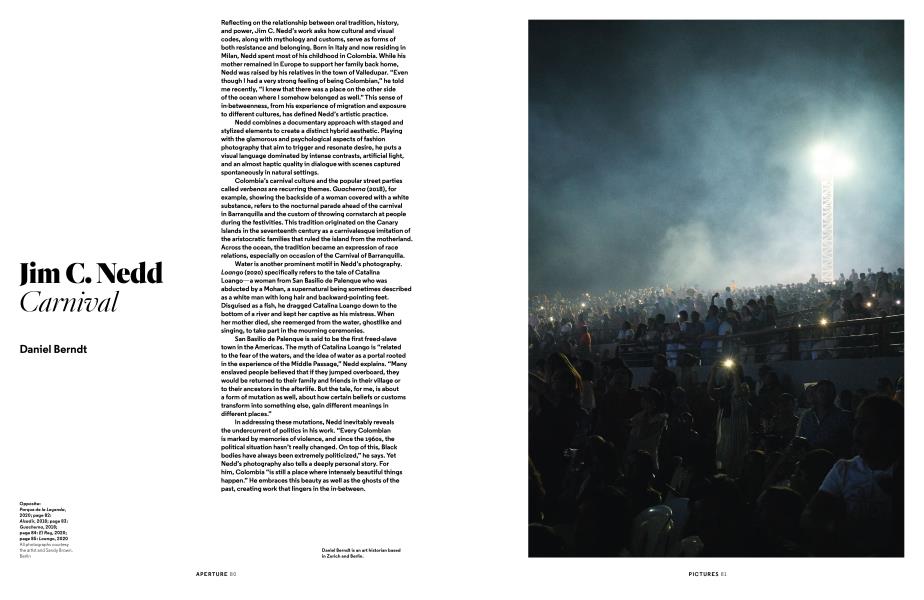
Colombia’s carnival culture and the popular street parties called verbenas are recurring themes. Guacherna (2018), for example, showing the backside of a woman covered with a white substance, refers to the nocturnal parade ahead of the carnival in Barranquilla and the custom of throwing cornstarch at people during the festivities. This tradition originated on the Canary Islands in the seventeenth century as a carnivalesque imitation of the aristocratic families that ruled the island from the motherland. Across the ocean, the tradition became an expression of race relations, especially on occasion of the Carnival of Barranquilla.
Water is another prominent motif in Nedd’s photography. Loango (2020) specifically refers to the tale of Catalina Loango—a woman from San Basilio de Palenque who was abducted by a Mohan, a supernatural being sometimes described as a white man with long hair and backward-pointing feet. Disguised as a fish, he dragged Catalina Loango down to the bottom of a river and kept her captive as his mistress. When her mother died, she reemerged from the water, ghostlike and singing, to take part in the mourning ceremonies.
San Basilio de Palenque is said to be the first freed-slave town in the Americas. The myth of Catalina Loango is "related to the fear of the waters, and the idea of water as a portal rooted in the experience of the Middle Passage,” Nedd explains. "Many enslaved people believed that if they jumped overboard, they would be returned to their family and friends in their village or to their ancestors in the afterlife. But the tale, for me, is about a form of mutation as well, about how certain beliefs or customs transform into something else, gain different meanings in different places.”
In addressing these mutations, Nedd inevitably reveals the undercurrent of politics in his work. "Every Colombian is marked by memories of violence, and since the 1960s, the political situation hasn’t really changed. On top of this, Black bodies have always been extremely politicized,” he says. Yet Nedd’s photography also tells a deeply personal story. For him, Colombia "is still a place where intensely beautiful things happen.” He embraces this beauty as well as the ghosts of the past, creating work that lingers in the in-between.
Daniel Berndt is an art historian based in Zurich and Berlin.
PICTURES