1990s The Shape of Trans to Come
At the end of the millennium, photography was forming our understanding of life beyond boundaries of gender, time, and space.
1990s The Shape of Trans to Come
At the end of the millennium, photography was forming our understanding of life beyond boundaries of gender, time, and space.
Susan Stryker
In Aperture’s fortieth anniversary issue, published in Fall 1992, there’s a brand-new book advertised in the back pages—William J. Mitchell’s The Reconfigured Eye: Visual Truth in the Post-Photographic Era. The marketing copy reads: “Enhanced? Or faked? Today the very idea of photographic veracity is being radically challenged by the emerging technology of digital image manipulation.”
Mitchell’s book heralded one of the most significant developments in the history of photography: the accelerating shift from analog to digital image formats that would, over the course of the 1990s and in anticipation of the post-truth dimensions of the present day, increasingly render reality as its simulacrum.
This shift, Mitchell contends, has been as profound as that from painting to photography, in that digital images are produced through fundamentally different material processes than analog photographs. Whereas an analog image indexes light bouncing off a physical object by means of chemical changes in a photosensitive emulsion fixed in space on some tangible medium, the string of ones and zeros that code a digital image’s pixels may have no physical point of reference at all. Because digital images can be entirely untethered from the world of physical objects, they enact a wholly different representational practice.
Photography in the ’90s was rife with exercises in the shaping of our understanding of identity, memory, time, and space amid technological advances—not just digital imaging, but the burgeoning cyberculture of the Internet—that increasingly blurred the boundaries between the factual and artifactual, the virtual and the real, the actual and the imagined. It solicited (then required) us to live in its dematerialized, ungrounded space. If the fin de millennium decade of the ’90s could be condensed to a single figure exemplifying this preoccupation, that figure could arguably be called transgender: a one-word name for the cultural fantasy of identity unmoored from embodiment’s physical substrate.
Transgender as a newfangled term for age-old practices of gender crossing catapulted into common parlance in 1992 with the publication of Leslie Feinberg’s Transgender Liberation: A Movement Whose Time Has Come. Feinberg penned their manifesto in the heyday of the queer, feminist, punk-inspired, rage-fueled, guerilla-style cultural production typified by artists such as David Wojnarowicz or the Gran Fury collective, which took aim at the ongoing necropolitics of the AIDS crisis. As Rita Felski noted back in the day in “Fin de siecle, Fin du sexe: Transsexuality, Postmodernism, and the Death of History” (1996), transgender came to stand in for any number of “premillennial tensions” and technocultural anxieties about the future of selfhood. By decade’s end, a diffuse trans sensibility so saturated society that the film theorist Cael Keegan could claim, credibly, that the transgender aesthetic covertly informing Lana and Lilly Wachowski’s first Matrix film, in 1999, was the secret sauce explaining how that work became the paradigmatic pop-cultural visual representation of digital-media environments. If trans-as-abstracted-from-physicality is what the post-Cold War New World Order increasingly feltWkt, for everyone, then The Matrix is what we imagined it looked like.
Aperture showed up late to this trans aesthetics party, and kind of hung around its edges without opening out to the deeper implications of what was at stake in decentering biological concepts of personhood. It capped its own fin de millennium with a Summer 1999 issue titled “Male/Female.” While the cover featured a stunningly gender-fluid 1928 double self-portrait by Claude Cahun, and the guest editor Vince Aletti’s cool catch of an interview with Madonna gave a drive-by nod to the megastar’s genderqueer 1990 “Vogue” video, Aperture’s own editorial introduction pointedly reinscribed the gender binary that structured the issue: “Humankind’s first and most essential dichotomy—that we are created in two natures, male and female—has fascinated artists for millennia.”
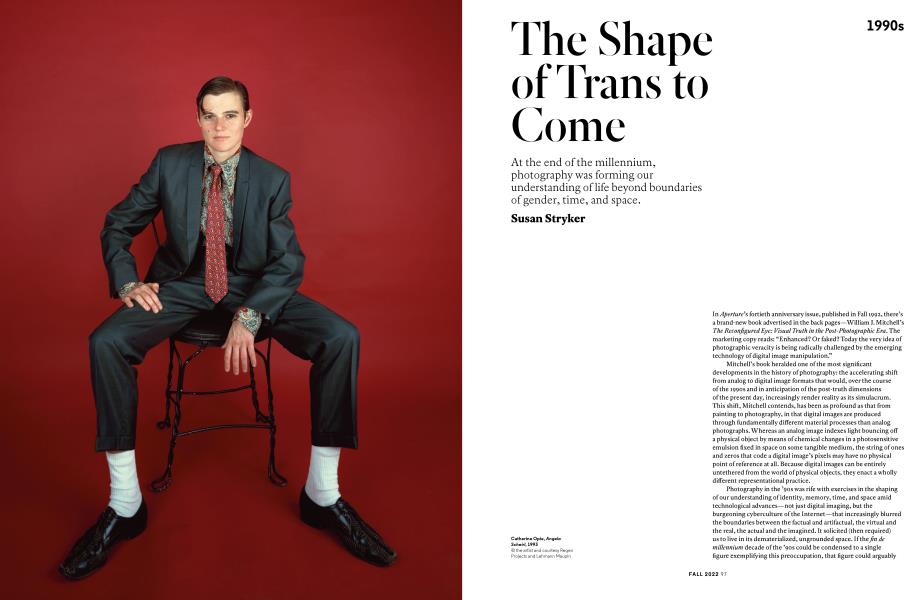
Instances of trans representation can be found sprinkled in Aperture’’s pages throughout the ’90s—a Nan Goldin drag queen here, Peter Hujar’s photograph of Greer Lankton’s legs there, Robert Mapplethorpe’s gender-bending physique pictorials of Lisa Lyons elsewhere. There was plenty of other work circulating in the ’90s, in and beyond the pages of Aperture, that pushed gender visibility and performance in exciting directions: Loren Cameron’s raw, unprecedented views of trans men, as well as more studied works by the likes of Catherine Opie in her Being and Having series (1991), Cindy Sherman’s playful self-portraits, Philip-Lorca diCorcia in his Hustlers series (1990-92), Walter Pfeiffer and Collier Schorr’s evocative photographs of feminine young men, and Inez & Vinoodh’s fashion images. But while Aperture sometimes depicted transgender people or things, it never foregrounded transness as a more-than-gender aesthetic mode, one that infused digital culture at the end of the millennium with fantasies about escaping the material realm.
But even in that 1992 issue with the ad for Mitchell’s Reconfigured Eye, published the same year as Transgender Liberation, there were glimmers in Aperture's pages of precisely that sense of transness: something in excess of the figural, gesturing beyond familiar habits of perception that reproduce bodies in our imaginations in accustomed ways. The broken mirror of Barbara Kruger’s You Are Not Yourself{1981) provides a good point of departure, showing us a world whose conditions of visual representation have been shattered. What is being trans if not the recognition that representation as it has been handed to you necessarily fails you?
Given the nonfigural, nonrepresentational dimensions of this emergent trans aesthetic, a photograph’s paratexts—those seemingly supplemental bits of verbiage, such as an artist statement, that contextualize the supposedly main attraction—can be as important as the visual work itself when they instruct audiences to see something otherwise visually imperceptible. The work by the multimedia artist Elaine Reichek titled Red Delicious (1991), published in Aperture’s Fall 1992 issue, has no discernible trans content, but her broader practice blends needlecraft with digital photography to translate the physicality of the stitch into the immateriality of the pixel in ways that resonate with the questions posed by transgender aesthetics in the ’90s and after. Red Delicious depicts a colonial encounter between an Indigenous perspective and cultural constructs of family, gender, and personhood rooted in the biology-based Western sex/gender binary criticized by movements for “transgender liberation,” but it’s Reichek’s comment on the image that most deeply drives home the connections to transness. Photography, she says, purports to observe what objectively exists, “when in fact [it] is part of an attitude, a cultural stance, a politics, an ideology, a whole mental structure of which the camera is only a small part... an iceberg with the photograph at its tip.” A nonfigural trans aesthetic likewise attends to rendering perceptible, if not necessarily visible, the structures underpinning the mode of a body’s appearing.
Michael L. Sand’s essay on Arthur Batut’s nineteenth-century photography, which concludes Aperture's 1999 “Male/Female” issue, similarly exposes submerged racial ideologies. In the 1880s, Batut was a pioneer in the recently developed technique for producing composite portraits by superimposing images of multiple subjects over one another on the same plate; he aimed to see beyond the particularities of any individual face to capture the essence of ethnic physiognomies native to a given geographical location. As Sand notes, Batut’s visual work anticipates the digital composites of artists such as Nancy Burson and Keith Cottingham, while the artist’s own words about his aims in that work presciently foreshadow the abstracted-from-physicality aesthetics of the digital era: “To reproduce, with the aid of photography, a face whose material reality does not exist, an unreal being whose constituent elements are disseminated among a number of individuals and which could not be conceived except virtually, is this not a dream?”
There were glimmers in Aperture’s pages of that sense of transness: something in excess of the figural, gesturing beyond familiar habits of perception.
Batut’s project was inherently racialist, in that it sought to produce the visual ideal of a biological body shape. But something funny happened on the way to Batut’s visualization of idealized racialist types—something evident in his Fifty inhabitants of Labruguiere and their composite “portrait-type” (ca. 1885-86). As surely as Batut’s technique selected for and reiterated a certain shape of whiteness, it merged the male and female forms of those French villagers into androgyny, resulting in a ghostly composite image that was simultaneously ethnically homogeneous and gender homogenized. In other words, he sought to sharply delineate a shape of race that was virtually present, only for it to come out looking like a gender blur.
That blurring of gender was a consequence of Batut’s attempt to visualize an essence that transcended the particularities of any given flesh. At his fin de siecle as well as our recent fin du millennium, the manifestation of transness as an aesthetic potential pointing beyond the physical—whether in the abstraction of race or the shift from analog to digital media—finds its most fitting image in transgender figuration.
Susan Stryker is the author of Transgender History: The Roots of Today’s Revolution (2017) and the founding coeditor of TSQ: Transgender Studies Quarterly.