The Living Archive
For many artists, collections contain the future of Asian American representation.
The Living Archive
For many artists, collections contain the future of Asian American representation.
Bakirathi Mani
Photographic archives are repositories of possibility. For myself, they are a store of images that appear to narrate, in ways unmatched by any other historical record, the trajectories of my own family’s migration from Kerala to Bombay to Tokyo, and later my immigration from Japan to the United States. For immigrants of East, Southeast, and South Asian descent in the United States, archives are where we turn to see ourselves reflected and preserved in the historical record. But what we often find in public archives are images that render us as strangers, or as spectacles on display. We see objects to be gawked at, our dark faces obscured in portraits where immigrants are identified by turbans, topis, braids, and kimonos.
By contrast, the family photo-album operates as a kind of domestic archive, an accumulation of pictures that intimately documents immigrant life outside of the public eye. At the same time, family photographs can fail to mirror our experience of belonging, within the family as well as in the nation. For Asian American viewers, encountering familial and national photography archives can secure a sense of historical origin and identity but also its inverse—a feeling of alienation and precarity, an inability to recognize ourselves within these carefully preserved images.
In the twenty-first century, how do we perceive Asian Americans in the photographic archive?
In the stnesAn Indian from India (2001-7), Annu Palakunnathu Matthew, an artist born in England, raised in Britain and India, and currently based in Rhode Island, pairs late nineteenthand early twentieth-century portrait images of Indigenous people taken by white settler photographers, such as Edward S. Curtis, with her own self-portraits, which mirror the poses, textiles, and jewelry worn by the Indigenous sitters. Each diptych duplicates the sepia tones and torn edges of the historical prints; they also reproduce the aesthetic form along with the anthropological focus found in Curtis’s work The North American Indian. Where Curtis identifies his subjects not by name but by tribe, such as “Navajo woman,” Matthew also identifies herself as an ethnographic type, as “Malayalee woman.”
Matthew’s diptychs initially appear to redouble the racial fantasies that shape the earlier prints: yet looking closely at her self-portraits, we notice how her posture, her glance, and her wry smile puncture both the ethnographic pictures as well as our own expectations of what it means to see “Indians.” For Matthew, these portraits activate another archive of images: nineteenth-century British colonial portraits of men and women on the subcontinent, who were also identified as “natives.” If An Indian from India initially appears to tell a story about Matthew’s immigration as a young adult from India to the United States—how she became “native” to this land—observing the diptychs from left to right and back again opens out a different story of representation, a story about how colonial depictions of racialized people, from Asia and the Americas, persist to this day.
The family album, in these artists hands, becomes an archive of diaspora: a repository of pictures that runs backward and forward in time and in space.
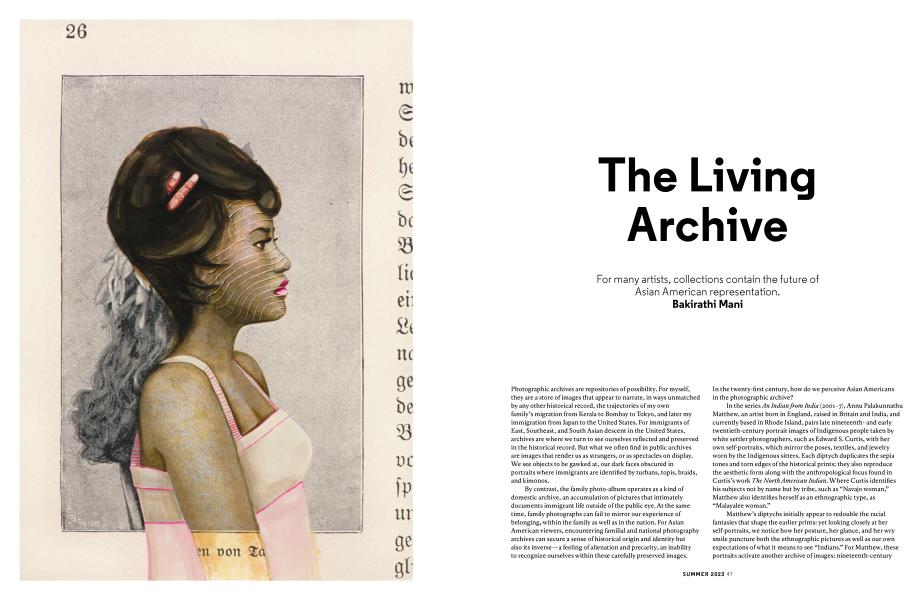
The legacy of ethnographic photography crosses history and nations, as Rajkamal Kahlon, a Berlin-based artist, shows us. Born and raised in Northern California, Kahlon encounters photographs of Black, Indigenous, and Asian subjects in German photographic archives. In the series Do You Know Our Names? (2017-ongoing), she reproduces and paints over images and text from Die Volkerder Erde (People of the Earth), a 1902 German anthropological treatise compiled by Kurt Lampert. Kahlon’s painting practice retraces the popularity of hand-colored photography in the early twentieth century, but in this series, she produces a radically different vision of selfhood. Through her intimate engagement with the women and men featured in these prints—many of whom were originally photographed as representations of Germany’s imperial ambitions in Asia, Africa, and the Pacific—Kahlon uses brushwork to adorn their bodies, reclaiming their humanity and, for Asian Americans who catch glimpses of ourselves in these photographs, our own.
Yet Kahlon’s intervention into this archive is not simply recuperative. Her identification with these unnamed photographic subjects, her depiction via painting of the violence of colonial conquest onto images that are themselves material evidence of empire, provokes us, the artist states, to consider relations of “restitution, reparation, and ‘repair’” toward Black and Indigenous people in our present day.
Far removed from national archives, family albums offer a private, intimate documentation of immigrant life. But the family photograph is also an archival object, one that affirms and at times destabilizes our understanding of who we are and where we come from. Matthew, in her digital portrait animation series To Majority Minority (2013-16), begins with a single archival print of an immigrant family and photographs its subject decades later, sometimes in the presence of their children and grandchildren. The viewer encounters what looks like a still photograph and experiences, instead, the mobility of the image. Across brief animations that compress decades, we watch between portraits the transition of youthful beauty to the graceful embrace of old age, with accompanying texts that narrate the geographic trajectories of Asian migration, from origins as diverse as Vietnam and the Philippines to the United States. At first glance, To Majority Minority visualizes Asian American assimilation.
But if we stay with the animations longer, what we begin to see are objects that represent US wars in Asia: a military jeep in Vietnam, identification photographs and placards for Hmong refugees who fought in the secret war in Laos. The quiet, insistent presence of these objects into the final frames of Matthew’s animated photographs reminds us of the histories of war and empire that continue to shape Asian American lives.
Sa’dia Rehman, an artist born and raised in New York, uses the visual archive of their Pakistani immigrant Muslim family (including family photographs as well as found images and audio/ visual clips) to create works that refract against ongoing military interventions in South Asia and the Middle East. In Family (2017), Rehman re-creates an image of their family as a large-scale silhouette, using powdered charcoal across five scrolls of newsprint. As the fine dust of the charcoal settles to produce an opaque image of domestic life, the image cannot be recuperated as a transparent representation of selfhood. Instead, in the artist’s words, the viewer must “activate the work,” contending with both the invisibility of Muslim American immigrant histories as well as the hypervisibility of US wars in South Asia and the Middle East in the twenty-first century.
The family album, in these artists’ hands, becomes an archive of diaspora: a repository of pictures that runs backward and forward in time and in space. This is also true of the work of Sunil Gupta.
In his series Social Security (1988), he compiles portraits and snapshots—a studio portrait of his parents in Delhi, a lakeside picnic with his parents and sister on the outskirts of Montreal, himself holding hands with his boyfriend on a hike—to capture the possibilities that migration to North America initially appeared to offer his middle-aged parents. But as we follow the series through images of Gupta’s father, who, after immigrating, worked overnight shifts as a security guard, as well as of his sister, who left Canada, and Gupta’s mother, who is pictured alone on her apartment balcony in Montreal, we witness the dissolution of family.
The series concludes with a photograph of Gupta’s father’s corpse laid out for mourners at his funeral, followed by an image of the possessions recovered from his body: cash, a watch, a Canadian social security card, neatly cut in half. Even as Gupta’s mother, whose voice emerges through the captions, presents the family’s migration from South Asia to North America as having been a personal choice, Gupta’s curation of his family photographic archive shows us how the lack of economic opportunity in post independence India precipitated his parents’ emigration, and how the family’s experience of downward class mobility in Canada contributed to his father’s untimely death.
In these artists’ hands, the archive contains the futures of Asian American representation. Even within national archives that continue to accumulate photographs that distort and constrain what it means to be a racial minority, Matthew’s and Kahlon’s strategies of photographic reproduction and painting enable Asian American viewers to come closer to the image, to see something that feels like the experience of our everyday life.
For those who turn to the family album to gain clarity about our own experiences of migration and belonging, Gupta’s work, Rehman’s charcoal drawings, and Matthew’s portrait animations lead us to speculate on who we are, and what we want to be.
As Asian American artists and as observers, we look and look again at these photographic archives, as if they can offer us the promise of representation.
Bakirathi Mani is a professor of English at Swarthmore College and the author of Unseeing Empire: Photography, Representation, South Asian America (2020).