Ishiuchi Miyako The Afterlives Of Objects
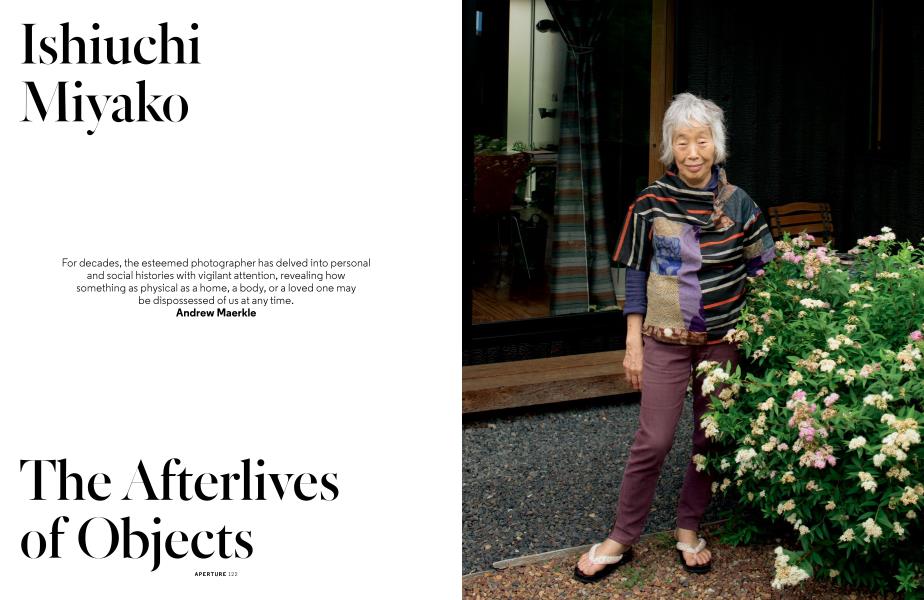
For decades, the esteemed photographer has delved into personal and social histories with vigilant attention, revealing how something as physical as a home, a body, or a loved one may be dispossessed of us at any time.
Ishiuchi Miyako The Afterlives of Objects
For decades, the esteemed photographer has delved into personal and social histories with vigilant attention, revealing how something as physical as a home, a body, or a loved one may be dispossessed of us at any time.
Andrew Maerkle
Ishiuchi has been one of Japan’s foremost photographers practically from the moment she first picked up a camera.
Maybe it’s just because it’s our first meeting, but Ishiuchi Miyako frequently deflects from herself when she speaks. She relishes asserting, several times over the course of the afternoon we spend together at her home in Kiryu, Gunma Prefecture, about two hours by express train north and inland from Tokyo, that she’s not really a photographer. Yet she’s been one of Japan’s foremost photographers practically from the moment she first picked up a camera, after receiving some equipment from a friend, in the mid-1970s. Ishiuchi insists that she doesn’t take many photographs and that, when she does, she never fusses over composition. And she demurs that she’s no writer, despite being a powerful storyteller whose 1993 book, Monochrome, a collection of reflections on photography, reads like a postmodern fiction in which the elements of her work—individual dots of black ink, a trio of vintage enlargers—function as characters in their own right, appearing as objects of desire, attachment, and relinquishment. Even Ishiuchi’s name is an invention of a sort: at a certain point, she took her mother’s full maiden name and dropped her given one.
Ishiuchi studied textile art at Tama Art University in the late 1960s before turning to photography, a field in which she is essentially self-taught. Steeped in the radical foment of that era, she has a bracingly independent mindset, unperturbed by the sanctities of what then was, and still is, a male-dominated field. Her investigations of the traces and markings of personal and social histories on the physical world, in everything from the built environment to the human body to domestic objects, have earned her sustained acclaim. She won one of Japan’s highest honors for photography, the Kimura Ihei Award, at the start of her career in 1979, and more recently received the Hasselblad Award, in 2014.
She moved back to Kiryu, a historical center of silk production, in 2018. Although this is the city where Ishiuchi was born and spent the first six years of her life, she surprises me again when telling me that she came here as an outsider, drawn not by family ties but rather the influence of three figures with local roots, all dead: Junichi Arai, the innovative textile designer; Eiji Okawa, a businessman and art patron whose collection forms the basis of his namesake Okawa Museum of Art, in Kiryu; and Shima Ryu, whose 1864 portrait of her husband is considered to be the earliest known photograph made by a woman in Japan. Ishiuchi now lives in a new house designed in the style of an airy modern bungalow, with skylights and sliding glass doors looking onto a garden.
Her main focus these days is preparing for an upcoming solo exhibition at the Okawa Museum of Art, scheduled to open in July 2024, which Ishiuchi informs me will be the first time the entire museum is dedicated to a single artist. When I visited, she had just decided the exhibition’s English title, Step through Time, which nods to both the central staircase leading down to the museum galleries and Ishiuchi’s view of photography as a means of “activating the past,” as she writes in Monochrome. Yet, more than her photography work, she seems to be most excited about a current project with two younger, local partners in a clothing business to make jackets out of salvaged kimono fabric and obi sashes, reams of which get thrown out every year as an older generation of Japanese dies off and younger family members are suddenly confronted with inheriting a lifetime’s worth of possessions. The jackets are fashioned in the style of sukajan, the souvenir garments commemorating US military deployments in the Asia Pacific through orientalized embroidered motifs.
The references in these textiles to the US military connect to her long-standing concern with US imperialism. An early celebrated body of photographs was made in Yokosuka, the port town at the entrance of Tokyo Bay, which since 1945 has been the base of the US Navy’s Seventh Fleet. The postwar Allied occupation and the terms of the US-Japan Security Treaty, signed in 1951 and renewed in i960 in the face of popular opposition, established populations of US military personnel in towns such as Yokosuka across the country, leading to quasi-colonial conditions for the surrounding communities. If the bases help sustain the local economies (the Korean War is credited with kick-starting Japan’s postwar recovery) and contribute to cross-cultural exchange, they are also a source of tension over everything from sexual violence to environmental concerns.
Ishiuchi, who was born in 1947, grew up in Yokosuka from age six onward and later returned to photograph the city for Yokosuka Story (1976-77). Her haunting images made there feature skewed, black-and-white snaps of military installations, street scenes, aging cinemas, and pastoral vistas, all printed with characteristic grain. Even the sky often appears as a sandpapery field of particulate matter rather than mere negative space. Through these photographs and her subsequent series Apartment (1977-78), focusing on dilapidated low-income housing, and Endless Night (1978-ongoing), exploring former brothel buildings across the country, Ishiuchi evocatively traces the overlaps between her own biography and the nexus of “liquor, girls, and soldiers, sex and war” (as she puts it pointedly in one of her essays) that loomed over her childhood.
Making the work was not easy, and it required Ishiuchi to also confront her own objectification as a woman in a patriarchal society. For six months in 1981, she took over a former cabaret on Dobuita Street, the main drag outside the Yokosuka naval base, then notorious for its rows of boozy, seedy establishments, which, Ishiuchi writes, “stank of semen.” She used the cabaret as a studio and exhibition space, capturing the environs, developing her photographs on-site, and then putting them on display. When I ask what gave her the confidence to pursue her practice in those early years, Ishiuchi replies with a grin, “I just imagined I was making the photographs for aliens, because obviously, they were never going to show up to see them.”
“A photograph is something I make in the darkroom,” Ishiuchi declares. "It's not a document.”
As urban development accelerated amid Japan’s economic surge in the 1980s, she continued seeking out buildings that were about to be torn down. Ishiuchi had a keen sense for quotidian sites inscribed with the history of Japan’s turbulent twentieth century, such as the Gorakuso apartments in Yokohama, the industrial port city just up the coast from Yokosuka. Built as modern luxury housing in the wake of the devastating Kanto earthquake of 1923, the complex was requisitioned by the Japanese Navy during the war, and then briefly converted into a brothel under the Allied occupation before eventually being returned to residential use. She also photographed the remnants of the US Navy’s Yokosuka Enlisted Men’s Club, in its heyday a privileged zone offering American servicemen movie screenings and slot machines, among other diversions.
Ishiuchi states that she sees her photographs of buildings as portraits: “Those buildings were alive, and they felt all the more alive to me knowing they were about to be torn down.” She used the printing process—manipulating contrast, the density of the ink, and the size of the prints—to heighten the sense of the spaces being organisms in their own right, paying particular attention to the teeming detail of paint flaking from the walls and ceilings or fields of debris scattered on the floors. The resulting images play on the spectral entanglements of photographer, setting, object, photograph, and viewer; the absence of multiple generations of former inhabitants and the inevitable obsolescence of the site loom equally large.
“A photograph is something I make in the darkroom,” Ishiuchi declares. “It’s not a document.” Given her experience with textile art, an important revelation in her photography practice was the realization that the printing process is akin to the dyeing process. She tells me that developing her own photographs offered her an escape from reality. In Monochrome, she describes darkroom work as being “close to sex,” emphasizing the sensuality of the process and the smells and sensations that overtake her when she is at work alone in the humid darkness. But her declaration against documentation is not just an assertion of artistic bravado. It also comes from an understanding that you can never actually revisit the substance of a photograph. For all its realism, a photograph will, sooner or later, become a reference without a referent. “All photographs have a will to document. The stronger that will, the more the identity of the subject gets dispersed and diminished,” Ishiuchi writes. “Until it gets obliterated in the photograph.” That is, the more we try to fix something in place, the more it escapes us.
Due to health concerns, Ishiuchi stopped developing her work years ago. She now sends her film to a lab. This transition coincided with a shift to working primarily in color. “If monochrome is something I held tight to me, color brings distance,” she says. Although she had to let go of her old way of working, over the past two decades she has found a new language for investigating the afterlives of objects. She has since pictured the possessions left behind after the death of her mother, the personal effects of victims of the atomic bombing of Hiroshima from the collection of the Hiroshima Peace Memorial Museum, and the former belongings of the artist Frida Kahlo held in a museum in Mexico City.
The series Mother’s (2000-5) was exhibited at the Japan Pavilion during the 2005 Venice Biennale and was recently shown alongside work by the younger photographer Yuhki Touyama (who accompanied me on my visit with Ishiuchi), as part of the 2023 edition of Kyotographie, an annual festival in Kyoto. These images hold a visceral charge similar to that of the much earlier Yokosuka work. Depicting personal items that once belonged to her deceased mother, there’s an oedipal frisson behind these color close-ups, enlarged to relatively massive proportions. Sticky red lipstick protrudes from its burnished metallic casing. Diaphanous lingerie on a white backdrop, printed slightly larger than life-size, seems ready to float off the wall. Without revealing anything explicit about the nature of Ishiuchi’s relationship with her mother, the images take on a life of their own, hovering uneasily between the allure of advertising, the macabre of a memento mori, and the banality of a product catalog. As with Ishiuchi herself, they refuse to be pinned down.
One of her recent projects, Moving Away (2015-18), represents a full-circle moment of a sort. These photographs depict the family home that Ishiuchi inherited on her mother’s passing. This was the home where Ishiuchi set up her main darkroom and that served as a base for her early projects. Photographed in lucid color, the scenes she captures—a workspace with a pair of enlargers, curled black-and-white test prints tacked to the walls nearby; a developing sink with scores of colorful plastic pans—convey, with a detached, almost forensic eye, the density of years of accumulated habitation. By forging something new from the materiality of the past, these are quintessential Ishiuchi images. “Moving away” is an inevitable theme for someone who studies how the world continually, inexorably changes around us. She shows us how something as physical and fixed as a home, a body, or a loved one may be dispossessed of us at any time. Ishiuchi’s photographs are so compelling because, rather than trying to hold a memory in place, they ultimately intend to set their objects free.
Andrew Maerkle is a writer based in Tokyo.