THE PHOTOBOOK REVIEW
B. Ingrid Olson
B. Ingrid Olson
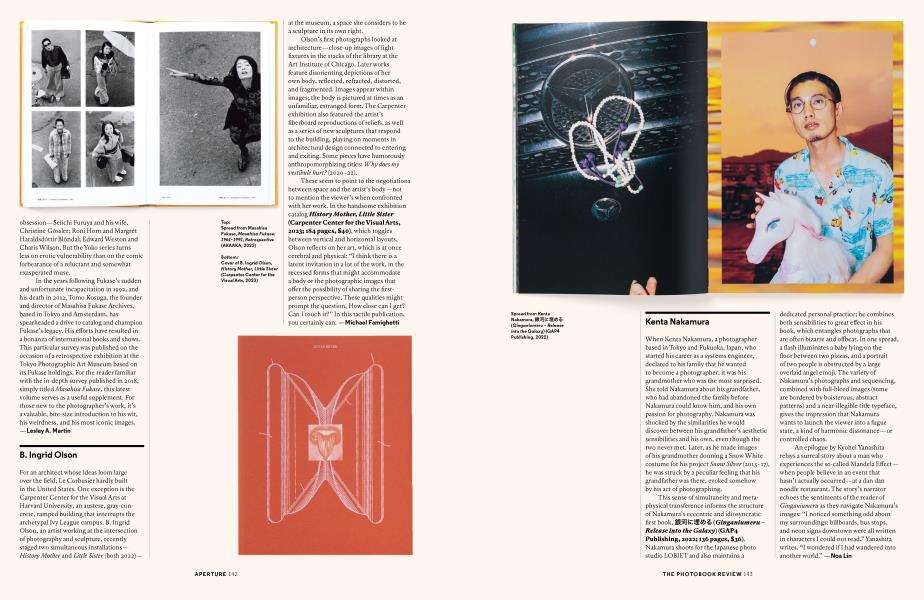
For an architect whose ideas loom large over the held, Le Corbusier hardly built in the United States. One exception is the Carpenter Center for the Visual Arts at Harvard University, an austere, gray-concrete, ramped building that interrupts the archetypal Ivy League campus. B. Ingrid Olson, an artist working at the intersection of photography and sculpture, recently staged two simultaneous installations— History Mother and Little Sister (both 2022)-
at the museum, a space she considers to be a sculpture in its own right.
Olson’s first photographs looked at architecture—close-up images oflight fixtures in the stacks of the library at the Art Institute of Chicago. Later works feature disorienting depictions of her own body, reflected, refracted, distorted, and fragmented. Images appear within images; the body is pictured at times as an unfamiliar, estranged form. The Carpenter exhibition also featured the artist’s hberboard reproductions of reliefs, as well as a series of new sculptures that respond to the building, playing on moments in architectural design connected to entering and exiting. Some pieces have humorously anthropomorphizing titles: Why does my vestibule hurt? (2020-22).
These seem to point to the negotiations between space and the artist’s body—not to mention the viewer’s when confronted with her work. In the handsome exhibition catalog History Mother, Little Sister (Carpenter Center for the Visual Arts, 2023; 184 pages, $40), which toggles between vertical and horizontal layouts, Olson reflects on her art, which is at once cerebral and physical: “I think there is a latent invitation in a lot of the work, in the recessed forms that might accommodate a body or the photographic images that offer the possibility of sharing the firstperson perspective. These qualities might prompt the question, How close can I get? Can I touch it?” In this tactile publication, you certainly can.
Michael Famighetti