Reviews
Reviews
Hans Wilschut
Among the most horrific reverberations of the Beirut port explosion of August 2020 was its sound. The detonation of 2,750 tons of ammonium nitrate produced a blast so powerful it was detected as a seismic event in Cyprus, more than 150 miles away across the Mediterranean Sea. Though most people viewed the destruction through camera-phone videos and followed dramatic tallies—over 220 dead, 7,000 injured, and 300,000 displaced—those in Beirut were reminded of familiar wounds from a not-long-ago civil war, and of the recurring failures of Lebanon’s political elite. “An explosion resonates across time,” the author and translator Lina Mounzer wrote the morning after the blast. “The people of Beirut have been shaped by the bombs that reconfigured this country.” The noise, in some form or other, persists.
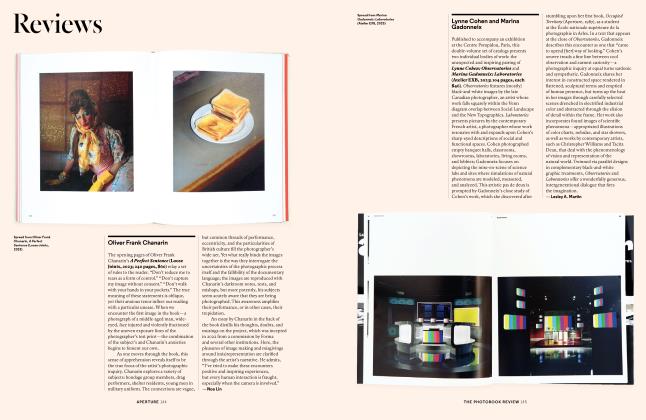
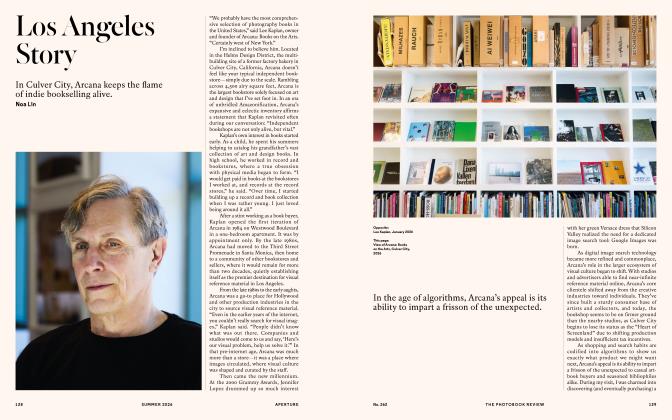
Hans Wilschut’s searching portraits of the aftermath are, in contrast, notably quiet. In Beirut, Epi-Centre Ville (FwsBooks, 2023; 128 pages, $34), the Dutch photographer attempts to register both the immediate and extended horror of the blast, choosing as his subjects the refigured urban facades of the city, often arranged in stark juxtapositions or stretched across full spreads. “I am looking for the signs of resistance in stillness,” he writes in a brief essay. The book references an earlier project, Beyrouth Centre Ville (1992), for which six photographers traveled to the capital to photograph its devastated downtown after the end of the civil war in 1990. Among them were losef Koudelka, Robert Frank, Fouad Elkoury, and Gabriele Basilico, the Italian photographer of cityscapes who helped shape Wilschut’s relationship to the urban space.
Like its precedent, Beirut, Epi-Centre Ville features almost no photographs of people. “They are absent but omnipresent,” writes the Lebanese novelist Dominique Edde, who contributed an essay to both books, “behind the windows, the holes, the hundred-times remade fabric of their city.” Amidst photographs of the mangled steel and concrete of shopping malls, mosques, and residential buildings, the reader is tasked with looking closely—archaeologically— at the possibility of each window, and what was lost.
Varun Nayar
Lin Zhipeng
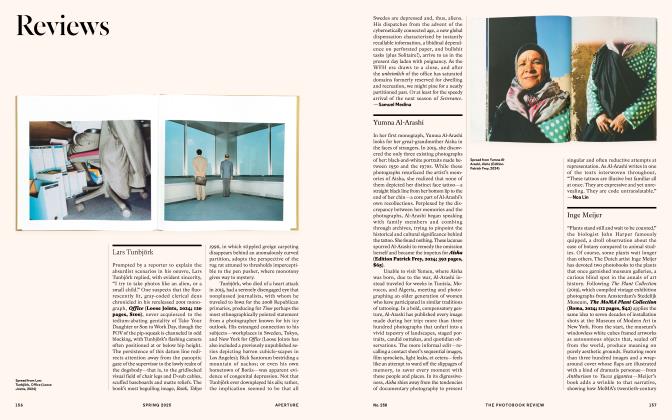
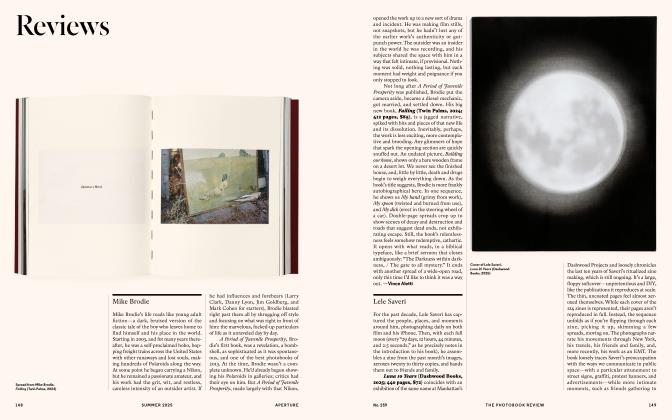
In his latest monograph, Skinny Wave (Same Paper, 2023; 254 pages, $50), Lin Zhipeng’s keen eye for symbolism and everyday idiosyncrasies constructs a strange and vibrant world. Zhipeng, who also goes by 223, a moniker borrowed from the pining police officer in Wong Kar-wai’s Chungking Express, is known for his dynamic photographs of Chinese youth culture— offbeat, colorful, and, more often than not, nude portraits of his friends that sit stylistically somewhere between the radical constructions of Ren Hang and the off-the-cuff, fashionable sensibility of Hiromix.
The magic of 223 lies in his ability to unite disparate subject matter through an attention to unusual and sublime patterns of light, form, and color. In Skinny Wave, anonymous, nude figures appear and disappear within fecund forests, beaches, and rivers. It’s a strange, vaguely Dionysian idea of nature: twisting branches, abundant flowers, an evocative splash of water against rock, each occasionally interrupted by signs of a world more recognizably modern—a flowering tree obscures the hood of a car, a dildo and hair dryer sit in an open desk drawer. Sometimes these two worlds merge. In one uncanny image, the smoke from a car engine blends into a cloud in the background. In this way, 223’s photographs possess a hallucinatory quality similar to Wong’s film.
The design of Skinny Wave complements 223’s striking images. Four unique, overlapping, one-side-coated jackets enclose an open spine-bound book block. This layering continues in the interior, where sheets of uncoated paper fold out to reveal horizontal images, interspersed among the standard folios. With no text apart from the colophon, Skinny Wave is a testament to 223’s ability to create an engaging, sensuous book carried by the power of image making. —Noa Lin
David Wojnarowicz
In the fall of 1978, a twenty-three-year-old David Wojnarowicz packed two bags and moved to Paris. It isn’t surprising that an artist known, in part, for his photographs of figures wearing Arthur Rimbaud masks around New York was drawn to the French capital. He planned to live an artist’s life there, to write a novel, to learn the language. He didn’t write the novel, but he did fall deeply in love with a man named Jean Pierre Delage, whom he met at a cruising spot in the center of the city, near the Tuileries Garden. A six-month romance ensued. When Wojnarowicz returned to New York, he and Delage kept up an intense exchange of letters, filled with images, desires, and the humdrum details of their everyday lives.
Wojnarowicz’s side of their threeyear correspondence has now been collected in a dense, six-hundred-page tome that reads as an illustrated diary. The book, simply titled Dear Jean Pierre (Primary Information, 2023; 616 pages, $40), is an engrossing visual and epistolary chronology that reveals the artist’s potent voice, the fits, starts, and frustrations of his early career, and his eye for imagery— through both his own work and postcard reproductions by everyone from Georgia O’Keeffe to Duane Michals. The book is a record of longing, loneliness, creative insecurity, and living precariously. Wojnarowicz always seems to be looking for a job or an apartment, or observing the extremes of the city’s weather— it’s hot, not so hot, it’s cold. Perennial New York concerns. Some letters are abbreviated; others are bricks of typewritten text with no paragraph breaks. We read of parties, of wild living, the Pope’s visit, NewWave bands on the ascent, wanderings on the waterfront, an encounter with Larry Clark’s Tulsa, photographs that remind him of Jean Genet, a favorite outlaw writer. Across the book’s many pages, we are reminded that Wojnarowicz was an artist who registered seemingly every vibration life offered, an artist the world lost far too soon.
Michael Famighetti
Aaron Turner
Aaron Turner’s Moves from the Archive (Sleeper Studio, 2023; 86 pages, §50) is the second offering in the Arkansas-based photographer’s ongoing project Black Alchemy Volumes 1, 2, and3. It’s a compelling meditation on abstraction, the archive, and the possibilities of photographic art making—and in particular, Black art making.
As an object, the book is simultaneously unassuming and ambitious, taking the form of a thin paperback volume with an exposed spine and double-fold, die-cut cover—a reenactment in ink and paper of the fractured, trompe l’oeil gestures that animate the work within. The fifty-three duotone interior images are studio constructs, echoing Laszlo Moholy-Nagy’s Light-Space Modulator images and drawing on a classically modernist ethos of experimentation and abstraction, albeit one fed via a distinct set of personal and cultural reference points.
The studio set-ups feature projected, pinned, folded, and layered images drawn from family photographs and portraits of James Baldwin, Bayard Rustin, David Hammons, and Frederick Douglass, among other icons of Black art and politics. Each image is accompanied by a title that runs vertically along the gutter, dropping further references to artists such as Carrie Mae Weems, Sol LeWitt, and Georgia O’Keeffe. The various call-outs, both visual and textual, function as an invocation—a recipe of sorts. Add two parts Douglass to equal portions of Hammons, LeWitt, and Weems, and an alchemical reaction sets to boil.
In There May Still Be Time Left (2022), Turner’s first volume within the Black Alchemy series, he asserts, “The photographs build a physical representation of my internal monologue ... a continuation of moves that are native to me, foreign in meaning to the viewer, but recognizable in the method.” In this second volume, the attentive viewer is ushered into a meticulously constructed image space and steeped in the artist’s visual ponderings on art history, American history, and the image. It’s a refreshing, entrancing book that leaves the viewer eager for the final volume. —Lesley A. Martin
RaMell Ross
In 2018, when the artist and filmmaker RaMell Ross sent out a Vimeo link to his film Hale County This Morning, This Evening, he implored viewers to use their best headphones, not a reedy laptop speaker. Every sound of his intimate documentary about Black life in Hale County, Alabama— which was nominated for an Oscar and has become one of the signal achievements of recent American cinema—was meant to be listened to with precision. Every thump of the basketball. Every revolution of the jump rope. Every outburst of thunder. Every spoken word or word misheard.
Ross’s photographs likewise possess a surround-sound quality, one that relies on imagination or recollection of the American South. “To be an index, a document, a testament, a moment, a facsimile, a reference, a distillation, a memory,” he writes in his monograph Spell, Time, Practice, American, Body (MACK, 2023; 252 pages, £50), “of that physical and nonphysical region. To feel of the South, and Southern, like an accent can. To ring the Southern bell. Gonggg.”
“Spell,” the first of the book’s five sections, opens with Ross’s interrogative image of a hand holding an iPhone, a run-down, white-columned plantation house set in the camera’s crosshairs. Ross’s mysterious, often gestural portraits and scenes—a church steeple lying supine in a parking lot, a smiling child in the trunk of a car—appear in a steady sequence interrupted only by his poem “Slangless,” a sly critique of Walker Evans and William Christenberry, who also chronicled Hale County and have long been totemic figures in Ross’s imagination: “part ghost, part momentum.”
From there, Spell, Time opens into four case studies that prove the expansive possibilities of the photobook as a vessel for forensics, video, sculpture, performance, and poetry. Ross breaks into a safe and discovers a cache of bullets and Confederate propaganda. He writes about the death of his mother and his discovery of photography. Designed like a schoolbook, with its riveted, three-hole-punch binding, Spell, Time is an assignment destined to be a classic, a claim on the future.
— Brendan Embser