Mixing The Media
A Look At Look
A LOOK AT LOOK
MIXING THE MEDIA
MARY PANZER
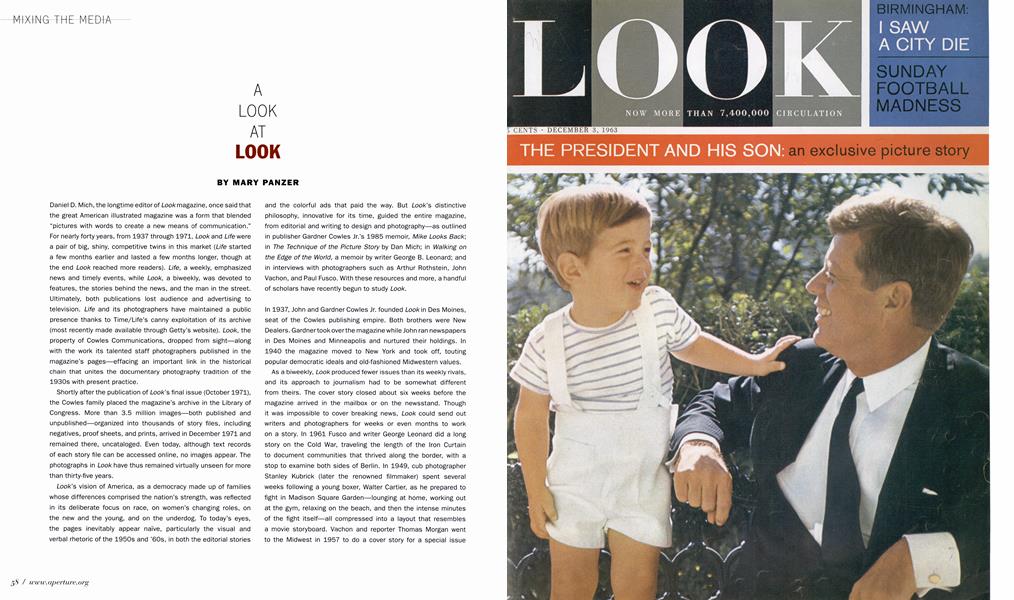
Daniel D. Mich, the longtime editor of Look magazine, once said that the great American illustrated magazine was a form that blended "pictures with words to create a new means of communication." For nearly forty years, from 1937 through 1971, look and Life were a pair of big, shiny, competitive twins in this market (Life started a few months earlier and lasted a few months longer, though at the end Look reached more readers). Life, a weekly, emphasized news and timely events, while Look, a biweekly, was devoted to features, the stories behind the news, and the man in the street. Ultimately, both publications lost audience and advertising to television. Life and its photographers have maintained a public presence thanks to Time/Life’s canny exploitation of its archive (most recently made available through Getty’s website). Look, the property of Cowles Communications, dropped from sight—along with the work its talented staff photographers published in the magazine’s pages—effacing an important link in the historical chain that unites the documentary photography tradition of the 1930s with present practice.
Shortly after the publication of Look’s final issue (October 1971), the Cowles family placed the magazine’s archive in the Library of Congress. More than 3.5 million images—both published and unpublished—organized into thousands of story files, including negatives, proof sheets, and prints, arrived in December 1971 and remained there, uncataloged. Even today, although text records of each story file can be accessed online, no images appear. The photographs in Look have thus remained virtually unseen for more than thirty-five years.
Look’s vision of America, as a democracy made up of families whose differences comprised the nation’s strength, was reflected in its deliberate focus on race, on women’s changing roles, on the new and the young, and on the underdog. To today’s eyes, the pages inevitably appear naive, particularly the visual and verbal rhetoric of the 1950s and ’60s, in both the editorial stories and the colorful ads that paid the way. But Look’s distinctive philosophy, innovative for its time, guided the entire magazine, from editorial and writing to design and photography—as outlined in publisher Gardner Cowles Jr.’s 1985 memoir, Mike Looks Back; in The Technique of the Picture Story by Dan Mich; in Walking on the Edge of the World, a memoir by writer George B. Leonard; and in interviews with photographers such as Arthur Rothstein, John Vachon, and Paul Fusco. With these resources and more, a handful of scholars have recently begun to study Look.
In 1937, John and Gardner Cowles Jr. founded Look in Des Moines, seat of the Cowles publishing empire. Both brothers were New Dealers. Gardnertook overthe magazine while John ran newspapers in Des Moines and Minneapolis and nurtured their holdings. In 1940 the magazine moved to New York and took off, touting popular democratic ideals and old-fashioned Midwestern values.
As a biweekly, Look produced fewer issues than its weekly rivals, and its approach to journalism had to be somewhat different from theirs. The cover story closed about six weeks before the magazine arrived in the mailbox or on the newsstand. Though it was impossible to cover breaking news, Look could send out writers and photographers for weeks or even months to work on a story. In 1961 Fusco and writer George Leonard did a long story on the Cold War, traveling the length of the Iron Curtain to document communities that thrived along the border, with a stop to examine both sides of Berlin. In 1949, cub photographer Stanley Kubrick (later the renowned filmmaker) spent several weeks following a young boxer, Walter Cartier, as he prepared to fight in Madison Square Garden—lounging at home, working out at the gym, relaxing on the beach, and then the intense minutes of the fight itself—all compressed into a layout that resembles a movie storyboard. Vachon and reporter Thomas Morgan went to the Midwest in 1957 to do a cover story for a special issue about teenagers; the journalists’ surprisingly candid report could not have been produced under deadline—or with preconceptions, aside from the typical Look view that kids were interesting and an essential part of the nation’s future.
More important than the taste for youth culture, and the generally liberal political view, Look touched the volatile issue of race in America more consistently than any other popular magazine of its time. This coverage begins in the 1940s and includes articles such Ernest Dunbar’s in-depth profile of NAACP organizer Ruby Hurley, who was an important official in Mississippi in the 1950s (Wil Blanche took the photographs); Carl Rowan’s challenging essays illustrated by Vachon’s images from the deep South; frank discussion of segregation in the north, and the work of integrating schools. Hodding Carter, Pulitzer Prize-winning editor of the Delta Democrat Times in Mississippi, was a frequent contributor on the subject of segregation (he tried to defend it). When Emmett Till’s killers confessed their crimes, Look got the story: William Radford Huie’s “The Shocking Story of Approved Killing in Mississippi” appeared in January 1956 after the men were acquitted. In all these pieces, Look’s point of view remained firmly with the black protagonist, not the writer or photographer. Life preferred to stick with the reporter on stories about race (most often through the work of African-American photographer Gordon Parks, who provided both images and text). At Look, no single reporter covered this beat. Though many stories were written by Dunbar, a leading black journalist who became a Senior Editor, plenty of others were produced by white writers. There were no black photographers on staff, but whoever produced the stories, they were frequent and varied. In many ways the unremarkable presence of this subject is
the most impressive sign of Look’s commitment to it.
The chief source of Look’s distinctive vision was the editor Dan Mich, who joined the magazine as a young man in 1937, straight from the Wisconsin State Journal, and, with one brief interruption, remained at Look for the rest of his life (he died at the age of sixty in 1965). Mich’s quiet, exacting style combined a fundamental belief in the freedoms guaranteed by the U.S. Constitution with an absolute intolerance of mediocrity. He was responsible for Look’s collaborative method of creating a story. The writer and photographer pitched an idea to the editors; if it was approved, the team went out; later, the art director and editor assigned the number of pages; then the writer, photographer, art director, and graphic designer together built the story that appeared in the magazine.
Modernist graphic-designer Merle Armitage was Look’s first art director, but its most influential was Allen Hurlburt, who began in 1953 and stayed with the magazine to the end. Hurlburt is given credit for Look’s lively design, always up-to-date and always using photographs in new ways—not as simple accompaniment to the text, but as true content.
Look’s staff photographers were generalists, and as a result long-timers like Phil Harrington or James Hansen were never able to develop a style that transcended that of the magazine. For special assignments, Look brought in experts—and paid them top dollar. Irving Penn shottravel and food stories; Philippe Halsman did portrait assignments. In 1957, Look hired Weegee (Arthur Fellig), crimephotographer-turned-social-satirist, already a national celebrity, to do a color story about spring hats. His comic distortions upstaged Look’s staff fashion photographer, Michael Vaccaro, whose task was to provide straight pictures of the milliners’ work. Magnum photographers sold reportage that was generally too racy or risky for Look to assign to staff; nonetheless, this is where René Burri published a long story on Cuba, complete with an iconic image of Che Guevara. In 1968, when Look wanted to put together an issue about the counterculture, they hired Richard Avedon to make portraits of the Beatles. For the same issue, Penn spent several weeks in San Francisco, photographing rock bands, hippie families, and members of the Hell’s Angels (Penn had first pitched the story to Vogue; they turned it down).
In manyways, Lookphotographerscontinuedtheworkofthe Farm Security Administration (FSA) and the Office of War Information (OWI: the propaganda organization that took over the FSA after 1941). Almost from the start, the Look photography department was run by Arthur Rothstein, one of the first photographers to be hired for the FSA. It was he who brought in FSA alumni John Vachon and Charlotte Brookes as Look staff photographers—and who perpetuated a distinctly FSA/OWI approach to photography: focusing on a wide sociological range of subjects, and looking hard and deep at both subject and context. Their subjects were never, to borrow a term from contemporary criticism, “Other.”
How did these mandates influence the formal structure and sequencing of photographs? Consider Rothstein’s 1947 story on gambling: the layout begins with a single, forceful, poster-style
image followed by two-page spreads of a mosaic of visual vignettes. The compositions are clear and simple, the tones bright. The views are candid, made from the perspective of a man in the crowd. Rothstein does not appear to implicate his subjects so much as join them. This stance allows the viewer to come close without feeling like intruders. He makes us, however briefly, part of the scene.
This viewpoint transcended both age and race. In 1956, Douglas Jones and Vachon accompanied writer George Leonard to Philadelphia for a story called “Jim Crow, Northern Style: You Never Know What to Expect” about middle-class, professional African-Americans living in Philadelphia, and their experience with racism, which was more subtle but just as pervasive as in the South. Fifty years later, it is difficult to imagine the shock such images must have delivered to white readers. But a search through 1950s mainstream media for images of the black middle class shows how very rare and valuable these portraits remain.
Look’s 1957 special issue on teens was designed as a “primer” for parents of the postwar generation. Vachon and Tom Morgan spent time in Gary, Indiana, and Mt. Pleasant, Iowa, following a few young couples, spending time in high schools, and hanging out with groups of kids, even some delinquents. The two reporters achieved a picture that resists both generalization and judgment. Vachon’s characteristically strong compositions emphasize the volumes and barely contained energy of these youngsters.
In the late 1950s, a new generation of photographers joined the staff, color stories became more frequent, and the magazine’s layouts lost their early, boxy style.
In 1959 Fusco, one of the newly hired talents, went with Morgan to the New York City streets that had inspired Leonard Bernstein’s immensely popular 1957 musical West Side Story. In place of pretty girls and well-choreographed gang members, however, Fusco showed a much realer vision of gritty, sexy street life.
Like Fusco, James Karales garnered much attention with his photographs of Vietnam and the civil-rights movement. Karales began his career as a darkroom assistant to W. Eugene Smith, and Karales’s dark, expressive prints and allegorical compositions betray his debt to Smith. In 1963, Karales joined Sam Castan for the first of several assignments in Vietnam. Castan was head of Look’s Southeast Asia bureau, and one of the earliest critics of the U.S. presence in Vietnam. As was typical for the magazine, the story took about six months from start to finish; it was assigned and reported while John F. Kennedy was still alive, but was not published until January 1964, just after Johnson had settled into the White House. With their story “What Johnson Faces in South Vietnam," Karales and Castan introduced a relatively new subject to their readers. Karales’s photograph of a U.S. soldier carrying the body of a young girl accidentally shot by South Vietnamese soldiers uses an allegorical composition to convey the misery and complexity of the war, and the reality of American and Vietnamese soldiers fighting and dying. The story did not condemn the fight against Communism, but stated outright that the United States was losing the war.
Indeed, Look was notable for allowing its reporters to take a stand. Fusco remembers a 1961 article by writer J. Robert Moskin and photographer James Hansen, about U.S. military stationed in Berlin. When Moskin returned from Germany, Dan Mich made it clear that he did not agree with the point of view of the story, which argued against the U.S. Army’s open-ended commitment to remaining in West Berlin. “But he published it,” recalls Fusco. Apparently, this was not uncommon: Look’s editors trusted their reporters. “You were there,” Fusco says, so “you know what’s going on. You decide what the story should be.”
For more than thirty-five years, Look has existed as an inaccessible archive, a set of old magazines, and a dim part of our common memory. For an unlucky group of photographers, thousands of excellent picture stories have been locked up, largely because until now, there was virtually no way to see, publish, or exhibit this work. This is already changing with the viewing opportunities the Web provides. But perhaps we also had to wait until common memory had faded sufficiently—for nostalgia to be replaced with genuine curiosity, as a motive for considering this medium and this work. When the cataract over the lens of history no longer blurs our vision, the view can be dazzling.©
Important sources for this article include Pat Carbine, Paul Fusco, Will Hopkins, Thomas B. Morgan, Jr., and Betty Sands. The author is indebted to the excellent work of scholars and curators, especially Sally Stein’s “Mainstream-Differenzen: Das unverwechselbare Aussehen von Life und Look in der Medienkulture der USA, " in Herta Wolf, ed., Diskurse der Fotografie (Frankfurt am Main: Suhrkamp, 2003), pp. 135-72; and to Beverly Brannan, Curator of Photography, Prints and Photographs Division, the Library of Congress, and Barbara Natanson, primary author of the Look collection website at the L.O.C.: http://lcweb2.loc.gov/pp/lookhtml/lookabt.html. Some Look files for New York stories are housed at the Museum of the City of New York. Reproductions courtesy Columbia University Libraries.