SHOT OUT OF THE CANON Advertising Photography in Vogue Magazine, 1930s-1950s
ARCHIVE
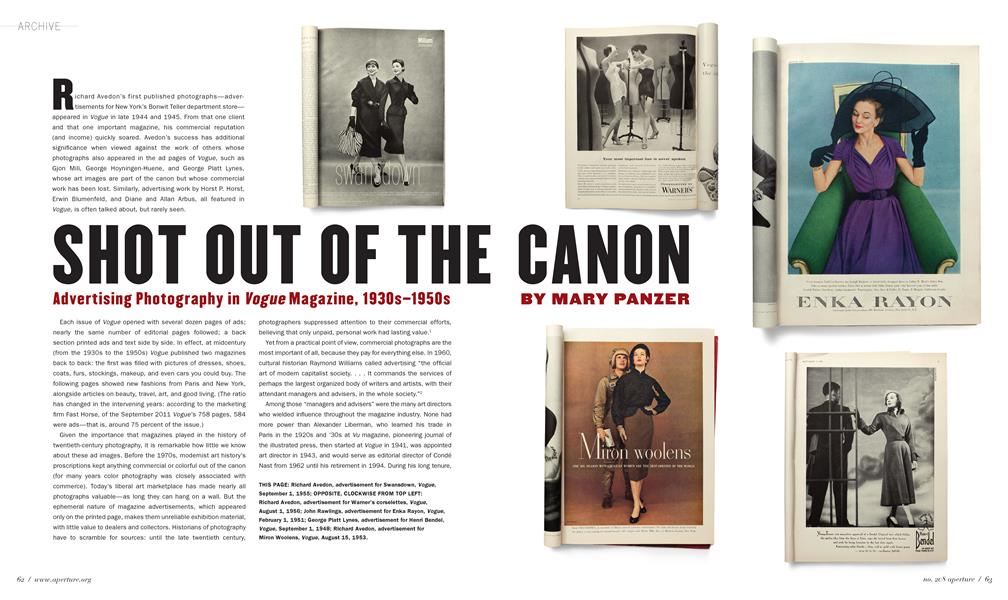
Richard Avedon's first published photographs—advertisements for New York’s Bonwit Teller department store— appeared in Vogue in late 1944 and 1945. From that one client and that one important magazine, his commercial reputation (and income) quickly soared. Avedon’s success has additional significance when viewed against the work of others whose photographs also appeared in the ad pages of Vogue, such as Gjon Mili, George Hoyningen-Huene, and George Platt Lynes, whose art images are part of the canon but whose commercial work has been lost. Similarly, advertising work by Horst P. Horst, Erwin Blumenfeld, and Diane and Allan Arbus, all featured in Vogue, is often talked about, but rarely seen.
Each issue of Vogue opened with several dozen pages of ads; nearly the same number of editorial pages followed; a back section printed ads and text side by side. In effect, at midcentury (from the 1930s to the 1950s) Vogue published two magazines back to back: the first was filled with pictures of dresses, shoes, coats, furs, stockings, makeup, and even cars you could buy. The following pages showed new fashions from Paris and New York, alongside articles on beauty, travel, art, and good living. (The ratio has changed in the intervening years: according to the marketing firm Fast Horse, of the September 2011 Vogue’s 758 pages, 584 were ads—that is, around 75 percent of the issue.)
Given the importance that magazines played in the history of twentieth-century photography, it is remarkable how little we know about these ad images. Before the 1970s, modernist art history’s proscriptions kept anything commercial or colorful out of the canon (for many years color photography was closely associated with commerce). Today’s liberal art marketplace has made nearly all photographs valuable—as long they can hang on a wall. But the ephemeral nature of magazine advertisements, which appeared only on the printed page, makes them unreliable exhibition material, with little value to dealers and collectors. Historians of photography have to scramble for sources: until the late twentieth century, photographers suppressed attention to their commercial efforts, believing that only unpaid, personal work had lasting value.1
Yet from a practical point of view, commercial photographs are the most important of all, because they pay for everything else. In 1960, cultural historian Raymond Williams called advertising “the official art of modern capitalist society. ... It commands the services of perhaps the largest organized body of writers and artists, with their attendant managers and advisers, in the whole society.”2
Among those “managers and advisers" were the many art directors who wielded influence throughout the magazine industry. None had more power than Alexander Liberman, who learned his trade in Paris in the 1920s and ’30s at Vu magazine, pioneering journal of the illustrated press, then started at Vogue in 1941, was appointed art director in 1943, and would serve as editorial director of Condé Nast from 1962 until his retirement in 1994. During his long tenure, Liberman kept all the magazines up to date, but never let the visual focus of the editorial pages stray from the content his readers had paid to see. At Vogue, every feature, from Irving Penn’s studio photographs of haute couture to Frances McLaughlin-Gill’s sportswear shots made on a plantation, preserved the illusion that readers were staring through a transparent wall at a world that looked remarkably real. As writer Dawn Powell acidly observed in 1963, Vogue had one overriding function: “to provide delicious discontent. Here is what other people have and you haven’t; here is where some go and never you. Here is the lovely land of never, and you may dream of it, but that’s all.”3
MARY PANZER
Overall, Vogue’s advertising carried far more variety and more innovation than its editorial section. Throughout the 1940s ad pages included work by artists such as Salvador Dali, Christian Bérard, and René Bouché. Cultural taboos challenged artists and photographers to sell brassieres, girdles, and negligees without inspiring the “wrong” kind of desire. Vogue staff photographers, such as John Rawlings, Toni Frissell, and even Penn, made plenty of ads, adhering to editorial rules—a useful strategy for advertisers, who could be confident that their pages would compete successfully with editorial for viewers’ attention. And ads from department stores, fabric companies and manufacturers, and dress manufacturers show that advertisers used Vogue to reach the whole garment trade, not just retail customers. Vogue’s ad pages also featured work by Harper’s Bazaar staff members, such as Louise Dahl-Wolfe and Lillian Bassman.
Familiar styles stand out. Mili applied multiple exposures to ads for Saks Fifth Avenue. Dayton’s of Minneapolis bought Blumenfeld double spreads that required readers to physically rotate the magazine into a long vertical. Frissell photographed her friends for Garfinkel’s in Washington, D.C. Lynes’s surrealist-inflected images appeared for years at the opening of Vogue as full-page ads for New York department stores such as Henri Bendel, Bergdorf Goodman, and Bonwit’s (before Avedon took that client away). Using stark, surreal settings he delivered surprising images with the freedom and implausibility of dreams.
Even in such sophisticated company, Avedon’s originality comes through. Every frame is tense with contrast between dark and light, slim and full, real and artificial. Most notably, his models are not actors behind glass. They occupy a different world, where it’s always breezy, and there’s always something going on—like a man outside the frame reaching in to hand a woman flowers. This world is a frank fantasy, but the price of entry is within reach—just buy a dress made of Enka Rayon. (Or buy one for your customers to find at the store.)
Access to this material has just grown much easier. In late 2011 Condé Nast launched a digital archive of Vogue. They scanned more than four hundred thousand pages, every issue from 1892 to today, and cataloged them using information from the original images and captions; you can search by photographer, model, designer, advertiser, and more. Less fun (and less dusty) than leafing through the actual pages—this is also much more expensive: an annual subscription to the digital archive costs around $1,500.
But whole careers can be uncovered, and missing chapters added to others. The canon will not change much. However, we can now begin to follow the history of photography along a narrative motivated by dollars and common sense.©
NOTES
1 Important reading on this subject includes: Patricia Johnston, Real Fantasies: Edward Steichen’s Advertising Photography (Berkeley: University of California Press, 1997), and Michele H. Bogart, Artists, Advertising, and the Borders of Art (Chicago: University of Chicago Press, 1995).
2 Raymond Williams, “The Magic System,” New Left Review 1, no. 4 (April 1960); repr. in Simon During, ed., The Cultural Studies Reader (London and New York: Routledge, 1993), pp. 421-22.
3 Dawn Powell, “Lovely Land of Never," New York Times, November 3, 1963, Book Review.
More From This Issue
-
 Theme And Variations
This Thing Called War And These People Called Photographers
Fall 2012 -
 Dialogue
The Past And Other Countries
Fall 2012 -
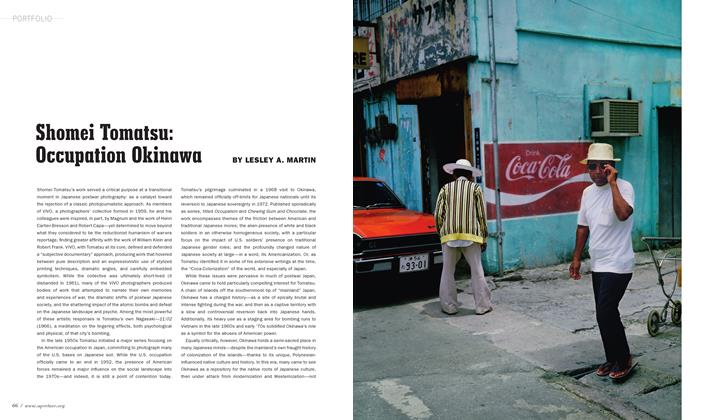 Portfolio
Shomei Tomatsu
Fall 2012 -
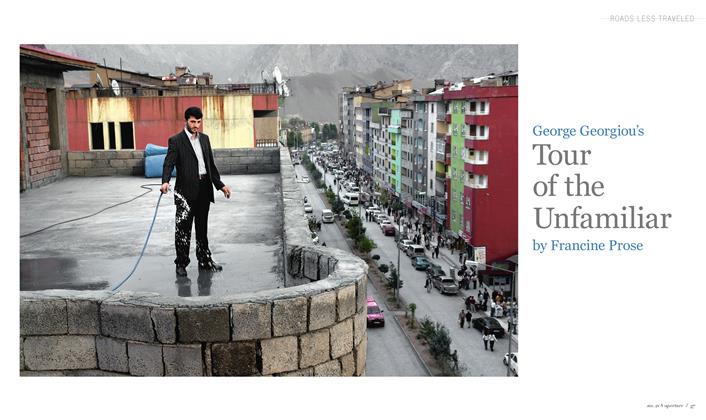 Roads Less Traveled
George Georgiou’s Tour Of The Unfamiliar
Fall 2012 -
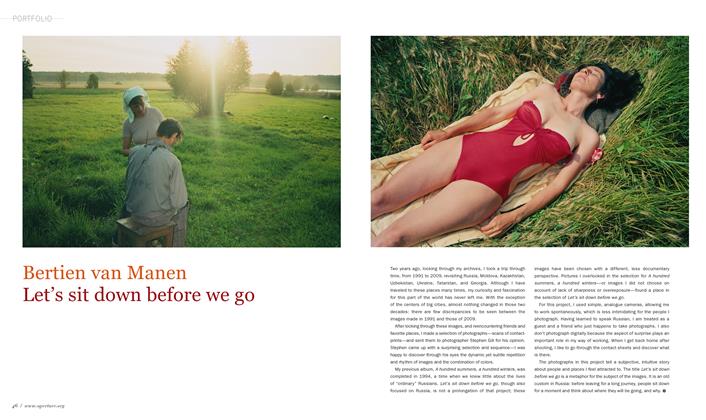 Portfolio
Bertien Van Manen Let's Sit Down Before We Go
Fall 2012 -
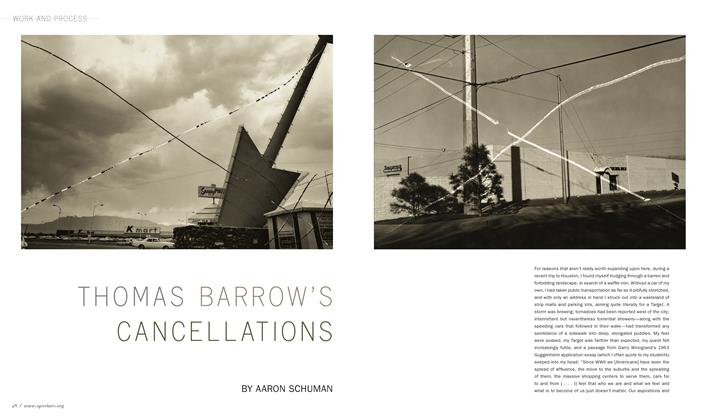 Work And Process
Thomas Barrow's Cancellations
Fall 2012
Mary Panzer
Archive
-
 Archive
Doisneau Noir
Winter 2004 -
 Archive
Jean Depara: Night And Day In Kinshasa
Summer 2012 -
 Archive
Russian Pictorialism: The Good, The Pure, And The Everlasting
Spring 2003 -
 Archive
Folk Photography The American Real-Photo Postcard
Fall 2009 -
 Archive
On The Art Of Lee Miller
Spring 2007 -
 Archive
Lost Worlds
Winter 2003


