On Feminism
On Feminism
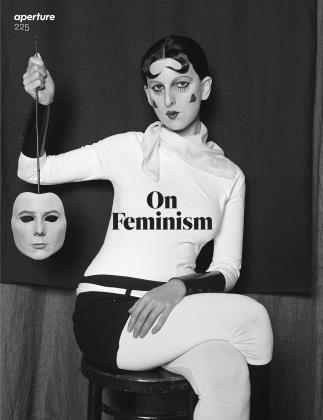
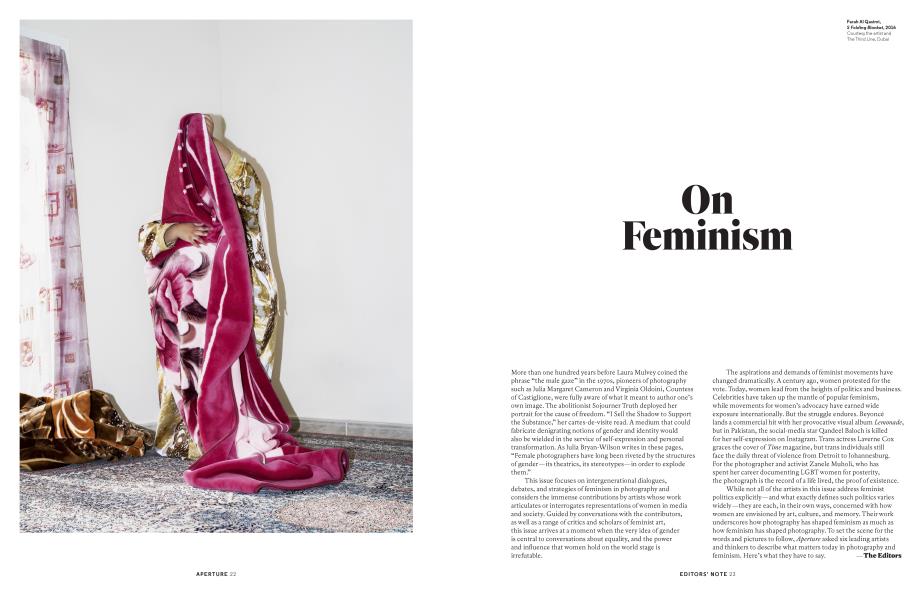
More than one hundred years before Laura Mulvey coined the phrase “the male gaze” in the 1970s, pioneers of photography such as Julia Margaret Cameron and Virginia Oldoini, Countess of Castiglione, were fully aware of what it meant to author one’s own image. The abolitionist Sojourner Truth deployed her portrait for the cause of freedom. “I Sell the Shadow to Support the Substance,” her cartes-de-visite read. A medium that could fabricate denigrating notions of gender and identity would also be wielded in the service of self-expression and personal transformation. As Julia Bryan-Wilson writes in these pages, “Female photographers have long been riveted by the structures of gender—its theatrics, its stereotypes—in order to explode them.”
This issue focuses on intergenerational dialogues, debates, and strategies of feminism in photography and considers the immense contributions by artists whose work articulates or interrogates representations of women in media and society. Guided by conversations with the contributors, as well as a range of critics and scholars of feminist art, this issue arrives at a moment when the very idea of gender is central to conversations about equality, and the power and influence that women hold on the world stage is irrefutable.
The aspirations and demands of feminist movements have changed dramatically. A century ago, women protested for the vote. Today, women lead from the heights of politics and business. Celebrities have taken up the mantle of popular feminism, while movements for women’s advocacy have earned wide exposure internationally. But the struggle endures. Beyoncé lands a commercial hit with her provocative visual album Lemonade, but in Pakistan, the social-media star Qandeel Baloch is killed for her self-expression on Instagram. Trans actress Laverne Cox graces the cover of Time magazine, but trans individuals still face the daily threat of violence from Detroit to Johannesburg.
For the photographer and activist Zanele Muholi, who has spent her career documenting LGBT women for posterity, the photograph is the record of a life lived, the proof of existence.
While not all of the artists in this issue address feminist politics explicitly—and what exactly defines such politics varies widely—they are each, in their own ways, concerned with how women are envisioned by art, culture, and memory. Their work underscores how photography has shaped feminism as much as how feminism has shaped photography. To set the scene for the words and pictures to follow, Aperture asked six leading artists and thinkers to describe what matters today in photography and feminism. Here’s what they have to say.
The Editors
EDITORS’ NOTE
Catherine Morris
Photography’s emergence as a vital medium in alternative practices, particularly conceptual art, corresponds with the growth of the women’s liberation movement in the United States and Europe in the 1960s. Women artists interested in documenting themselves and their lived experience aligned easily with feminism. Photography, seemingly a less fraught medium for women artists to take up—since it lacked entrenched historical baggage and engaged fewer heavily invested male egos—offered flexible and unencumbered opportunities outside traditional studio practices.
Conceptualand performance-based actions, such as those documented by Martha Wilson, utilized the medium in distinctly unpretentious and utilitarian ways. While the photograph Posturing: Male Impersonator (Butch) (1973/2008) is deceptive, what it isn’t, according to most viewers and Wilson herself, is convincing in its posturing. The initial task Wilson set up for her in-drag self
was an experiment in visual perception. Asking her boyfriend to take photographs as she moved incrementally closer to the camera, Wilson wanted to see if there was a distinct moment when the camera exposed her gender-bending charade.
(The single photograph presented here is extracted from her series Posturing.) After these images were shot, Wilson expanded her project, venturing into a Halifax, Nova Scotia, men’s room to see if unsuspecting men would discern her subterfuge as readily as her boyfriend’s viewfinder had. One of this photograph’s deceptions, then, is the implication that the picture was taken for purposes of illustrating the narrative attached to it, when, in fact, it was taken before Wilson even had the idea for her performative confrontation. It doesn’t offer any actual information about the moment it purports to document.
Wilson credits the conceptual performance artist Vito Acconci, a visiting professor at Nova Scotia College of Art & Design when she was studying there in 1973, with giving her the agency to consider the tropes of gender as legitimate subjects for art making. Out of her personal interior dialogues of critique and insecurity, she wanted her work to honestly and humorously describe the weight of internalized social scrutiny under which women somehow managed to function.
That same year Wilson met the critic Lucy R. Lippard, who was also at the school as a visiting critic. In a resonant gesture of support, Lippard assured Wilson the work she was doing was art, and through their conversations Wilson began to understand that it was feminist.
In 2016, we might easily consider the portrait in Posturing: Male Impersonator (Butch) a successful enactment of gender self-positioning—Wilson appears as a challenge to binary representation, sitting comfortably and critically within an understood spectrum of culturally proscribed gender indicators. But in 1973, Wilson’s impersonation of a man was a failure confirmed by the first cisgender man she encountered on her brave, if brief, foray into a public restroom: a barked command—“Get out”—marked the entire span of her performance. With their crafty ambiguity, Wilson’s 1970s activities, impulses, and priorities continue to reflect feminist sensibilities that resonate in many photographic practices today.
— Catherine Morris is Sackler Family Curator of the Elizabeth A. Sackler Center for Feminist Art at the Brooklyn Museum.
Zanele Muholi
All that I do is about advocacy: it’s about visual activism; it’s about pushing an agenda; and it just happens that photography is an easy means of articulation. So for those who don’t understand what’s going on, they get to see and have an understanding, and maybe those who are curious get to ask questions.
In South Africa, we legalized same-sex marriages under the Civil Union Act of 2006.
We set a good example as Africans within the continent by giving this human right to those who want to practice same-sex marriage, and who also want to live their lives as recognized spouses— as human beings. But, as we celebrate this tenth anniversary, we also remember those we have lost along the way due to hate crimes. Visibility becomes the key element in all of this.
How do these wedding pictures connect with many other things that I do? I work in categories.
I take images of weddings and juxtapose them next to funerals of the LGBT human beings who are being butchered on a daily basis. As I write, there was a seventeen-year-old who was killed on Saturday, August 6, in Northwest province. Even as you want to embrace these same-sex marriages, you can’t forget that there is so much violence that is happening at the same time. The violence blurs all the milestones.
Consider those couples who are in the open. They have a white wedding in societies where queerphobia, transphobia, lesbophobia, and homophobia is still rife. People are risking their lives—and yet, at the same time, helping many who are benefiting from those coming-out sessions. You cross your fingers, and hope after photographing a wedding that nothing happens to those people who got married, because you don’t want to feel as if you outed them, but to say that the people who are already out just happen to be there.
For me, it goes beyond just the marriage; it goes beyond just this beautiful family portrait. It becomes a political process. We capture these images for posterity. We are enjoying all these freedoms now, and these kinds of visuals then inform many people beyond just the LGBT community—the different institutions that use the marriage for education, or use the marriage to further their own organizational agendas.
— Zanele Muholi is a photographer and visual activist based in South Africa.
Laurie Simmons
My series How We See (2015) is partly concerned with directives in language and the expectations imposed by pronouns like he, she, it, they, them. There is an assumption of universality in this title— black and white, boys and girls, chocolate and vanilla. In How We See, I am directing a viewer how to see while asking that they attempt to make eye contact with women who can’t gaze back.
The subjects’ closed eyelids have realistic eyes painted on them by makeup artists Landy Dean and James Kaliardos. While shooting, I thought carefully about formal methods of portraiture that put forward conventional roles, like school photos and engagement announcements.
Each one of the models I posed in this series presents a very glamorous version of feminine beauty. Two of the models are trans women. Social media allows us to perform identity, to put forward our most desirable versions of ourselves while simultaneously questioning the nature of those desires—our deepest yearnings and vulnerabilities.
I certainly think about the shifting and fluid nature of gender roles and identity in how we present ourselves online. The possibilities for constructing a visual, physical, and theoretical identity are overwhelming at the moment. Social media also allows us a level of control in our presentation of self that isn’t always possible in real life. How do we reconcile the personal with the public? What does it mean to show the face you were born with? Does such a thing still exist?
— Laurie Simmons is an artist, photographer, and filmmaker based in New York.
Johanna Fateman
Cindy Sherman’s recent show at Metro Pictures in New York refreshed her legendary status, invoking her perennially cited, prescient, and game-changing series Untitled Film Stills (1977-80) while breaking new ground. The new photographs, from 2016, comprise an almost parallel indexical series. They are imprecisely but evocatively referential portrayals of actresses—not the starlet types of her black-andwhite Stills, but women-beyond-a-certain-age from Hollywood’s golden era, played (as always, in Sherman’s work) by the artist herself, who is now in her early sixties.
Ungracefully aging, some would say, the women she depicts are ultramaquillaged and unflattered by the period’s thin arched eyebrows, dark lips, and tight ringlets. One thinks of the abject comeback narrative of Sunset Boulevard (1950)— but also of Jack Smith’s film Flaming Creatures (1963), with its incantatory drag flamboyance. If Sherman, throughout her career of shape-shifting, has profited from a particular versatility—the screenor vessel-like neutrality bestowed on white femininity—she now exploits its expiration date.
In contrast to her treatment of the portraits’ backgrounds (they are highly manipulated), she’s done little to filter the signs of aging from her face, neck, and hands. Past that “certain age,” we find she’s more specific, less malleable, more “herself.”
The show was a reminder that, as the artist continues to draw from a pop-culture reservoir of images, she adds to it, too. Her self-sufficient studio practice, an awfully influential tradition of something like self-portraiture, was once a
harbinger of social media’s defining representational
mode. Now, her work is inevitably in the mix.
While Sherman’s striking images have taken on a new aura of permanence—her dye-sublimation metal prints slyly evoke, say, the durable panels of photographic abstraction used for modern decor in hotel lobbies—they’re not so unlike the zillions of snaps that are born in a phone, live in a feed, and die in the cloud.
In Public, Private, Secret, last summer’s inaugural show for the International Center of Photography’s new location on the Bowery, in New York, Sherman’s Untitled (1979)—a film noir-ish image of the artist in a platinum wig and sunglasses, painting her toenails and smoking on a leafy patio—was installed next to a fifteen-minute looping video of hands flipping through Kim Kardashian West’s Selfish (2015), a book of selfie photography celebrating a particular aesthetic—or lifestyle—of enhanced naturalism. It’s not a straight shot between these works, of course, but rather a long and winding road. Over the past four decades, authenticity and artificiality have been forever dislodged as poles of self-portraiture, thanks, in large part, to Sherman’s career-spanning oeuvre of serial exploration and incremental variation.
But the implicit feminism of her work—its wily deconstructionist transgression—is a quality not always shared by the proliferation of recent art so indebted to hers. Instantaneity, oversharing, and the garnering of likes are new, often gendered demands generated by social-media platforms, but the infiltration and disruption of such image trafficking is not (certainly not only) a young woman’s game.
— Johanna Fateman is a writer, musician, and owner of Seagull Salon in New York.
Zackary Drucker
When I was fourteen years old, I shoplifted a copy of Kate Bornstein’s book Gender Outlaw from Barnes & Noble. I don’t know what possessed me, but I discovered a whole way of thinking about gender that I never knew was possible, that was so accessible and easy to understand. I realized that I was a part of that legacy.
As a trans woman, I was exposed to so few images of other trans people in my early years. Representations of trans people were limited to talk shows. You had these early pioneers jumping into the lion’s den. Just so brave. It was a really popular theme in the 1990s, the reveal that somebody you’d had sex with was actually born— assigned—male at birth, and there would be a scandalous moment when they announced they were not who they said they were. That kind of scene was probably my only exposure to the possibility of a gender that wasn’t just cis male or female.
For too long, our history has been concealed and hard to find. We’re just now starting to uncover these archetypal moments of perseverance. My work with Flolly Woodlawn, Vaginal Davis, Kate Bornstein, these trans elders, fairy godmothers, has been key to understanding my own life as sustainable. Art making can provide a space for intergenerational bonding. That was how I became close to Flawless Sabrina, a performer, activist, and maker of the trailblazing 1968 documentary The Queen, whose archive I’m now helping to preserve. For me, these relationships have always been proof that it’s possible to live outside of the rules, to survive brutal intolerance.
So, when I think about photography and feminism, and trans feminism, I also think trans feminism is an extension of the work that women have been doing for centuries, the work that feminists and queer activists have been doing to fight for equal rights. I think about those amazing archival images of the activists Sylvia Rivera and Marsha P. Johnson, protesting with their group STAR (Street Transvestite Action Revolutionaries) in the early 1970s at the Christopher Street parade. They ostensibly ignited the Stonewall riots in 1969, yet they were very quickly erased from the early history of the Gay Liberation Front.
It’s astounding to measure the progress we’ve made over the past, say, fifty years. As the fight for gender equality continues, and as we’ve opened up our definitions of men, women, and folks in
between, we’re moving toward a horizon where people are free from the gender binary. That’s coming with the next generation, for whom the Internet and social media are really important sites for community formation.
But even as the Internet has opened new opportunities to project images of self-exploration and to connect with others, we still have to be vigilant. I’ve been thinking about the Pakistani social-media star Qandeel Baloch, who was murdered in July by her brother in an honor killing. We are living in a globalized world, where all of the atrocities and freedoms of other nations are in our visual realm, right in front of us, on our screens, in our hands. It’s imperative that we set a precedent of liberation, of women having autonomous identities, selves, sexualities, agency over our representation, and not having our bodies regulated by men. You know, trans people are still not fully protected as citizens. We are part of a long fight, a long struggle.
— Zackary Drucker is an artist based in Los Angeles and a producer of the Amazon series Transparent.
A. L. Steiner
The patriarchy has no gender. After teaching visual arts for the past fifteen years in higher education,
Fve found that a majority of academics do not ascribe to any form of lived practice or social activism connected to their scholarship, and have fully embraced a neoliberal agenda. Fve watched feminist-identified academics vying exclusively for power and money, no longer for pedagogy, learning, or social justice. Fve witnessed “award-winning” academics lie and threaten faculty for organizing to change non-tenure-track pay scales, which have been frozen since 1995. Fve seen those claiming various forms of “feminisms” pillage funds, renege on funding and curricular offers, and lie to students, staff, faculty, and each other under the guise of “competition” and “meritocracy,” simplistic covers for inequity and corruption.
I was told explicitly that it doesn’t matter who teaches the university’s classes.
“Lean in” feminism is capitalism’s handmaiden, as philosopher and author Nancy Fraser stated in the New York Times last year. Feminists such as Paula Gunn Allen, Gloria Anzaldúa, Grace Lee Boggs, Silvia Federici, bell hooks, Audre Lorde, and Benita Roth, among others, have highlighted Eurocentric neoliberal feminisms’ eradication of the fight against unpaid “reproductive” (i.e., care) labor, noting contemporary feminism’s prioritization of participation in a system of exploitative, competitive,
and destructive “productive” (i.e., industrialized) labor. This has left contemporary mainstream feminisms largely bereft of values, insight, and foresight—a mere reflection of patriarchal domination.
To ensure that schools continue to be places of study, we must heed poet Fred Moten’s succinct analysis of the neoliberal turn, that “the university as a place for thought or as a refuge for study— it just doesn’t exist anymore and it’s kind of crazy to keep acting like it does.” As teachers and students self-identify with the corporatocratic notions of “service provider” and “customer,” respectively, the educational system devolves into an abyss of debt, confusion, disdain, and recklessness.
In the new technocratic educational model, students and faculty are considered resource drains, and human learning is saddled with the false front of analytical metrics. So we must remember that the etymologies of teaching and learning are synonymous, stemming from the notion of lore.
As feminist practitioners, we must recognize and fully resist the tentacles of the financial class by speaking truths to power, and support teaching and learning in unison with art’s varied applications while remaining conscious and observant of mechanisms of supremacy and annihilation— especially within the potent image world.
— A. L. Steiner is a multimedia artist based in New York and Los Angeles.