The Feminist Avant-Garde
In the 1970s, as the struggle for gender equality transformed the United States and Europe, pioneering women artists pushed to reframe the female body.
The Feminist Avant-Garde
In the 1970s, as the struggle for gender equality transformed the United States and Europe, pioneering women artists pushed to reframe the female body.
Nancy Princenthal
WORDS
It seems that it’s time, once again, to consider the naked truths revealed by second-wave feminist art. In 2007, a year of women in the arts was spearheaded by WACK! Art and the Feminist Revolution, a traveling exhibition of women’s art from the 1970s organized by Connie Butler for the Museum of Contemporary Art in Los Angeles. That year also saw Global Feminisms, at the Brooklyn Museum, and the Museum of Modern Art’s two-day symposium “The Feminist Future.” Traveling since 2010, the exhibition Feminist Avant-Garde of the 1970 s: Works from the Sammlung Verbund, Vienna returns to the achievements of that formative decade. An assembly of photo-based work by thirty-four artists, the exhibition was organized by Gabriele Schor, who is also editor of the accompanying publication discussed here (its other primary authors are Mechtild Widrich and Merle Radtke; there are numerous additional contributors of shorter texts). Schor’s aim, she writes, is simply to “draw the connection between the concepts of‘feminism’ and ‘avant-garde’”—that is, to challenge the idea that at the leading edge of culture there is always a battalion of men.
Seen forty years later, these many exercises in self-exposure have grown increasingly complicated—often raw and innocent, sometimes angry.
In her catalogue essay, Schor divides the artists into a Borgesian list of incommensurate, sometimes overlapping, and yet productive categories, including “Bride/Marriage/Sexuality,” “Homemaker/Wife/Mother,” “Role-Play,” “The Dictate of Beauty,” and “Violence Against Women.” There is also “Measurement,” as both an artistic strategy and a social constraint, and, more obscurely, “Critique of Reification,” which sets “the female body in opposition to institutions and architecture.” Some of these linkages comprise curatorial tours de force:
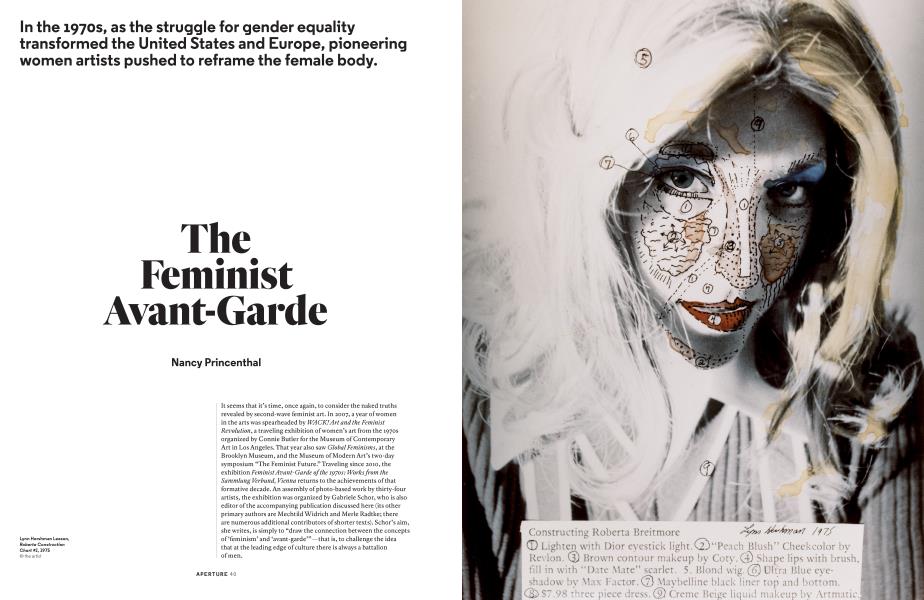
Donna Henes, Françoise Janicot, Renate Eisenegger, and Annegret Soltau are all shown to have wrapped their heads in various binding materials; Elaine Shemilt did the same to her body. Birgit Jürgenssen and Helen Chadwick both devised full-body costumes that took the form of kitchen appliances, while Ulrike Rosenbach posed at a kitchen stove wearing one of a series of marital “bonnets,” and Martha Rosier produced the hilariously deadpan Semiotics of the Kitchen (1975). Lynn Hershman Leeson’s commitment to her alter ego, Roberta Breitmore, was extraordinary—for several years, Roberta had an independent and fully credentialed personal and professional life, and even her own psychotherapist—but Hershman Leeson was only one among a host of artists who undertook role-play to explore the dramatis personae of womanhood. Other themes are likewise substantiated.
Schor, however, declines to situate them in a lineage that includes precedents and successors. A compendium, then, rather than a polemic, this book nonetheless offers strongly provocative gatherings, primary among them the abundance of women turning the camera on themselves. As noted in Widrich’s catalogue essay, art historian Rosalind Krauss’s “The Aesthetics of Narcissism,” an article that appeared in the first issue of the influential journal October, in 1976, identified a prevailing “narcissism” in the nascent medium of video art. Widrich claims that Krauss “disparages ... a preoccupation with the artist’s own self.” But rather than actually exploring such preoccupations, malign or otherwise, Krauss applies the term narcissism to structures of perceptual relation. Similarly, fellow art historian Anne Wagner’s “Performance, Video, and the Rhetoric of Presence,” written nearly twenty-five years later for October and also cited by Widrich, is, like “The Aesthetics of Narcissism,” concerned with the nature of photographic address, although Wagner explicitly counters Krauss by noting the preponderance of early video work that directs the camera, often rather aggressively, at its audience as well as, or instead of, at its creator.
Both essays, it should be said, focus mainly on work by men— they include Vito Acconci (a focus in each case), Richard Serra,
Bruce Nauman, Peter Campus, Robert Morris, and Bill Viola, along with Joan Jonas and Lynda Benglis (Wagner also discusses Laurie Anderson). And although the writers’ attention to the question of narcissism sheds valuable light on women’s use of video and photography in the 1970s, it is an oblique kind of illumination.
In the artworks Feminist Avant-Garde celebrates, the medium of photography—whether video or still, documentation of a live performance or freestanding—is less an object of interest in itself than a device for recording personal experiences, and in particular the experience of having a female body. More specifically still, in a great number of cases the camera found these artists with their clothes off. Those shown nude include fully half the artists in the exhibition, among them Eleanor Antin, Lynda Benglis,
Lili Dujourie, Birgit Jürgenssen, Ana Mendieta, Rita Myers, ORLAN, Ewa Partum, Ulrike Rosenbach, Martha Rosier, Carolee Schneemann, and Hannah Wilke; shown mostly nude, or exposing their genitals, are Valie Export, Cindy Sherman (in an early, uncharacteristic work), Martha Wilson, and Francesca Woodman.
In her conclusion, Schor claims “self-deprecation and humor were important strategies” for the women she brought together, and that is certainly true of some—for instance, Antin’s rueful exercise in “carving” her body (through scrupulously documented dieting) and Benglis’s arch sendups of Hollywood cheesecake. Straightforward expressions of spirit and pleasure are important too; Wilke is probably the poster girl for defiantly flaunting physical beauty. But, seen forty years later, these many exercises in self-exposure have grown, it seems to me, increasingly complicated—often raw and innocent, sometimes angry, occasionally abashed. Mendieta and Woodman both caused their breasts to be seen painfully distorted by panes of glass, and their bodies to be placed in various positions of acute vulnerability— most dramatically in Mendieta’s searing photographic work Untitled (Rape Scene) from 1973. Myers’s presentations of her “better” and “worse” halves show her standing stone-faced and stiff", as if for a full-body mug shot. In the well-known documentation of her performance Action Pants: Genital Panic (1969), for which a gun-toting Export spread her legs to reveal a hole cut into her pants at the crotch, the artist presents us with a scowl as wary and fearful as it is aggressive. Even the generally irrepressible Wilke allowed herself to be seen as vulnerable, not only in the late photographs in which her body is ravaged by cancer, but also, for instance, in the guarded crouch she assumes in So Help Me Hannah: Snatch-shots with Ray Guns (1978). At the time they were made, these admittedly complicated and heterogeneous images of self-disclosure were all understood to be, primarily, acts of proud defiance. In this respect, it is helpful to go back to Krauss, because the poststructuralist criticism of the kind she so forcefully propounded, with its scathing disdain for lived experience (men’s as well as women’s), and its “bracketing out” (to use a term favored by Krauss) of emotional and physical life, is what women were up against. Despite the reliance on Sigmund Freud and Jacques Lacan, such criticism rendered women’s full psychological lives invisible even to female critics.
Perhaps not surprisingly, the headlong rush to disrobe was brief. Most of the women who were leaders of the deconstructivism that arose in the following decade turned the camera away from themselves, using the codes of commercial photography to subvert the media’s framing of gender. Even when the women who were at the forefront of the Pictures Generation—including Sarah Charlesworth, Barbara Kruger, Louise Lawler, Cindy Sherman, Laurie Simmons, Lorna Simpson, and Carrie Mae Weems— featured themselves in their photoworks, they chose not to portray themselves nude. And as the art world opened, in the 1990s, to an awareness of non-Western cultural traditions and values, it was recognized that being covered up—indeed being clothed nearly head to toe, as are some Muslim women—can be a positive choice, and its violation a form of oppression. But perhaps, too, the discomfort that is still, or newly, caused by the variously naked artworks of the 1970s reveals an alarming return of repression, a squeamishness styling itself as sophistication. In any case, seeing this work again is deeply instructive, and powerful in ways perhaps not originally intended.
If this wholesale baring of the self still seems provocative, some of the battle lines drawn by female artists in the 1970s appear less revolutionary now. The ways conventional heterosexual couples struggle to manage domestic chores is hardly different from arrangements made by same-sex couples, male or female, and although more women than men still stay home to care for infants, and disparity across the board remains a pressing concern, work/life issues are now understood to involve class as much as sex—a triumph, perhaps, of feminism. Similarly, the commodification of women’s bodies and the pressure to be alluring remain important issues, but again, they are mitigated
The notion that "male” and "female” are fixed categories, and that the landscape of gender is divided between them, has been thoroughly discredited.
by both greater pushback and the recognition that such pressures are not restricted to women.
By the same token, the notion that “male” and “female” are fixed categories, and that the landscape of gender is divided between them, has been pretty thoroughly discredited in recent years. There is little evidence of that change in this book. Admittedly, it covers a period in which the dismantling of the gender binary was yet to come, but it is still very odd that LGBT identities and rights do not come up at all. Nor do those of race, in a volume that represents only white women, almost all from Europe and the United States. Where, in the Sammlung’s collection, or in this publication, is Lorraine O’Grady? Adrian Piper? Camille Billops? Theresa Hak Kyung Cha? This disregard is most glaring in a section of Schor’s essay called “Whiteface,” which features the (white) artists Martha Wilson, Cindy Sherman, and Suzy Lake, among others. In describing the images that fall under this heading, of work by women who “made up their faces with white foundation for the process of transformation,” Schor writes that “the basic effect of whiteface is to neutralize the artist’s own identity.” Not a word is said about actual skin color and its ramifications.
For American readers and viewers, another bias of note, this one positive and instructive, is toward European artists and Continental points of reference. A touchstone for Schor’s essay, Simone de Beauvoir’s The Second Sex (published in 1949 in France and in 1953 in the United States), differs from the founding texts of 1960s and 1970s feminism in America—Betty Friedan’s The Feminine Mystique (1963), Kate Millett’s Sexual Politics (1970)—by its mandarin tone, its political and philosophical commitments (to socialism and existentialism), and its historical scope, which spans the globe and reaches to antiquity. While it is profoundly rousing, it is not a call to action. It also stakes out a chronology of feminism that differs from the one generally followed in the United States. Beauvoir’s book supports Schor’s statement that the artists gathered in this publication, who were born between 1933 and 1958, spent “their childhood and teenage years [in] what we might call the long 1950s.” In this view, the culture in which feminism emerged was shaped by the left’s challenge to a rising capitalism, and by the lingering shadow ofWorld War II. Figures who negotiated those forces— preeminently, for German speakers, Joseph Beuys—were lodestars. “Joseph Beuys’s actions in Germany... were important experiences for many women artists,” Schor writes, noting, for instance, that Ulrike Rosenbach had studied with Beuys, who “explicitly conceived of his appearances as a form of mythmaking.” While insisting that everyone is an artist, and that the boundary-crossing practice of “social sculpture” is a kind of activism-as-art available to all, Beuys put his highly dramatized personal story to work in consolidating his authority as a performance artist, sculptor, and teacher, and ultimately as a founder of the leftist Green Party in Germany.
But looked at, instead, from the perspective of the many artists included in this publication who came of age in what was perhaps an even longer 1960s, the prevailing influences are different— and they shift to the United States. While Schor sees the 1960s as dominated by “critique of the capitalist-imperialist economic system,” in America the most pressing issues were surely the civil rights movement and the Vietnam War. Mobilization for the first and against the second clearly set the stage here for the feminism of the 1970s.
If Beuys is key to socially oriented performance work in Europe during this period, a comparable figure in the United States might be Vito Acconci, as is suggested by Schor (who credits him, along with Chris Burden, as having influence comparable to that of Beuys) and Krauss alike. For women taking on the mantle of the avant-garde, as Schor defines the feminist art movement, usurping Beuys would have meant engaging with an enormously
charismatic politician-cum-shaman who proudly wielded considerable real-world power. Acconci, on the other hand, was determined, especially in his years as a performance artist, to dodge such power, using his own considerable (if decidedly unconventional) charm to explore body and soul at their most naked. Stripping off his clothes, burning his hair, biting his flesh, and rubbing his skin until it bled, alternately taunting viewers and prostrating himself before them, he exhibited a brave (and still very disturbing) willingness to recognize the less amiable aspects of being embodied. It is by illustrating the vivid legacy of women who propelled this impulse, using their own physical and emotional lives to examine the full range of personal experience rather than—as is sometimes thought—generalizing expressions of collective strength, that Schor’s publication makes its most valuable contribution.
Nancy Princenthal teaches art writing at the School of Visual Arts and is a contributing editor of Art in America.
Feminist Avant-Garde of the 1970s: Works from the Sammlung Verbund, Vienna, in addition to an extensive tourthroughout Europe, is on view at The Photographers' Gallery, London, October 2016 until January 2017.