1950s The Invention of Minor White
How did one of Aperture's founding editors find spiritual liberation through photography?
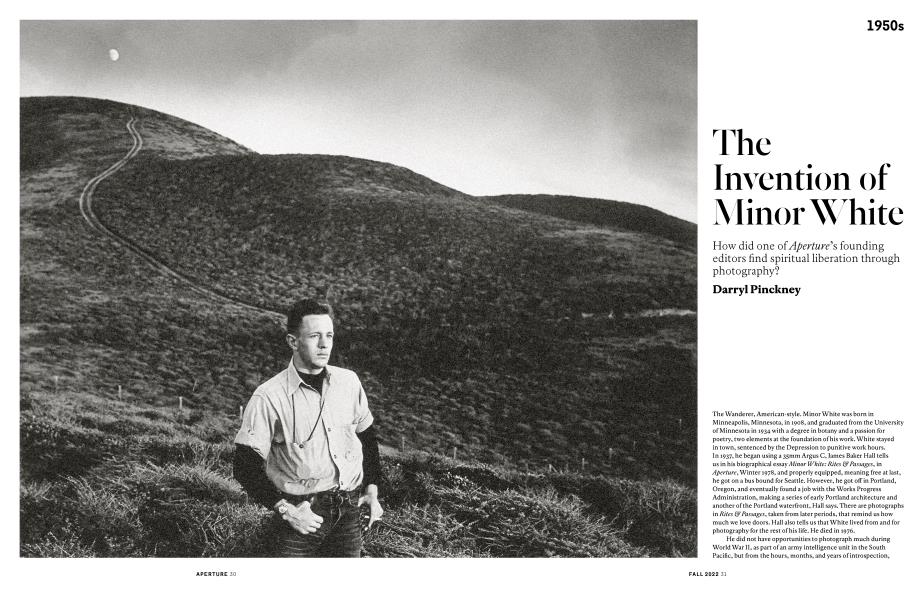
1950s The Invention of Minor White
How did one of Aperture's founding editors find spiritual liberation through photography?
Darryl Pinckney
The Wanderer, American-style. Minor White was born in Minneapolis, Minnesota, in 1908, and graduated from the University of Minnesota in 1934 with a degree in botany and a passion for poetry, two elements at the foundation of his work. White stayed in town, sentenced by the Depression to punitive work hours.
In 1937, he began using a 35mm Argus C, James Baker Hall tells us in his biographical essay Minor White: Rites & Passages, in Aperture, Winter 1978, and properly equipped, meaning free at last, he got on a bus bound for Seattle. However, he got off in Portland, Oregon, and eventually found a job with the Works Progress Administration, making a series of early Portland architecture and another of the Portland waterfront, Hall says. There are photographs in Rites & Passages, taken from later periods, that remind us how much we love doors. Hall also tells us that White lived from and for photography for the rest of his life. He died in 1976.
He did not have opportunities to photograph much during World War II, as part of an army intelligence unit in the South Pacific, but from the hours, months, and years of introspection, White identified the struggles of his life and thereby the themes of his work: his attraction to men; photography as symbol hunting. Settling in New York after the war, he was too shy to keep his first appointment with Alfred Stieglitz in 1946, but he made the most of all the others, and then that same year, he went back to San Francisco, where he joined, under Ansel Adams, the faculty of the California School of Fine Arts, as the San Francisco Art Institute was known at the time. He first encountered the f/64 group of San Francisco photographers, including Adams, in 1940. The group “prized sharply focused, tightly framed compositions and masterly printing,” Paul Martineau writes in Minor White: Manifestations of the Spirit (2014). White liked the Speed Graphic for landscapes or a Leica for what he called his action shots.
When White accepted a position at George Eastman House in Rochester, in 1953, there was the upstate New York landscape he had to learn to appreciate. White then taught at MIT from 1965 until his retirement in 1974. Like W. H. Auden, White liked to live with his students, alive in an all-male novitiate community. He was fortunate, more or less, in the institutions he became associated with, especially Aperture, where he was editor from its founding in 1952 until 1975, his one-man band for the kind of photographs he wanted to feature. So he said. Its constellation of names has in it Barbara Morgan of the rhythmic photographs of the Martha Graham Dance Company; Edward Weston, the first to be published in the magazine’s monograph series; Manuel Alvarez Bravo, who initially learned by studying photography journals, although his work had a more social tone, with the Mexico of the 1930s as a subject; and the great Dorothea Lange, one of the magazine’s founders, she who during the Depression documented in white poverty the nobility of its suffering.
“Much of White’s best work, both as a photographer and as an editor, came directly and consciously out of Stieglitz’s idea of the Equivalent, the photographic image as a metaphor, as an objective correlative for a particular feeling or state of being associated with something other than the ostensible subject,” Hall writes in Rites & Passages. “Each man in his day embodied and promulgated that controlling idea by editing journals of comparable impact, Stieglitz with Camera Work, White with Aperture?
In San Francisco in the postwar 1940s, ideas that were Blakedescended, Whitman-sanctioned found original expression in White’s own “camerawork” of “self-discovery.” San Francisco, refuge of iconoclasts, a port where sailors who weren’t going home shared the adhesive democracy of shipboard brotherhood, a sexuality innocent and earned. Was not the new moon sinking through the troubled sky, as White describes in a long letter, twisting his revolving river of thought back on himself more than ever. It’s because a sailor ran his hand over White’s shorn head.
“It feels good—like a brush,” he recalls the sailor saying. An anonymous, rounded, black butt is not plant life, the photograph Nude Foot, San Francisco, made in 1947, announces.
A search for a higher power is also a quest for order.
It is impossible to look at White’s black-and-white photographs of his student Tom Murphy, taken in 1947 and 1948, as anything less than a spiritual liberation. Tom Murphy’s Michelangelo-like hands through a chair; his rough, veiny feet and the trouser cuffs of the period. Tom Murphy pensive, or sprawled on the rocks, or squatting on a wooded bank. This is his torso and his completely bizarre navel; this is his athletic torso in profile with his dick in shadow. He is photographed from behind, starting at the small of his back, a leg extended behind, about to become the release of a step. He is sitting on the floor, in the nude, a piece of driftwood between his thighs; he is reclining nude with driftwood, with a rose; he is seated alongside a table, not looking at the rose, then sitting up so his head is out of the frame. He is in quarter pose staring at his biceps, his hands crossed over his navel, his dick emerging from the pubic hair under his knuckles.
The photograph of Tom Murphy looking down past his left shoulder, his arms tightly crossed and his palms facing away from each other with his large navel in its bed of hair and muscle, says that Minor White was a man whose intense spirituality disguised a whacking big sex drive. He did not exhibit in full in his lifetime this thirty-two-photograph sequence, titled The Temptation of Saint Anthony Is Mirrors. “A cinema of stills,” he called it. Whose demons again? He once wrote to a woman that to love men could lead to Christ. He tried Roman Catholicism, and analysis, but found that cheerfulness and teaching worked. “I was fearful of loving Christ because of being shy of loving men.” If you’re queer, then you don’t need the hisses of Sinclair Lewis’s Zip City or Gopher Prairie. The twentieth-century laws that declared criminal his same-sex desires took him by one elbow while second-century church treatises that condemned his desires had him firmly by the other, and he guided himself toward transcendence. His liberation would seek expression through an odor of sanctity, a force field of piety, religiosity as deflection, hiding out in high seriousness. Purity of vision is absolution. The Russian philosopher George Gurdjieff was dead when, in the 1950s, his writing attracted White, who can sound in his sequence titles as the years went by as comfortably opaque as another follower of Gurdjieff, the black writer Jean Toomer, patiently waiting for the great fear to cross over into blessedness.
Find the dead bird on its bier of driftwood or identify what the dark field behind the angled white axe is composed of. Chart the motion of black branches floating on gray water, the swirling grain of bark, the ghostliness of stalagmites, the marriage of pebble and shore, the fugal sands of his desert. Here is the great sky of Wyoming, or a zooming California surf. A daydreaming windowsill is crisscrossed with shadows and reflections and planes and exposures. Ivy, rocks, beaches, tidal pools, barns, rooftop angles, shells, tire tracks in the snow, a parked truck, hellebores seen from above in a metal urn. In Moencopi Strata, Capitol Reef National Park, Utah (1962), we are either looking down into a valley or across a patch of rock. Often we are not supposed to know what things are. The photograph is the subject, the composition, the feeling, the light and the dark, the technique, the result, the aesthetic that sustained him beyond trends. He didn’t publish or exhibit much of his work, and so there is now more to inform our sense of him, such as the use of color in some photographs in Minor White: The Eye That Shapes (1989).
A search for a higher power is also a quest for order. Look at the sculpture Time made of this rock; note the turbulent, workedover landscapes, acted on by Time itself. His photographs ask Time of us, that we not just hit it and quit it, but look, look into what is going on. Be still. Observe. Be observed. He is engaged in a guerrilla war with the Tibetan Lord of Time. Who will blink first? Kalachakra or Minor White?
Aperture, a home for the most gentle weirdness.
Darryl Pinckney is a regular contributor to The New York Review of Books. His latest book is Come Back in September: A Literary Education on l/l/est Sixty-Seventh Street, Manhattan (2022).